
Share this @internewscast.com
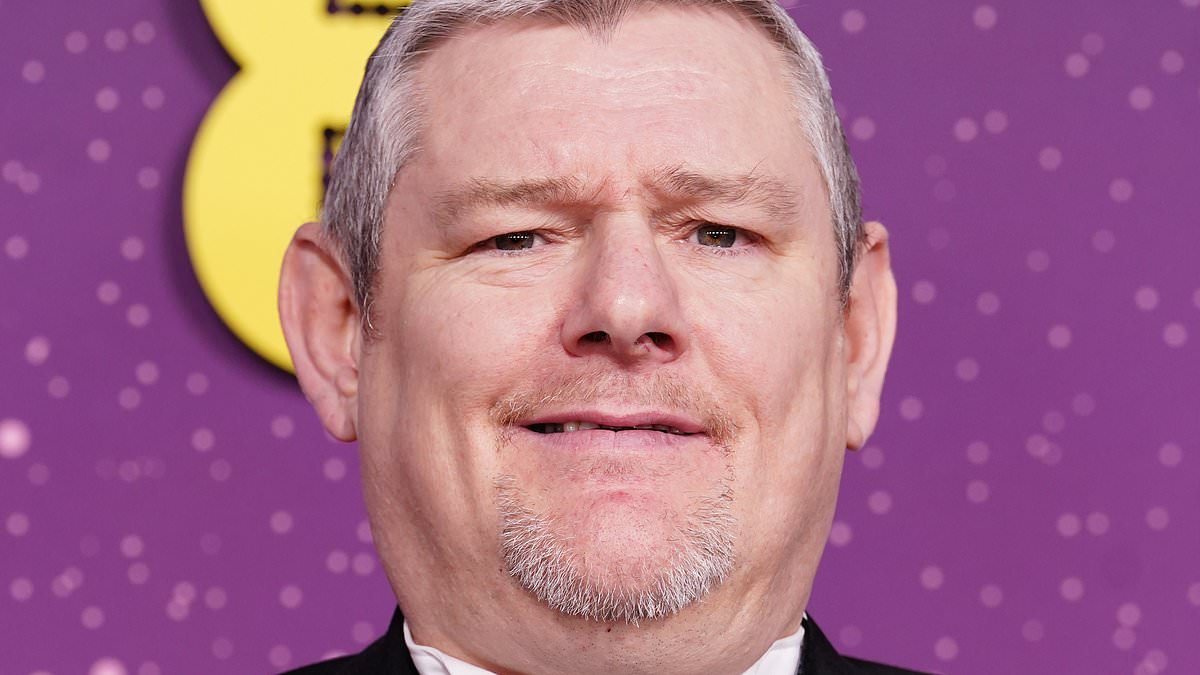
The Tourette’s advocate who caused a stir at the BAFTAs by shouting a racial slur at two Black presenters has expressed profound regret for his actions.
John Davidson, whose life story served as the basis for the film “I Swear,” was overheard using the offensive language as actors Michael B. Jordan and Delroy Lindo announced the evening’s first award at London’s Royal Festival Hall on Sunday.
The incident was broadcast live to millions on BBC One, drawing significant criticism. Among those condemning the behavior was Oscar-winning actor Jamie Foxx, who labeled it ‘unacceptable.’
While neither Jordan nor Lindo visibly reacted, host Alan Cumming later offered an apology on behalf of the event, acknowledging any potential offense caused. Following several disruptive outbursts, Davidson chose to exit the ceremony prematurely.
Davidson has since issued an apology, expressing his deep embarrassment over the incident. He emphasized that his involuntary tics were not meant to convey any intentional message or meaning.
In his statement, he conveyed gratitude towards BAFTA and those involved, thanking them for their support, understanding, and the opportunity to attend the event.
‘I appreciated the announcement to the auditorium in advance of the recording, warning everyone that my tics are involuntary and are not a reflection of my personal beliefs.
‘I was heartened by the round of applause that followed this announcement and felt welcomed and understood in an environment that would normally be impossible for me.’

John Davidson, who yelled the N-word at two black presenters during the BAFTAs, has said he is ‘deeply mortified’ by his outburst.

Sinners stars Michael B Jordan and Delroy Lindo were subject to the expletive as they presented the first prize of the night at London’s Royal Festive Hall on Sunday
‘In addition to the announcement by Alan Cumming, the BBC and BAFTA, I can only add that I am, and always have been deeply mortified if anyone considers my involuntary tics to be intentional or to carry any meaning.’
‘I was in attendance to celebrate the film of my life, I Swear, which more than any film or TV documentary, explains the origins, condition, traits and manifestations of Tourette Syndrome.
‘I have spent my life trying to support and empower the Tourette’s community and to teach empathy, kindness and understanding from others and I will continue to do so.
‘I chose to leave the auditorium early into the ceremony as I was aware of the distress my tics were causing.’
One of Davidson’s biggest symptoms is coprolalia which makes him involuntarily say socially inappropriate words or phrases, including when he famously shouted ‘f*** the Queen’ at Elizabeth II when he was awarded his MBE in 2019.
Davidson, who has suffered with Tourette’s since the age of 12, was criticised by Jamie Foxx who said: ‘Out of all the words you could’ve said Tourette’s makes you say that. Nah he meant that s**t. Unacceptable.’
Despite there being a two-hour time delay on the BBC’s coverage, Davidson’s BAFTAs slur was aired on BBC One and could still be heard on iPlayer on Monday morning.
The BBC initially apologised for ‘any offence caused’ but has now admitted the slur should have been ‘edited out prior to broadcast’. The awards ceremony has disappeared off iPlayer while the BBC removes the N-word outburst.
Davidson was defended by a black actor who portrayed his lawyer in a movie about his battle with Tourette’s.
Scottish actor Thierry Mabonga, who was born in the Democratic Republic of Congo, said actors should have been warned about Davidson’s condition, which is characterised by involuntary movements or sounds known as tics.
Mabonga responded with a video on TikTok where he discusses the scene in which he acts as Davidson’s lawyer after he gets himself into trouble.

Scottish actor Thierry Mabonga, who was born in the Democratic Republic of Congo, said actors should have been warned about Davidson’s condition

BAFTA host Alan Cumming thanked audience for Tourette’s understanding as I Swear’s John Davidson let out involuntary shouts during Sunday’s ceremony
‘I’m representing him but at the same time, he’s hurling abuse at me and it’s very offensive words,’ the I Swear actor says. ‘Now, this is the condition, the disease of Tourette’s Syndrome. John cannot control what he says. In fact that’s the whole point of why we’re making this film.’
‘We’ve made this film, I Swear, to educate people about Tourette’s syndrome.’
Mabonga added: ‘How can you say that he can’t be there at the awards? This is a film about his life. This is a film about him. Absolutely he has to be there. And absolutely it’s great that he was there.
‘And I don’t know if some of the actors there were told in advance about someone with Tourette’s being there. Hopefully they would have been told [and] therefore prepared for that kind of stuff that happened.’
Mabonga concluded the video by saying: ‘Regardless, John has Tourette’s. Enough said.’
Charity Tourette’s Action said it ‘deeply understands that these words can cause hurt’ but insisted they are ‘not a reflection of a person’s beliefs, intentions or character’. High-profile celebrities including Scottish singer Lewis Capaldi and US star Billie Eilish have publicly spoken about living with Tourette’s.
Lindo later hit out at BAFTA for failing to speak with him after Davidson yelled the N-word at him and Jordan.
Speaking at the Warner Bros afterparty, he told Vanity Fair that he and Jordan ‘did what we had to do’ while presenting, but he wished ‘someone from BAFTA spoke to us afterward’.
A Sinners production designer also later alleged she was subjected to Davidson’s involuntary racial slurs, adding that the situation was made worse by ‘the throw away apology’ of ‘if you were offended’.
Conservative leader Kemi Badenoch has accused the BBC of making a ‘horrible mistake’ and called for the Corporation to explain why the slur was not initially ‘bleeped out’.
Jordan’s former co-star on The Wire, Wendell Pierce, also reacted furiously, saying: ‘It’s infuriating that the first reaction wasn’t complete and full throated [sic] apologies to Delroy Lindo and Michael B. Jordan. The insult to them takes priority. It doesn’t matter the reasoning for the racist slur.’
During the broadcast, Cumming issued an apology for the language viewers may hear.
He said: ‘You may have heard some strong and offensive language tonight. If you have seen the film I Swear, you will know that film is about the experience of a person with Tourette syndrome.

Hannah Beachler – a production designer on Sinners – also alleged she was subjected to Davidson’s involuntary racial slurs

Oscar winner Jamie Foxx has blasted Tourette’s activist John Davidson for his ‘unacceptable’ N-word outburst at the BAFTAs
‘Tourette syndrome is a disability and the tics you have heard tonight are involuntary, which means the person who has Tourette syndrome has no control over their language. We apologise if you were offended.’
Earlier on Monday, BAFTA issued an ‘unreserved apology’ for the ‘very offensive language that carries incomparable trauma and pain for so many’.
In a statement, they said: ‘We want to acknowledge the harm this has caused, address what happened and apologise to all.
‘One of our guests, John Davidson MBE, has Tourette Syndrome and has devoted his life to educating and campaigning for better understanding of this condition.
‘Tourette Syndrome causes involuntary verbal tics, that the individual has no control over. Such tics are in no way a reflection of an individual’s beliefs and are not intentional. John Davidson is an executive producer of the BAFTA nominated film, I Swear, which is based on his life experience.
‘We take the duty of care to all our guests very seriously and start from a position of inclusion.
‘We took measures to make those in attendance aware of the tics, announcing to the audience before the ceremony began, and throughout, that John was in the room and that they may hear strong language, involuntary noises or movements during the ceremony.
‘Early in the ceremony a loud tic in the form of a profoundly offensive term was heard by many people in the room.
‘Michael B. Jordan and Delroy Lindo were on stage at the time, and we apologise unreservedly to them, and to all those impacted. We would like to thank Michael and Delroy for their incredible dignity and professionalism.
‘During the ceremony, John chose to leave the auditorium and watch the rest of the ceremony from a screen, and we would like to thank him for his dignity and consideration of others, on what should have been a night of celebration for him.
‘We take full responsibility for putting our guests in a very difficult situation and we apologise to all.
‘We will learn from this, and keep inclusion at the core of all we do, maintaining our belief in film and storytelling as a critical conduit for compassion and empathy.’
A BBC spokesperson said: ‘Some viewers may have heard strong and offensive language during the BAFTA Film Awards. This arose from involuntary verbal tics associated with Tourette syndrome, and as explained during the ceremony it was not intentional.
‘We apologise that this was not edited out prior to broadcast and it will now be removed from the version on BBC iPlayer.’
In contrast, the BBC edited out ‘Free Palestine’ from an acceptance speech made by filmmaker Akinola Davies Jr after My Father’s Shadow won the BAFTA for outstanding British debut.
In the days before the BAFTAs, it emerged that the BBC was going to be monitoring politically charged speeches after it was embroiled in a scandal last year when it streamed Bob Vylan chanting ‘death to the IDF’ at Glastonbury.

I Swear stars Robert Aramayo (pictured in the film) as campaigner John. The film depicts his younger years living in Glasgow, when he was first diagnosed with Tourette’s

Viewers reacted furiously after the BBC edited out ‘Free Palestine’ but kept in the N-word slur


Davies Jr closed his speech by dedicating the award to ‘all those whose parents migrated to obtain a better life for their children’.
He added: ‘To the economic migrant. The conflict migrant. Those under occupation, dictatorship, persecution, and those experiencing genocide. You matter. Your stories matter more than ever. Your dreams are an act of resistance.
‘To those watching at home, archive your loved ones. Archive your stories yesterday, today, and forever. For Nigeria, for London, the Congo, Sudan, free Palestine, thank you.’
This part of his speech was removed from the BBC, with viewers instead featuring Davies Jr thanking his family and his brother, Wale, for ‘nurturing this spark’.
A BBC spokesperson said: ‘The live event is three hours and it has to be reduced to two hours for its on-air slot. The same happened to other speeches made during the night and all edits were made to ensure the programme was delivered to time. All winners’ speeches will be available to watch via Bafta’s YouTube channel.’
Meanwhile, Hannah Beachler – a production designer on Sinners – said: ‘I keep trying to write about what happened at the BAFTAs, and I can’t find the words. The situation is almost impossible, but it happened three times that night, and one of the three times was directed at myself on the way to dinner after the show.
‘And a third time at a Black woman. I understand and deeply know why this is an impossible situation. I know we must handle this with grace and continue to push through. But what made the situation worse was the throw away apology of ‘if you were offended’.
‘At the end of the show. Of course we were offended… but our frequency, our spiritual vibration is tuned to a higher level than what happened. I am not steal, this did not bounce off of me, but I exist above it. It can’t take away from who I am as an artist.’
Tourettes Action said it was ‘incredibly proud’ of Davidson and those involved in the film I Swear, which tells the story of his life, having developed the condition when he was 12.
A spokesperson for the charity said: ‘We also want to address the negative comments that have surfaced following John’s involuntary vocal tics during the ceremony.
‘We deeply understand that these words can cause hurt but, at the same time, it is vital that the public understands a fundamental truth about Tourette syndrome, tics are involuntary. They are not a reflection of a person’s beliefs, intentions or character.
‘People with Tourette’s can say words or phrases they do not mean, do not endorse and feel great distress about afterwards.
‘These symptoms are neurological, not intentional, and they are something John – like many others with Tourette’s – lives with every single day.’
It went on to say that it had found the ‘backlash’ to the incident ‘deeply saddening’ and added that Davidson had made a decision to leave the ceremony early.