
Share this @internewscast.com
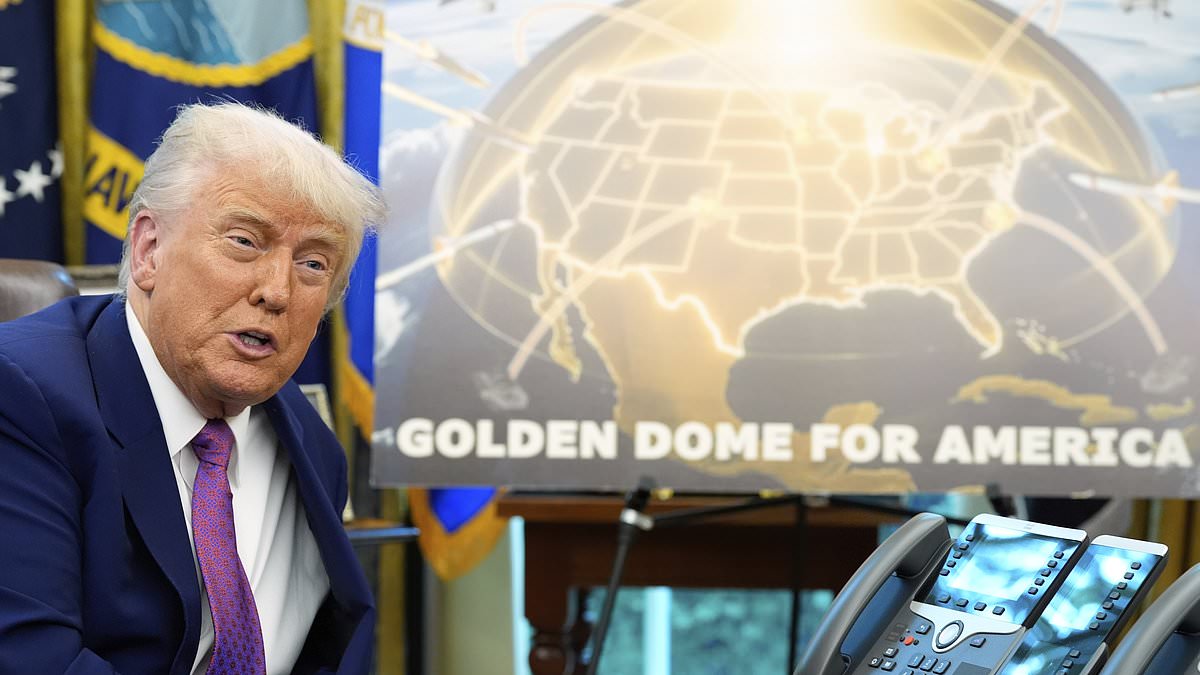
President Donald Trump’s ambitious Golden Dome missile defense project is gaining momentum, with initial testing potentially set to begin this summer amid increasing concerns about potential domestic attacks.
According to sources cited by the Wall Street Journal on Tuesday, defense technology companies Anduril Industries and Palantir Technologies are collaborating to develop the software framework for Trump’s $185 billion Golden Dome initiative.
These companies are working diligently to ensure that the software is ready for testing as early as this summer.
The timing could prove crucial, as the recently released 2026 Annual Threat Assessment warns of the United States’ vulnerability to thousands of missiles held by adversarial nations.
The report highlights that “China, Russia, North Korea, Iran, and Pakistan are actively developing a range of new, advanced, and conventional missile delivery systems capable of targeting the U.S. mainland,” with both nuclear and conventional warheads.
The intelligence community projects that potential threats to the U.S. homeland could increase to over 16,000 missiles by 2035, compared to the current estimate of more than 3,000 missiles.
China and Russia, the report states, are actively developing weapons to penetrate or bypass current US missile defense systems.
Trump even warned that Iran was close to hitting the US itself as part of his justification for war, saying the regime had developed long-range missiles that ‘could soon reach the American homeland.’
Fears of strikes on the US were further exacerbated when an FBI terrorism notice went out in California, warning of a potential Iranian drone strike in the Golden State.

The developers of President Donald Trump’s Golden Dome US missile defense system aim to have the system’s software ready for testing by this summer amid heightened threats to the American homeland

Defense Tech Firm Anduril, maker of the autonomous Fury combat drone shown above, is developing the software for Golden Dome alongside Palantir
The massive Golden Dome project aims to develop technologies that can track incoming airborne threats and neutralize them before they reach US shores.
Arguably the most critical component of such a technology is the software that will link US radars, sensors and interceptor systems to displays showing soldiers the location, trajectory and potential destructive power of incoming ballistic, cruise and hypersonic missiles.
And after Iran launched ballistic missiles at Diego Garcia – a small UK-operated military island in the Indian Ocean, demonstrating their weapon’s longer-than-anticipated range – Trump has warned that the Islamic Republic has been developing weapons that soon could hit the US mainland.
Space Force Gen. Michael Guetlein, the leader of the Golden Dome project, has stressed repeatedly that the US must stand up a system capable of defending the homeland from increasingly sophisticated long-range threats, notably from Russia and China, but now perhaps Iran as well.
‘Our adversaries have become very capable and very intent on holding the homeland at risk,’ Guetlein said in the Oval Office last year after Trump announced the project.

The Golden Dome is intended to detect, track and intercept incoming nuclear, cruise or hypersonic missiles headed for US shores. Above is a test launch of Russia’s Yars ICBM in October 2025
‘Our adversaries have been quickly modernizing their nuclear forces, building out ballistic missiles capable of hosting multiple warheads, building out hypersonic missiles capable of attacking the United States within an hour and traveling at 6,000 miles an hour.’
Most important to the Golden Dome’s success is the command and control system that US operators will interface with while dealing with any potential incoming threats.
A former Pentagon official advising on the Golden Dome Program told the Daily Mail that command and control software ‘is absolutely necessary for any successful combat operation.’
The Golden Dome software being developed by Anduril and Palantir is being handled directly by Guetlein’s office, underscoring its importance.

The Iskander missile system, a Russian mobile short-range ballistic missile complex capable of carrying nuclear or conventional warheads, pictured in June 2024

Gen. Michael A. Guetlein, director of the Golden Dome program

Palestinians inspect the remains of a ballistic missile that landed in the West Bank village of Haris, near Salfit, 24 March 2026. The Israeli military reported that it detected multiple waves of missiles launched from Iran towards Israel throughout the morning
Other aspects of the Golden Dome project dealing with missiles and radars are being handled by other parts of the military, including the Air Force, Missile Defense Agency and other groups within the Pentagon.
Aalyria Technologies, a networking company, Scale AI and software firm Swoop Technologies are also contributing to the program, sources told the WSJ.
So too are more traditional military manufacturers like Lockheed Martin, RTX and Northrop Grumman.
Interestingly, the two smaller, newer firms of Anduril and Palantir have been given more control over the program than the prime contractors, which are acting as subcontractors on the software.
‘Golden Dome is a bold and aggressive approach to hurry up and protect the homeland from our adversaries,’ Guetlein has said.
‘We owe it to our children and our children’s children to protect them and afford them a quality of life that we have all grown up enjoying. Golden Dome will afford that.’