
Share this @internewscast.com
In a surprising turn of events, former President Donald Trump has revealed a potential collaboration between the United States and Iran concerning the strategically crucial Strait of Hormuz. This arrangement could see Tehran capitalizing on a significant financial windfall, reportedly earning up to $1 million per ship passing through the waterway.
Last night, Trump disclosed that Iran has agreed to a temporary ceasefire spanning two weeks. During this period, the vital passage for global oil transport will be reopened. Both nations are currently deliberating over a proposed 10-point peace plan as part of this temporary agreement.
Although the specifics of the arrangement have yet to be finalized, sources indicate that Iran plans to levy tolls reaching up to $1 million on vessels traversing the Strait during the ceasefire. This information was shared by an unnamed Middle East official in a report by the Associated Press.
Trump expressed his approval of this concept during an interview with ABC on Wednesday. He suggested the possibility of a “joint venture” with Iran, emphasizing that such a move would not only ensure the security of the Strait but also protect it against various threats. “It’s a beautiful thing,” Trump remarked.
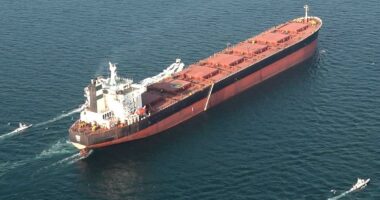
Known as a vital artery for global oil flow, the Strait of Hormuz has earned the moniker “Tehran Tollbooth,” as reported by Bloomberg. With about 20% of the world’s oil passing through this channel, the implications of such a toll could be far-reaching for international trade and diplomacy.
The Strait, through which a fifth of the world’s oil flows, has now become known as the ‘Tehran Tollbooth’, according to Bloomberg.
Ship owners go through a complex and expensive process of negotiation which includes middlemen, foreign currency and crypto transactions.
The ships must inform intermediary companies linked to the Islamic Revolutionary Guard Corps (IRGC) of the ship’s cargo, destination, and ultimate owner.

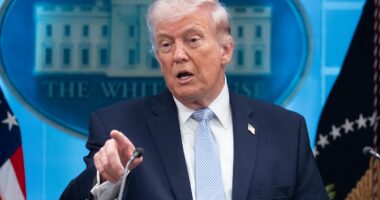
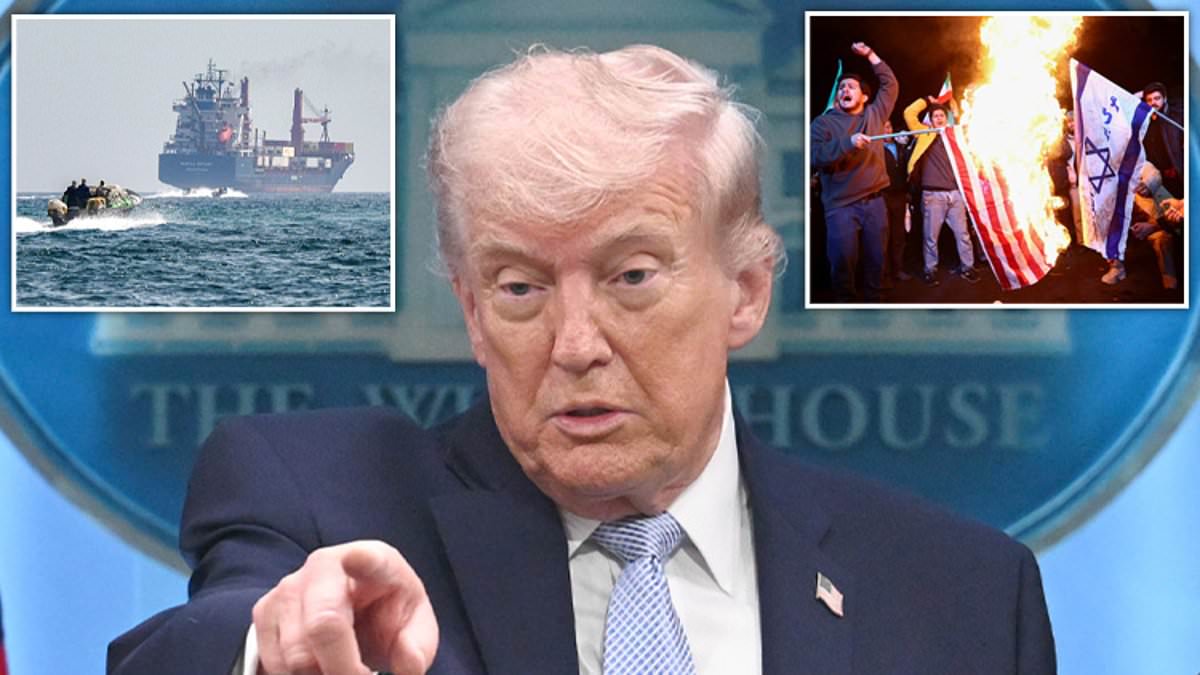
Donald Trump speaks during a news conference in James S. Brady Press Briefing Room of the White House on April 6

A boat approaches the St Kitt’s and Nevis-flagged container ship Marsa Victory while crusing in the waters of the Strait of Hormuz off the coast of Khasab in Oman’s northern Musandam peninsula on June 25
Iran then charges a ‘toll’ of at least $1 per barrel – and this must be paid in Chinese yuan or cryptocurrency.
The average rate for a single oil tanker is $2 million. If everything is approved, IRGC boats will finally provide an escort into and out of the ‘tollbooth’.
Some analysts believe it could make as much as $500 billion in five years.
The exact terms of the peace deal have not been revealed.
Trump said Wednesday: ‘They are very good points – and most of them have been fully negotiated. If it isn’t good, we’ll go right back to it very easily.’
The ten-point plan, reported by Iran’s Tasnim news agency, says that the US should accept Tehran’s continued control over the Strait, recognize its right to uranium enrichment, lift all sanctions, pay compensation, and withdraw all troops from the region.
Trump vowed that Iran will not be able to enrich uranium and that the US will coordinate with Tehran to extract ‘nuclear dust’ buried deep underground after airstrikes.
The President wrote on Truth Social on Wednesday: ‘There will be no enrichment of uranium, and the United States will, working with Iran, dig up and remove all of the deeply buried (B-2 bombers) nuclear “dust.”‘

An unnamed regional official told the Associated Press that Iran wants to charge tolls of up to $1million on ships that pass through the Strait during the two-week period
According to the White House the safety of the uranium was confirmed before an eleventh hour deal was struck.
‘Nothing has been touched from the date of attack,’ Trump said, claiming that the nuclear site has been watched closely since it was bombed.
It is not clear whether Trump was referring to the US bombing of Iran’s nuclear facilities in June, or to more recent strikes during the current Iran war.
Trump said that tariff and sanctions relief were being discussed as part of a peace plan with ‘many’ points already agreed.
Trump described the deal as ‘total and complete victory’ on Tuesday night.
The US and Iran will now engage in negotiations over the next two weeks, buying some time to try to reach a permanent settlement.
It is unlikely to be smooth sailing, but in after-hours trading, the price of a barrel of oil dropped below the $100 mark for the first time in days, and US stock futures soared.
Following the confirmation of the deal, the US President hailed ‘a big day for world peace’ after agreeing to pause the attacks.
Iranians burn U.S. and Israeli flags during a demonstration following the announcement of a two-week ceasefire at Enghelab Square in Tehran

Iranians burn U.S. and Israeli flags on Wednesday, April 8, 2026
Iran has ‘had enough’ of the conflict, the US president said on Truth Social, and there will now be ‘lots of positive action.’
Israel has also agreed to halt attacks on Iran for two weeks, a senior White House official told Axios, with the ceasefire taking effect once the Strait of Hormuz is reopened.
Iran accepted the Pakistan-brokered deal after a last-minute Chinese intervention urged Tehran to show flexibility over the war’s economic fallout, three Iranian officials told the New York Times.
US crude oil prices plunged after Trump’s announcement, with West Texas Intermediate contracts falling by more than 15 percent to $95 per barrel after hitting $116 earlier Tuesday.
Trump had warned Tuesday morning that ‘a whole civilization will die tonight, never to be brought back again’ if no deal was reached by his 8pm ET deadline.
Trump said that the 10-point proposal ‘is a workable basis on which to negotiate,’ despite saying on Monday that the deal was not ‘good enough.’
Vice President JD Vance, along with Trump’s son-in-law Jared Kushner and Special Envoy Steve Witkoff, have been leading US negotiations to end the war, which was launched on February 28 – dubbed Operation Epic Fury.
The deal came after Pakistani PM Sharif posted on X that major breakthroughs had been made between US and Iranian negotiators.

Iranians burn U.S. and Israeli flags during a demonstration following the announcement of a two-week ceasefire

Iranians wave flags during a demonstration in Tehran

Iran and the USA agreed to the two-week truce to halt military operations and keep the Strait of Hormuz open for oil and gas shipments, with formal peace talks set to begin in Islamabad on 10 April
White House Press Secretary Karoline Leavitt said: ‘There are discussions about face-to-face meetings between the United States and Iran, but nothing is final until it is announced by the President or the White House.’
Iran proposed the 10-point counter-proposal to US negotiators via Pakistani officials on Monday after the US gave Islamabad a 15-point proposal to begin a ceasefire.
The President refused to comment on the 10-point plan earlier on Tuesday, telling Fox News: ‘I can’t comment, because right now we’re in heated negotiations.’
Sharif had called on both Trump and the Iranian regime to accept the two-week ceasefire before the President finally relented.
‘To allow diplomacy to run its course, I earnestly request President Trump to extend the deadline for two weeks. Pakistan, in all sincerity, requests the Iranian brothers to open Strait of Hormuz for a corresponding period of two weeks as a goodwill gesture,’ Sharif said on Tuesday afternoon.
‘We also urge all warring parties to observe a ceasefire everywhere for two weeks to allow diplomacy to achieve conclusive termination of war, in the interest of long-term peace and stability in the region.’