
Share this @internewscast.com
Donald Trump’s ambition to purchase Greenland took a step forward during a significant meeting with American allies at the World Economic Forum in Davos. This situation unfolded in a manner typical of Trump’s negotiation style.
Prior to his address at the forum, held in the Swiss ski resort on Wednesday, the former real estate mogul and president laid out an assertive opening stance.
Trump hinted at the possibility of military action against Greenland, indirectly suggesting an attack on Denmark, a NATO ally that governs Greenland. He also proposed imposing 10 percent tariffs on eight European nations that opposed his Greenland plans, set to begin on February 1.
As these bold threats resonated, European and NATO allies expressed their discontent, accusing Trump of behaving like an “international gangster” in a series of indignant statements.
In a strategic move during his speech in Davos, Trump withdrew the military threat, assuring his audience that force would not be used. Instead, he called for immediate and reasonable negotiations, likely finding a more receptive audience after easing tensions.
With the specter of military action removed, European leaders breathed a sigh of relief, as the risk of a NATO internal conflict seemed to dissipate. Meanwhile, Greenlanders could stop preparing for a potential U.S. siege, feeling more secure in their daily lives.
Just a few hours later, Trump announced that he and NATO Secretary General Mark Rutte had reached the outlines of a deal on the future of Greenland, and he was dropping the tariffs threat.

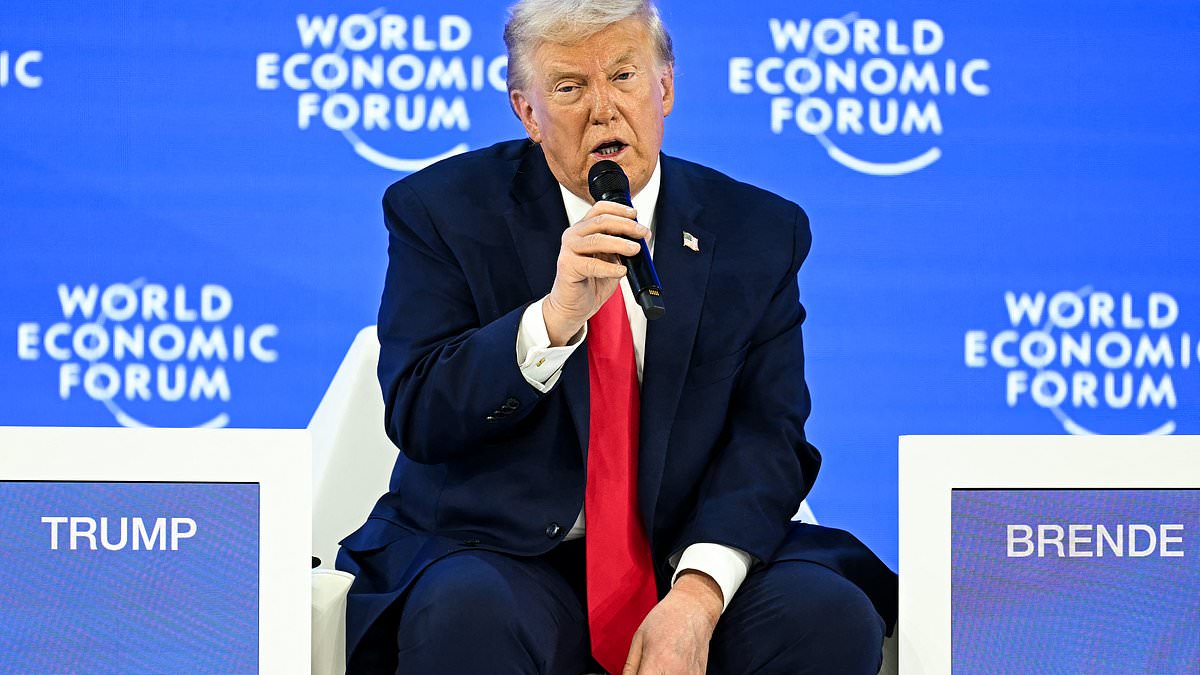
President Donald Trump speaks during the World Economic Forum (WEF) annual meeting in Davos on January 21, 2026
Ever the showman, Trump had first teased his listeners, asking: ‘Would you like me to say a few words on Greenland? I was going to leave it out of the speech.’
Then, he added: ‘We probably won’t get anything unless I decide to use excessive strength and force, where we would be, frankly, unstoppable. But I won’t do that…I don’t have to use force, I don’t want to use force…’
That last line was delivered with a knowing smile.
To some European leaders, Trump’s approach may have seemed as subtle as a sledgehammer – akin to a school bully offering protection in return for lunch money, or a Godfather-style offer they could not refuse. But it clearly worked.

President Donald Trump arrives for a bilateral meeting with Switzerland’s President on the sidelines of the World Economic Forum (WEF) annual meeting in Davos on January 21, 2026

Trump said Greenland is part of North America
Before Trump arrived in Davos, European leaders had been warned that he was coming for them like a ‘T-Rex’ and that you ‘mate with him or he devours you.’
That prediction, from Gavin Newsom, proved accurate as, early in his speech, Trump went about savaging his allies.
‘I don’t want to insult anybody…’ he began, before doing just that.
Denmark was ‘ungrateful’ for being saved by America in WWII. Canada got ‘freebies’ and ‘lives because of the United States,’ Trump said.
He boasted of his ability to ‘financially destroy’ Switzerland, the host nation. NATO was a ‘one way street’ that gave America ‘nothing’. And Europe has ‘been screwing us for 30 years,’ he went on, before mocking Emmanuel Macron for wearing mirrored sunglasses. He failed to mention Britain’s Sir Keir Starmer at all.
Trump also called European nations ‘stupid people’ for buying Chinese-made windmills. He slammed them over everything from excessive government spending, mass migration, and sending jobs overseas, to the ‘green new scam.’
They would all be ‘speaking German and a little Japanese’ if it wasn’t for America, he said to nervous chuckles in the audience.

A man holds a map of Greenland covered in the American flag crossed out with an X during a protest against Trump’s policy towards Greenland in front of the US consulate in Nuuk, Greenland, Saturday, Jan. 17, 2026

A map of Greenland showing its capital Nuuk
Amid that kind of sustained verbal onslaught, the key question now is which European leader, if any, jumps ship first and sides with Trump over what he went on to call his ‘small ask’ to own Greenland.
‘They (allies) have a choice. You can say yes, and we will be very appreciative. We will remember,’ Trump said ominously.
His message was crystal clear: ultimately, America’s friends will have to decide whether defending Denmark’s right to Greenland is a hill worth their own economies dying on.
The specter of U.S. military action may have receded, but Trump’s second most destructive threat – an economic one involving tariffs – remains a Sword of Damocles hanging over Europe.
Trump did not look like a man who was bluffing. And, on any assessment, America holds the better cards in a trade war. If Europe does not fold the economic consequences would be dire, ushering in a new era of global uncertainty.
Trump’s recent imposition of 10 percent tariffs on eight European allies for not backing him on Greenland could lead to the EU retaliating by using its so-called ‘trade bazooka’ – officially known as the Anti-Coercion Instrument (ACI) – which includes steep retaliatory tariffs and customs duties against America.
That could spark a spiraling trade war that would risk millions of jobs on both sides of the Atlantic. The $1.6 trillion trading relationship between Europe and the U.S. is the largest in the world.
Despite all their bluster about defending the right of Denmark and the people of Greenland to decide the the territory’s fate, European leaders are now in an insidious position.
For each of them, the U.S. is a vastly more important ally than Denmark. And it may only be a matter of time before the first of them decides to act in their own self-interest.
Whoever bales first and sides with Trump in negotiations, demanding that Denmark hand over Greenland for a fair price, will no longer be seen by him as an enemy.
It will be the turncoats who avoid a potentially crippling trade war with America, get a hefty tariff cut for their country, and a warm welcome at the White House.
For the benefit of any European leaders quietly thinking of defecting, and calling for Greenland to be handed over, Trump set out his case in reasoned terms.
His desire to own the ‘beautiful piece of ice’ had nothing to do with avarice and enriching America with Greenland’s minerals, which were too far under the ice anyway, he said.
Instead, he argued that the U.S. right to Greenland was stronger than Denmark’s, and that American ownership would make all of NATO safer.
Only America was able to secure Greenland’s strategic position amid Russian and Chinese aggression, he said, noting that Denmark had fallen to Germany in six hours in WWII.
If Armageddon starts, it may well do so with ballistic missiles flying over Greenland, and America should therefore be in charge of it, he suggested.
He would build a ‘golden dome’ defense system to protect from incoming Russian and Chinese attacks.
Trump added that European nations themselves had a long history of acquiring land masses, so the U.S. taking Greenland would be nothing unusual.
He also made clear that his desire for Greenland was not an aberration, but rooted in a coherent foreign policy. His revival of the 19th Century Monroe Doctrine – renamed the ‘Donroe Doctrine’ – calls for America to dominate its own hemisphere to protect its future.
There are shades too, of another 19th Century policy, ‘Manifest Destiny,’ which justified the territorial expansion of the United States as a divinely ordained measure to spread the American way of life from the Atlantic to the Pacific.

A man walks near a sign that reads: “Greenland Is Not For Sale!” on January 21, 2026 in Nuuk, Greenland.
Trump’s genuine enthusiasm for Greenland was obvious in his speech. Body language expert Judi James observed: ‘His voice maintained a low and at times weary-sounding growl that gained traction and energy when he referenced Greenland.’
And there was more than a hint of contempt for Denmark, she added, as Trump ‘bit at the word with a micro-sneer of his top lip.’
In making his case for why he should get the world’s largest island, Trump misrepresented that America had ‘stupidly’ given it ‘back’ to Denmark after WWII.
A 1941 agreement, which allowed the U.S. to install military bases, in fact recognized Denmark’s continued sovereignty.
He also referred to Greenland as ‘Iceland’ several times, which may have unnerved that nation’s government.
It will now be for allies to digest Trump’s case, including the misrepresentations, and decide how to respond.
The White House hopes that, after a decent period of public support for Denmark, European leaders may gradually start to come around to Trump’s way of thinking.
In any event, it seems unlikely they will be able to fend him off for the three years he has remaining in his term.
If Davos proved one thing it is that his obsession with Greenland – and it is now an obsession – is not going away.
Trump seems all the more determined to pursue it because it is achievable, unlike pipe dreams such as making Canada the 51st state.

Most Greenlanders have said they do not want to be part of the United States

Danish Army soldiers at a shooting range in Greenland shortly after they arrived in Greenland as part of an Arctic Endurance exercise on Monday Jan 19, 2026
His Greenland obsession appears to have been born, like many fantastical Trump schemes, out of a chat with a billionaire buddy, in this case Ronald Lauder, the Estee Lauder heir, in 2017.
According to John Bolton, Trump’s national security adviser at the time, it was Lauder who suggested looking into acquiring Greenland.
A few years later, Trump recalled how, after seeing a map, he had thought ‘Look at the size of this, it’s massive,’ and that getting it should be ‘no different from a real-estate deal.’
It is unclear – but more than possible – that Trump was looking at a Mercator Projection map, which are very common in school textbooks and as posters, and make Greenland appear much larger than it in fact is.
The map was drawn up in the 16th Century to help sailors navigate the globe using a two-dimensional representation, causing areas near the North Pole to be greatly enlarged.
It makes Greenland look the same size as Africa when, in reality, it is 1/14th as big. However, at 836,000 square miles, Greenland is still three times the size of Texas.
For all Greenland would improve America’s security blanket, and at some point bring wealth in the form of minerals, Trump’s determination to acquire it also seems tied up with securing his own legacy, and his own perception of what makes a great presidency. His urgency to return men to the Moon also fits into that bracket.
Greenland would be the biggest land grab in the history of the United States, besting the purchase of Alaska – an area of 665,000 square miles – from Russia by Secretary of State William H. Seward in 1867.
That purchase of a vast and apparently barren expanse was initially known as ‘Seward’s Folly’ – before gold and oil were discovered – and Trump currently faces similar criticism. Only 17 percent of Americans approve of his efforts to acquire Greenland, according to a Reuters/Ipsos poll.
But he appears confident that in the long run, like Seward, he will be proved right.
Meanwhile, European leaders are currently in a state of outraged denial but might do well to realize it is a battle they are unlikely to win, and to find an off-ramp which causes as little collateral damage to NATO and the world economy as possible.