
Share this @internewscast.com
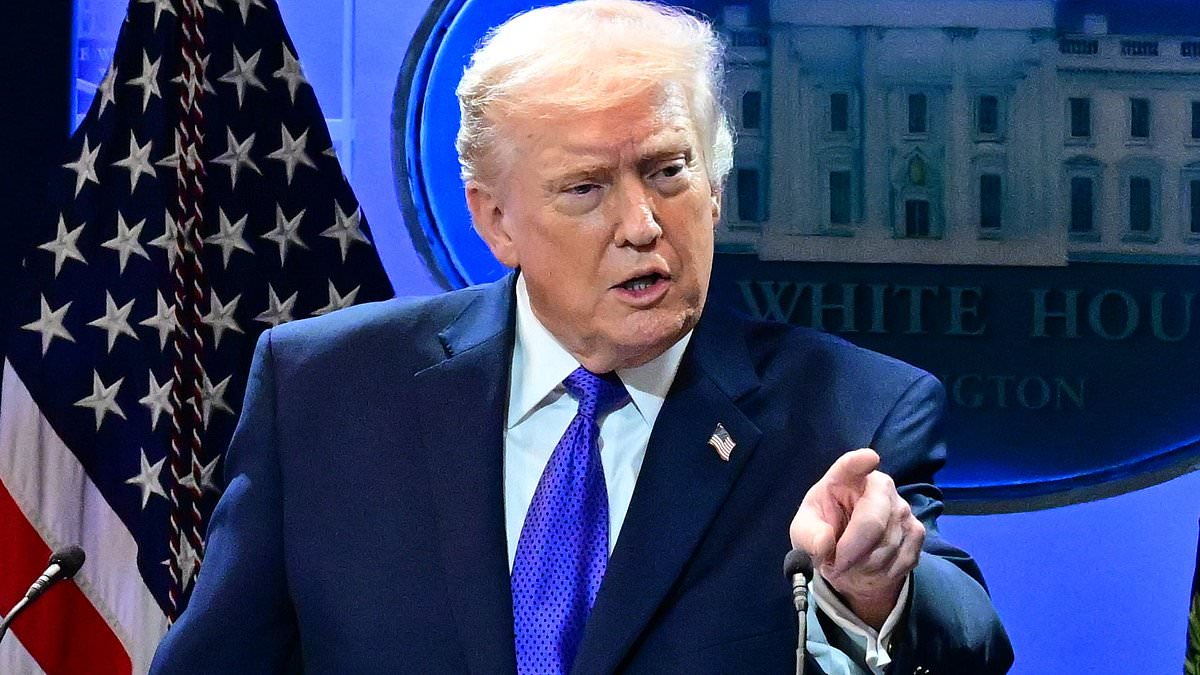
Reports have surfaced that President Donald Trump is contemplating a drastic move: the assassination of the son of Iran’s supreme leader. This development comes as courageous demonstrators once again filled the streets of Tehran, loudly chanting “death to Ayatollah” over the recent weekend.
Mojtaba Khamenei, the 55-year-old son of Ayatollah Ali Khamenei, is viewed as the likely heir to his father’s position. His potential ascension is bolstered by his strong connections with the Islamic Revolutionary Guards Corps (IRGC), a formidable military faction that the United States has labeled a terrorist organization.
As speculation about Trump’s potential actions circulates, students from the Sharif University of Technology have resumed protests, echoing cries of “death to Khamenei” and “shameless, shameless.” This resurgence of dissent was reported by the anti-government outlet Iran International.
These protests initially erupted in December 2025 in response to economic hardships under the Ayatollah’s rule. Despite their peaceful beginnings, the demonstrations faced brutal suppression, with some reports indicating that as many as 30,000 protesters were killed by security forces loyal to the government.
According to more conservative figures from the US-based Human Rights Activists News Agency, at least 6,876 people have lost their lives, and 50,000 individuals have been detained amid the unrest.
Meanwhile, a formidable presence of the US Navy, referred to as an “armada,” has gathered near Iran’s coastline in the Persian Gulf. President Trump has expressed his support for the demonstrators, assuring them that “help is on its way” as of January 22. Currently, over one-third of American military personnel are stationed in the region, underscoring the escalating tensions.
The White House has been considering launching ‘limited’ military strikes since last Friday to force them to the negotiating table and curb their nuclear programme.
If these negotiations should fail, the assassination of Mojtaba and his father is one option being considered by the president, aiming at wholesale regime change.

Donald Trump is considering assassinating Ayatollah Ali Khamenei’s 55-year-old son, Mojtaba Khamenei, US officials told Axios

Meanwhile, brave protesters have been chanting ‘death to Khamenei’ in the streets of Tehran after thousands were killed by pro-government security forces
A senior US official told Axios: ‘They have something for every scenario. One scenario takes out the Ayatollah and his son and the mullahs.’
Footage over the weekend showed a large group of student protesters dressed in all black and wearing face coverings as they marched and chanted slogans against the supreme leader.
However, the activists then became involved in clashes with members of the Basij, a volunteer internal police force that is a branch of the IRGC, according to anti-government media.
Video footage showed the moment the two groups began throwing punches at each other.
The US has now assembled the largest amount of airpower in the Middle East since the 2003 Iraq War. More than two-thirds of the available E-3 Sentry reconnaissance planes have also been deployed to the region, which analysts take as a sign that President Trump is prepared to launch military action.
America has long feared that Iran is developing nuclear capabilities, and indirect negotiations between the two in Geneva last week reportedly failed to reach a meaningful conclusion.
Iran has denied motivations to develop a nuclear arsenal, but has maintained its right to enrich uranium, which is the most-used fuel for nuclear power.


Mojtaba Khamenei (left), 55, is Ayatollah Ali Khamenei’s son and most likely successor. President Trump is considering assassinating him and his father with a view for wholesale regime change

Video footage from last weekend showed protesters clashing with members of the Basij, a volunteer internal police force that is a branch of the IRGC

More than a third of US Navy forces have now gathered on Iranian shores with Donald Trump threatening ‘limited’ strikes to bring them to the negotiating table on curbing their nuclear programme
The White House has said it was open to Iran continuing a scaled-back enrichment programme as a compromise in order to avoid war between the nations, a senior US official confirmed with Axios. But regulations on this deal would have to be very strict to convince sceptics.
The US official said: [Mr Trump] will be ready to accept a deal that would be substantive and that he can sell politically at home.
‘If the Iranians want to prevent an attack, they should give us an offer we can’t refuse. The Iranians keep missing the windows. If they play games, there won’t be a lot of patience.’
Last Thursday, President Trump gave the Iranian regime ‘ten to 15 days’ to come to a deal. Meanwhile, the world’s largest aircraft carrier, the USS Gerald Ford, entered the Mediterranean Sea and will be within range within that time frame.
Major military moves are being made in Qatar, where hundreds of personnel were relocating ahead of a possible strike, a US official told ABC News last Saturday.
Although the report did not state the exact base, the major military facility in Qatar is the Al Udeid Air Base.
The outlet reported that 35,000 troops had been stationed in the Middle East ahead of potential military action, including the USS Gerald Ford, 100 cargo planes, fighter jets, and the USS Abraham Lincoln strike group.

A combination of satellite images shows an increase in the number of aircraft at the Al Udeid Air Base, near Doha, Qatar, comparing January 17, 2026 and February 1, 2026

Nimitz-class aircraft carrier USS Abraham Lincoln sails alongside Arleigh Burke-class guided-missile destroyer USS Frank E. Petersen Jr. and Lewis and Clark-class dry cargo ship USNS Carl Brashear in the Arabian Sea
More than 60 attack aircraft were also captured on satellite imagery on Friday at a US base in Jordan – triple the usual number.
Earlier this month an Iranian doctor said the Iranian regime has been executing protesters in hospital beds by shooting them in the head.
Dr R, a member of the Aida Health Alliance, said that many wounded civilians had been found lying in their treatment beds, still attached to machines, with bullet holes in their heads.
They accused the Islamic Revolutionary Guard Corps (IRGC) of murdering those injured following the Tehran protests and also arresting several medical staff suspected of treating them.
Dr R also shared chilling images with the newspaper of bodies in black bags with bullet wounds to the head, surrounded by blood, and still connected to medical tubes and catheters. These photographs have not been independently verified.