
Share this @internewscast.com
The Trump administration, alongside the US Congress, is reportedly gearing up this week to overturn former President Joe Biden’s prohibition on mining activities in northern Minnesota.
This area, especially the Duluth Complex, is rich in resources including copper, nickel, cobalt, and platinum-group elements, among other minerals.
These resources are crucial for the United States, playing a key role in advancing clean energy technologies, supporting defense infrastructure, and contributing to the electronics and heavy industry sectors, thereby bolstering national security and economic development.
The nation’s heavy dependence on foreign mineral imports has exposed significant vulnerabilities in supply chains, leading to shortages.
In 2023, President Biden imposed a 20-year ban on mining across 225,504 acres within the Superior National Forest, citing environmental protection and the potential for greater economic benefits through tourism and recreation rather than mining.
This mining restriction was implemented without the formal Congressional notification typically required for large-scale land decisions.
According to official documents reviewed by Reuters, Trump’s plan will prevent future administrations from banning mining in Minnesota.
Minnesota Congressman Pete Stauber, a Republican who represents northern Minnesota, plans by Friday to introduce legislation aiming to reject the mining ban.

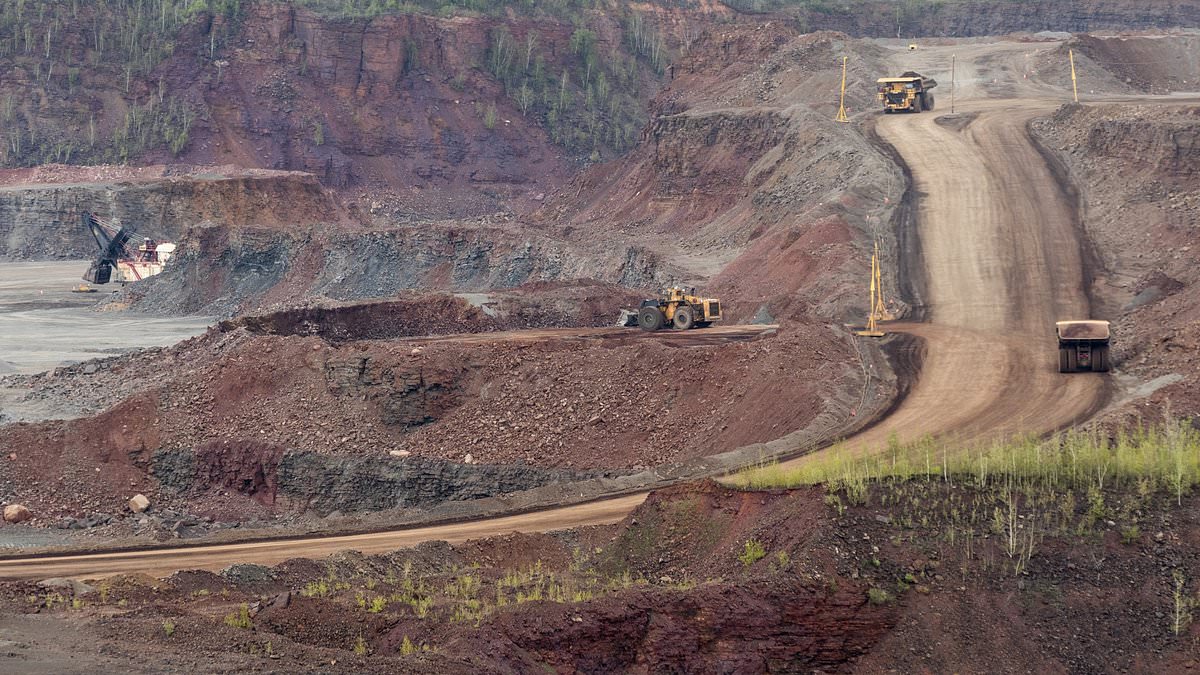
Northern Minnesota, particularly the Duluth Complex, holds significant deposits of copper and nickel, essential for clean energy and national security. Pictured is a strip mine in the famed Mesabi Range of Minnesota

The Trump administration and the US Congress are moving this week to crush former President Joe Biden’s mining ban in northern Minnesota, a new report has claimed
Daily Mail has contacted the Department of the Interior for comment.
Stauber said in a Thursday statement: ‘This dangerous and illegal mining ban was thrust upon my constituents and our way of life in Northern Minnesota and put our nation’s mineral security in jeopardy.’
‘Northern Minnesota mined the iron ore that won this nation two World Wars, and we will mine the copper, nickel, and other critical minerals that will allow the United States to compete and win in the 21st Century.’
Mining in Northern Minnesota is primarily concentrated in the Mesabi, Vermilion, and Cuyuna iron ranges, stretching across the Arrowhead region.
In addition to iron, taconite and some copper-nickel deposits are also extracted, with operations centered near towns like Hibbing, Virginia, and Ely.
Why these minerals matter to America
Biden’s ban restricts mining across much of the Duluth Complex, home to one of the world’s largest untapped reserves of copper, nickel, cobalt and platinum-group metals.
These minerals play a key role in producing electric vehicle batteries, solar panels, wind turbines, and other technologies essential for a clean-energy transition.

Northern Minnesota is estimated to have billions of tons of ore containing significant copper (PICTURED)
Copper, for example, is a cornerstone of electricity and electronics, from power grids to home wiring, and is also used in high-tech equipment for healthcare and defense.
Northern Minnesota is estimated to contain billions of tons of copper ore, making it a vital domestic source to reduce reliance on foreign suppliers and strengthen national security.
The US has domestic copper mines in Arizona, with major suppliers in Chile, Canada, and Mexico, plus Peru and the Democratic Republic of the Congo.
Nickel is equally important, forming the backbone of stainless steel, high-strength alloys, and lithium-ion batteries, while also supporting renewable energy systems and advanced electronics.
The mineral is primarily shipped to the US from Canada, Norway and Australia.
Experts estimate that Minnesota could hold the world’s third-largest nickel deposit, representing 95 percent of the US resource.
Cobalt, another key mineral in lithium batteries, is used in jet engines, medical devices and high-performance alloys. It comes mostly to America from Norway, Canada and Japan.
Platinum-group metals, including platinum, palladium, and rhodium, are essential for catalytic converters, hydrogen fuel cells, chemical manufacturing, advanced electronics, and certain defense applications.
These minerals are imported from South Africa, Russia, and Canada, alongside significant recycling, but also rely on refining and processing in countries like Germany, Belgium, and Switzerland for refined materials.
Together, these minerals make northern Minnesota one of the most strategically important mining regions in the country.