
Share this @internewscast.com
Amid the Trump administration’s focus on ‘America First’ trade strategies and the looming imposition of tariffs on European imports, a small nation of just 5 million people is quietly making a significant impact on the U.S. job market.
Instead of merely shipping goods to the United States and facing potential tariff penalties, Irish companies are directly investing in the U.S. economy by establishing their operations stateside. This approach is fostering a ‘mutually beneficial’ surge in economic activity, highlighting the reciprocal nature of the transatlantic alliance.
This year, Irish Prime Minister Micheal Martin is set to replace the customary exchange of shamrocks with a remarkable $6.1 billion investment commitment during his visit to the Oval Office. This pledge underscores a substantial boost for American employment and manufacturing sectors.
The centerpiece of Wednesday’s announcements is a $5 billion commitment over five years from Smurfit Westrock, a leader in eco-friendly packaging. Accompanying this, Kingspan, a major player in the construction industry, is contributing $1 billion, while Glanbia, a nutrition company, is infusing an additional $100 million into the U.S. economy.
Moving beyond traditional exports like Guinness, Ireland’s latest and most dynamic export is its technological expertise. Irish companies are set to significantly expand their support for U.S. data centers and Amazon distribution hubs, reinforcing tech construction as Ireland’s largest global industry outside of food production.
At the forefront is CEL Critical Power, which plans to enhance an Amazon facility in Williamsburg, Virginia. This initiative, anticipated to double the workforce to 500 by 2030, highlights Ireland’s commitment to bolstering U.S. technological infrastructure, according to Enterprise Ireland, the Irish government’s trade and innovation arm.
When in the past, President Trump accused Ireland of taking advantage of the US economy, Aidan McKenna, the Head of Enterprise Ireland for the Americas, pushed back to the Daily Mail when asked about it. He noted that he doesn’t understand the accusation at all, emphasizing that the relationship between the two nations is deeply ‘mutually beneficial.’
While it is true that Ireland benefits from the presence of US companies, McKenna highlighted that Irish companies are highly reciprocal. Today, they are responsible for creating over 110,000 jobs in the U.S. and have poured hundreds of billions of dollars into the American economy.
In fact, Irish–origin investment reached a staggering $389 billion as of 2024. This massive financial footprint means that, on a per capita basis, Ireland is the number one investor in the U.S., placing the small nation fifth overall in the league of foreign direct investment into the country.

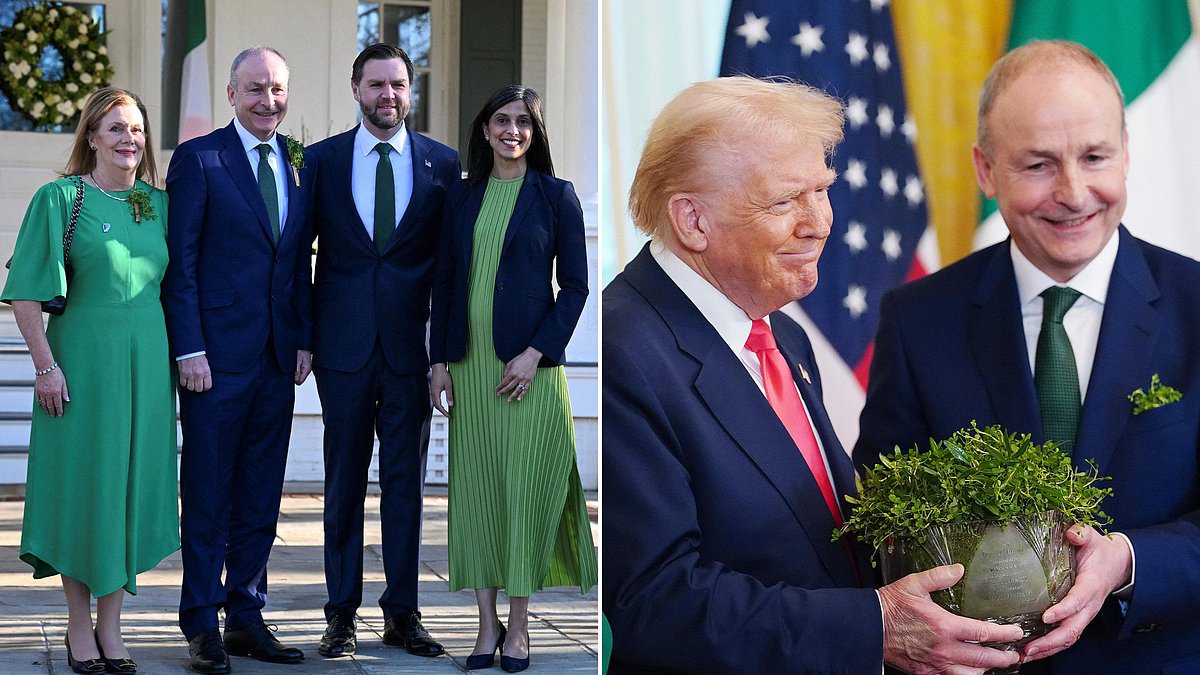
JD Vance and Second Lady Usha Vance greet the Taoiseach of Ireland Micheal Martin and his wife Mary O’Shea for a St. Patrick’s Day breakfast at the Vice President’s residence

Prime Minister Michael Martin of Ireland, right, and his wife Mary O’Shea, left, present United States President Donald Trump with the traditional shamrock bowl during a St Patrick’s Day reception in the East Room of the White House back in March 2025

Rather than just exporting goods to the US and taking the hit from tariffs, Irish companies are physically setting up shop in America, creating a ‘mutually beneficial’ boom that proves the transatlantic relationship is a two–way street
The need to highlight these monumental contributions has never been more urgent. In just the past few weeks, the transatlantic trade landscape has been defined by unprecedented legal whiplash.
On February 20, the US Supreme Court struck down President Trump’s original tariffs, ruling his administration lacked the legal authority to enact them. But the relief didn’t even last the weekend.
Almost immediately, the administration invoked an obscure law—Section 122 of the Trade Act of 1974—to slap a new, temporary 10% global import surcharge on foreign goods, which went into effect on February 24.
This absolute whiplash has plunged global trade into chaos and triggered a massive March 5 lawsuit, where 24 US states sued the administration to block the new tariffs.
But as the Trump administration shifts its geo–economic policy toward aggressive tariffs, how does an export–driven nation respond?
When asked if he thinks Trump knows what he is doing regarding tariffs, McKenna tactfully offered a simple ‘no comment.’
Instead of panic, McKenna’s advice to European countries and Irish businesses dealing with the Trump administration is rooted in pragmatism and steady relationship–building.
‘So when tariffs happen, what did we do with our clients and our Irish businesses? So we said, remain calm, speak to your customers, come to the market, figure out a solution,’ McKenna explained. ‘You know, businesses is hard won, and it’s really important to maintain it and keep relationships. And a lot of people misunderstand this market has been quite transactional, but it’s actually not. It’s built on relationships.’

Taoiseach Micheal Martin speaking during the Ireland Funds National Gala at the National Building Museum in Washington DC, during his visit to the US for St Patrick’s Day

JD Vance and Second Lady Usha Vance greet the Taoiseach of Ireland Micheal Martin and his wife Mary O’Shea for a St. Patrick’s Day breakfast at the Vice President’s residence

While it is true that Ireland benefits from the presence of US companies, McKenna highlighted that Irish companies are highly reciprocal. Today, they are responsible for creating over 110,000 jobs in the U.S. and have poured hundreds of billions of dollars into the American economy

To weather the storm of political accusations and potential tariffs in the US, McKenna advises Irish businesses to ‘remain calm’ and intensely focus on maintaining long–term partnerships with their US customers
Following the rising transatlantic trade tensions, Ireland has doubled down on a strategy of diversification to reduce over–exposure to any single market—a hard–learned lesson from the economic fallout of Brexit.
McKenna’s stark warning to businesses navigating this volatile era is simple: ‘Don’t put all your eggs in one basket in this economy.’
That warning is no longer just good business advice—it is now aggressive state policy. On March 4, the Irish Government published its first progress report on the ‘Action Plan on Market Diversification.’
To protect against this exact US trade volatility, Enterprise Ireland has actively launched specific tariff–mitigation grants, including a Market Research Grant of up to €35,000, to help Irish companies figure out how to survive the US trade barriers or find new markets entirely. They also recently led their largest–ever trade mission to the Netherlands to secure high–tech construction contracts in mainland Europe.
To weather the storm of political accusations and potential tariffs in the US, McKenna advises Irish businesses to ‘remain calm’ and intensely focus on maintaining long–term partnerships with their US customers. He argues that the key to surviving a tariff–heavy environment is offering undeniable quality.
McKenna says, overall, the relationship is a unique diplomatic and economic bond that goes far beyond wearing green on St. Patrick’s Day.
‘Ireland has fundamentally intertwined its economic success with America’s,’ McKenna said.
And as for whether this strategic, boundary–pushing partnership might ever extend to conversations about Greenland?
‘Let’s not even go there,’ McKenna quipped.