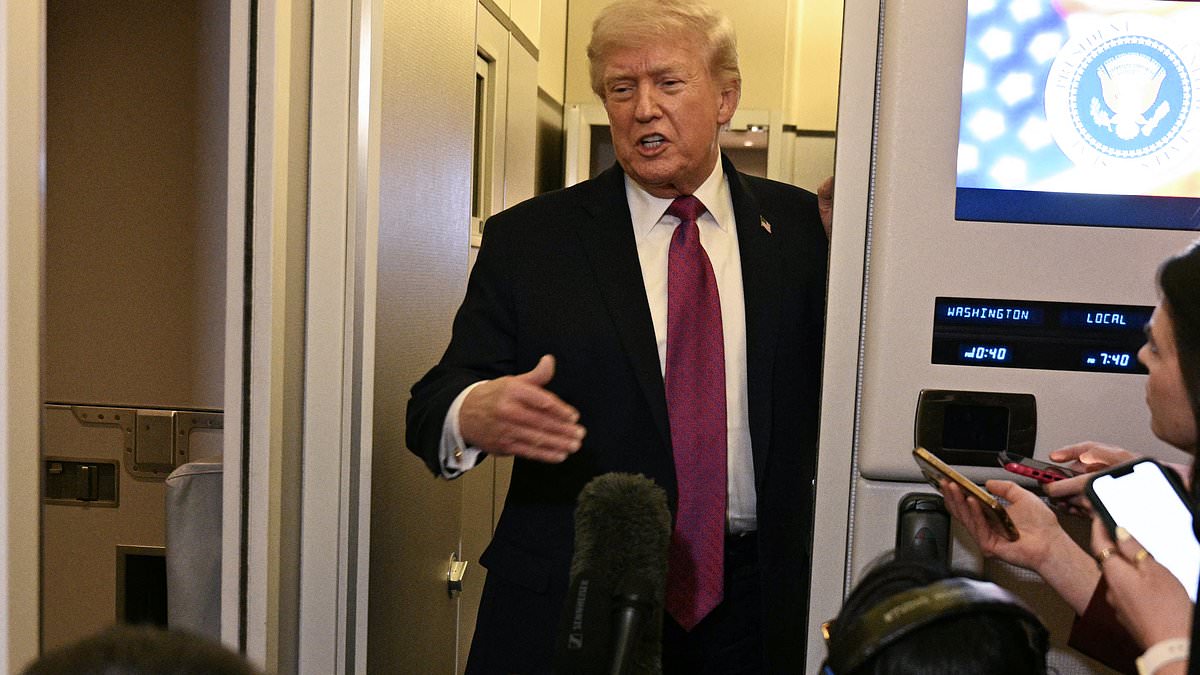

President Donald Trump is contemplating whether to prolong the ceasefire with Iran as the current agreement nears its expiration, while simultaneously hinting at the potential for further military intervention.
During a statement on Friday, Trump revealed that a decision is still pending, with the ceasefire expected to conclude next week.
In an interview with News Nation’s Kellie Meyer, Trump suggested an alternative course of action might involve “starting to drop bombs again,” highlighting the seriousness of the situation.
Expressing confidence, Trump remarked, “I think it’s gonna happen,” in reference to the ongoing ceasefire negotiations.
This development follows Trump’s comments to CBS News, where he stated that Iran had “agreed to everything” and plans to cooperate with the U.S. to eliminate its stockpile of enriched uranium.
Negotiations between both parties are slated for this weekend, as the U.S. maintains its military blockade on Iranian ports until a resolution is achieved, according to reports.
Earlier on Friday night, Trump alleged in a post on Truth Social that China’s President Xi Jinping is ‘very happy’ that the Strait of Hormuz would be reopening.
‘Our meeting in China will be a special one, and, potentially, Historic,’ Trump wrote.

President Donald Trump announced on Friday night that he may consider not extending the ceasefire with Iran, which is set to expire next week

Both sides of the conflict were set to meet this weekend, while the US continues its military blockade of Iranian ports ‘until we get it done.’ Pictured: The Strait of Hormuz on April 2

The President told News Nation’s Kellie Meyer that, instead, he unfortunately may have to ‘start dropping bombs again’
‘I look forward to being with President Xi – Much will be accomplished!’
On Thursday, China’s Foreign Minister Wang Yi told Iranian Foreign Minister Abbas Araghchi that ‘working to resume normal passage of the strait is a unanimous call from the international community.’
Around 20 percent of China’s oil comes from Iran, with more than half of its total energy supplies coming through the Strait of Hormuz.
Earlier on Friday night, Iran’s parliament speaker Mohammed Bagher Ghalibaf, suggested on a social media post that the Strait would be closed again if the US Military blockade wasn’t lifted from Iranian ports.
‘With continuation of the blockade, the Strait of Hormuz will not remain open,’ he wrote on X.
Ghalibaf claimed that Trump made seven claims in one hour, ‘all seven of which were false.’
‘They did not win the war with these lies, and they certainly will not get anywhere in negotiations either… Passage through the Strait of Hormuz will be conducted based on the “designated route” and with “Iranian authorization.” Whether the Strait is open or closed and the regulations governing it will be determined by the field, not by social media.’
Ghalibaf went on to condemn media warfare and ‘engineering public opinion.’

Earlier on Friday night, Iran’s parliament speaker Mohammed Bagher Ghalibaf, suggested on a social media post that the Strait would be closed again if the US Military blockade wasn’t lifted from Iranian ports
Earlier on Friday, Iranian Foreign Minister Araghchi wrote on X: ‘In line with the ceasefire in Lebanon, the passage for all commercial vessels through [the] Strait of Hormuz is declared completely open for the remaining period of the ceasefire, on the coordinated route as already announced by Ports and Maritime Organization of the Islamic Republic of Iran.’
However, Trump said at a Turning Point USA event Friday that his plans to reach a ceasefire with Iran are ‘not in any way tied to Lebanon.’
Israel agreed to cut back its assault on Hezbollah as part of the ten day ceasefire deal CBS News reported. Yet, Iran has said that the situation in Lebanon is intertwined with negotiations on a larger scale.
Access through the Strait was limited by Iran until the deal among Israel and Lebanon was reached, claiming that Lebanon was part of a ceasefire deal stretching 14 days with the US.
Both the US and Israel have denied that that is the case.
In an announcement on Friday, Iran’s foreign minister said ‘the passage for all commercial vessels through Strait of Hormuz is declared completely open’. This immediately caused oil to become 10 per cent cheaper – its lowest price in over a month – and stock markets to surge.
The shipping route, through which a fifth of the world’s oil flows, has been closed for weeks – worsening the cost-of-living crisis.
Tehran said its decision to ‘open’ the Strait was linked to a ceasefire announced in Lebanon, where Israel had been bombing Iran’s proxy terror group Hezbollah.

The Strait of Hormuz is responsible for one-fifth of all global oil supply
President Donald Trump claimed Iran ‘has agreed to never close the Strait of Hormuz again’, but said the US would continue its own naval blockade ‘until such time as our transaction with Iran is 100 per cent complete.’
He added this would happen ‘pretty soon’ as ‘the war in Iran is going along swimmingly’. But sources in Tehran warned it would be a dealbreaker if the US continued to block marine traffic.
It came as 49 leaders held a summit in Paris to discuss how to re-open the strait.
As the US-Iran ceasefire continued to hold, Washington officials said they were negotiating a three-page plan to end the war.
This could involve Iranians surrendering their enriched uranium in exchange for $20billion of funds being unfrozen, it was reported.
But Trump has claimed that ‘no money will exchange hands in any way’.


