
Share this @internewscast.com
Homeland Security Secretary Kristi Noem has set her sights on the demolition of numerous historic structures in Washington, D.C., citing urgent security concerns as her justification for immediate action.
This follows President Donald Trump’s controversial decision to remove the East Wing of the White House without undergoing the usual historical assessment. The Justice Department supported this move, claiming that any delay in constructing a new ballroom would compromise security.
According to a report by The Washington Post, Noem has issued a memorandum to the General Services Administration, urging the demolition of 13 additional buildings on the Department of Homeland Security’s campus, which were not initially part of the demolition plan.
The DHS has established its operations on the west campus of St. Elizabeths Hospital, a historic psychiatric facility dating to 1855.
The transformation of this campus has been a lengthy process, involving a comprehensive historical review. Many of the original brick buildings, famous as the backdrop for the film “A Few Good Men,” have been preserved.
However, several structures remain unoccupied, and Noem contends that these vacant buildings pose an immediate threat to both safety and security.
She included a DHS report in her memo that suggested the vacant structures ‘may be accessed by unauthorized individuals seeking to cause harm to personnel.’
The report continues by warning that the empty buildings ‘provide a tactical advantage for carrying out small arms or active shooter scenarios.’

Department of Homeland Security Secretary Kristi Noem has greenlit demolishing 13 historic buildings that were not slated for destruction on DHS’ campus, which originally was the insane asylum, St. Elizabeths Hospital

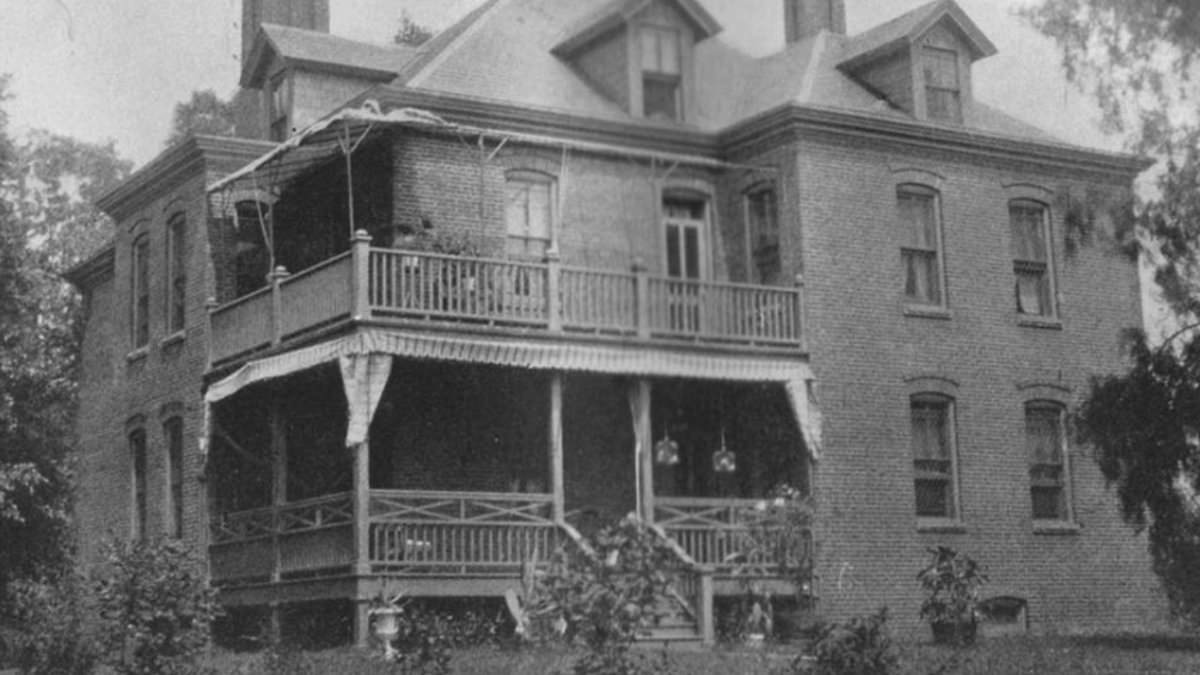
ON THE CHOPPING BLOCK: The building now referred to as ‘Burroughs Cottage’ was completed in 1881 as a home for wealthy patient Sarah Catherine Borrows (pictured, front), with the name changed due to a misspelling
DHS spokesperson Tricia McLaughlin also told the Daily Mail that ‘Several of these structures cannot be safely accessed or cleared by law enforcement or first responders, creating security blind spots adjacent to senior leadership and critical operations.’
‘This is about safety,’ McLaughlin argued. ‘DHS security and safety assessments have determined that these dilapidated, vacant buildings on the DHS campus pose unacceptable safety, security, and emergency-response risks.’
‘Demolition is the only permanent corrective action that eliminates these,’ she added.
The National Trust for Historic Preservation and the D.C. Preservation League issued ‘strong objections’ to the plan in an urgent letter to the acting head of the GSA, obtained by the Daily Mail.
The top preservation groups argued that nothing had changed on DHS’ campus to suddenly represent an ’emergency’ and noted that the buildings all stand behind a ‘double security perimeter.’
‘If these buildings are considered such a security threat, DHS should first reevaluate the location of its perimeter security fence, as suggested in early consultation meetings,’ wrote Elizabeth Merritt, the deputy general counsel for the National Trust for Historic Preservation, and Rebecca Miller, the executive director of the D.C. Preservation League.
The preservationists also said the condition of the buildings is thanks to ‘federal agency neglect.’
‘If the space within these vacant buildings is accessible, that’s because DHS and GSA have failed to effectively secure them,’ Merritt and Miller said.

The Daily Mail obtained a map of the endangered buildings, 13 that weren’t originally slated for demolition, including the four Allison buildings, the East Lodge, the greenhouses, creamery, staff house and residence and the Linden and Holly wards

All four buildings in the Allison group are on DHS’ list. The group was completed in 1899 and were used to house disabled veterans

Linden ward (left) and the Holly ward (right) are also among the buildings that the DHS is requesting be torn down. The buildings were built in 1893 and housed white female epileptics, according to a GSA study on the history of St. Elizabeths Hospital

A vintage map of St Elizabeths, the ‘government hospital for the insane,’ which shows the front elevation of the main hospital, a portion of the campus that has been preserved and serves as the Department of Homeland Security’s headquarters in Southeast D.C.

A vintage photo of the greenhouses on St. Elizabeths campus in Northeast Washington, D.C. The greenhouses are among the structures that could be demolished if the DHS gets its way

Another view of the ‘Burroughs Cottage,’ which was completed in 1881 and photographed in 1898
A map of the buildings, obtained by the Daily Mail, shows that overall 17 structures are on the chopping block, but four had already been approved for demolition by the National Capital Planning Commission and the Commission of Fine Arts.
Among those that previously hadn’t been slated for the wrecking ball is the cottage built for wealthy patient Sarah Catherine Borrows, which goes by the name ‘Burroughs Cottage’ due to an unfortunate misspelling, which was completed in 1881.
All four Allison buildings are on the list – they were constructed in 1899 and were used to house disabled veterans – as are the Linden and the Holly wards, which were built in 1893 for white female epileptics.
The East Lodge, which topped the list, had been used to house female African-American patients, according to St. Elizabeths, A History, a 2013 document compiled by the General Services Administration, which included historical photos of the buildings.
Noem also requested that the campus’ staff house, staff residence, creamery and greenhouses be torn down.
The preservationists argued that the District of Columbia State Historic Preservation Office and the Advisory Council on Historic Preservation can step in and have until Wednesday, December 31, to do so.
As of Tuesday afternoon, the D.C.and federal entity had yet to take action.
The DHS did not reveal when demolitions could begin.