
Share this @internewscast.com
The White House and the International Monetary Fund (IMF), located just a couple of blocks apart in downtown Washington, share a geographical closeness that belies their often distant policy interactions.
As the largest stakeholder in the IMF—a global financial entity it helped establish at the Bretton Woods Conference—the United States holds significant influence over the organization. However, this influence does not always translate into adherence to the IMF’s economic assessments and recommendations.
Historically, US administrations have tended to overlook the IMF’s critiques and advice outlined in its annual examination of the American economy. The implication is that while the IMF’s guidance is considered essential for other nations, the United States often exempts itself from such scrutiny.
The latest ‘Article IV’ consultation report on the US economy sheds light on why President Trump’s notion of boundless American resources to act as the world’s police force should be approached with skepticism.
Even before the US decided to support Israel in conducting extensive military operations, totaling 1,700 sorties over Iran, the nation’s financial health was already in a precarious state.
The budget deficit, hovering between 7% and 8% of the country’s GDP, is double the target set by US Treasury Secretary Scott Bessent. Without corrective measures, this trajectory could propel national debt to 140% of GDP by 2031.

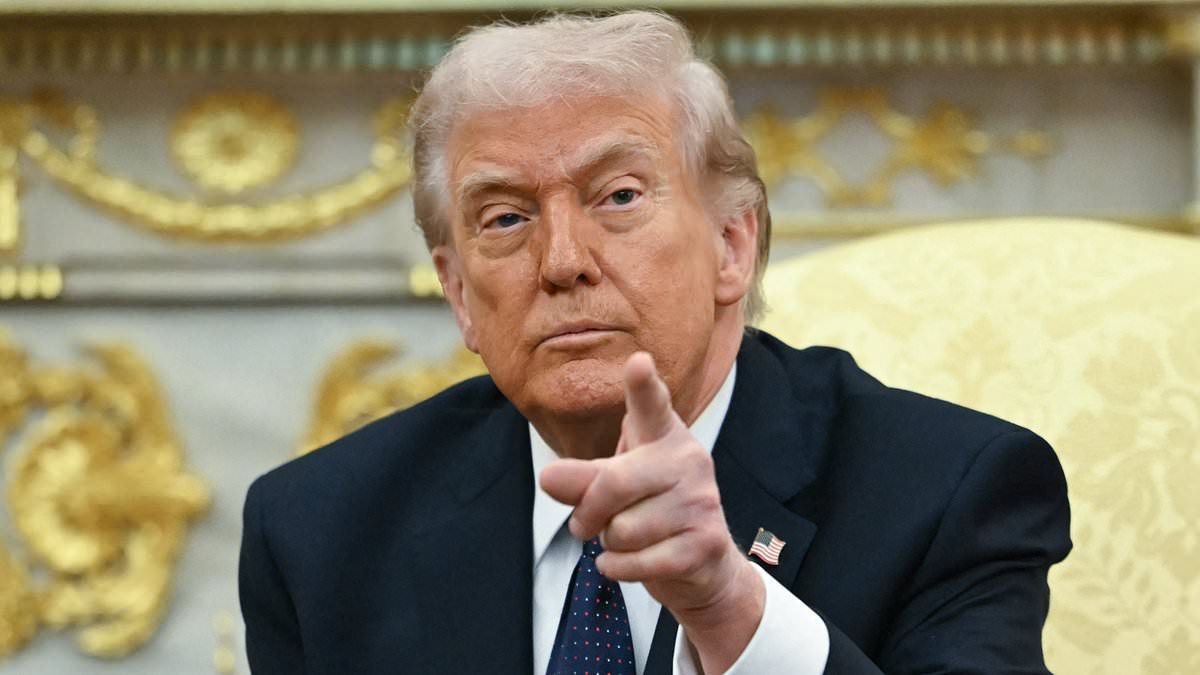
Big spender: Under President Trump, pictured, America’s budget deficit, running at 7% to 8% of national output, is at twice the level targeted by US Treasury Secretary Scott Bessent
The IMF went on to argue that the scale of this fiscal shortfall represents a risk not just to American economic stability but that of the world.
Donald Trump’s war on Iran makes this considerably worse. The costs of the deployment of Trump’s armada in the Gulf are mounting by the day.
Some $700million was spent on advanced fighter planes and missile systems in the first 24 hours using ordnance that is far more expensive than Iran’s drones.
Despite the rocky state of the public finances, the White House is asking Congress for a 50 per cent uplift in military spending to $1.5 trillion, while at the same time lowering taxes on wealthier Americans.
The President argues that the US’s forecast growth rate of 2.4 per cent for 2026 will pay the bills.
Maybe, but that takes no account of unexpected costs such as the $175billion of income from tariffs at risk because of the Supreme Court’s recent warning.
America has long enjoyed the exorbitant privilege of being the world’s reserve currency.
Indeed, its status as a haven has improved since the outbreak of Middle East hostilities. But when conflict subsides, all hell could be let loose on the bond and currency markets.
Home coming
Will Rachel Reeves have the last laugh? Her £75billion or so of tax raising since becoming Chancellor may have provided the Government with fiscal headroom, but it has come at a terrible cost.
Latest analysis from broker Rathbones shows that 6,000 high growth business owners left Britain between January 2024 and January 2026, frightened off by wealth taxes.
The end of non-domicile tax status, higher inheritance, capital gains and venture capital levies made the UK a much less attractive place for enterprise and entrepreneurship.
Some of those leaving have chosen Italy or Portugal for refuge. But for many, Dubai, with its increasingly sophisticated financial infrastructure and terrific travel connections, has been the destination of choice.
Loss of entrepreneurship clearly has come at a huge cost to UK growth, and taxing the better off until the pips squeak, plainly is a terrible mistake.
Nevertheless, there is something deeply disturbing about those with the most resources fleeing these shores, leaving those of us left behind to pick up the slack.
Entrepreneurs who thought they would find tranquillity and easy access to finance in the Gulf might be starting to feel queasy as the current Iran conflagration spreads to nations previously insulated from conflict.
Air miles
There are always winners from conflict. A friend heading for Bali this week told me that when two flights booked via Dubai were cancelled, they were offered alternative business-class tickets via Singapore for £9,000 extra. They decided to head for South Africa instead.
Ryanair’s Michael O’Leary is never slow to see an opportunity.
He reports a take-off in short-haul Easter holiday bookings to European destinations as travellers recoil from trips to the Middle East. O’Leary predicts no change in longer-term bookings.
If the panicked response of many of those trapped in the hostile surroundings of ultra-luxury Dubai hostelries is any guide, he could be wrong.
Join the debate
Do YOU think Trump’s economic gamble could backfire once the Iran conflict ends?
DIY INVESTING PLATFORMS
AJ Bell

AJ Bell
Easy investing and ready-made portfolios
Hargreaves Lansdown

Hargreaves Lansdown
Free fund dealing and investment ideas
interactive investor

interactive investor
Flat-fee investing from £4.99 per month
Freetrade

Freetrade
Investing Isa now free on basic plan
Trading 212

Trading 212
Free share dealing and no account fee
Affiliate links: If you take out a product This is Money may earn a commission. These deals are chosen by our editorial team, as we think they are worth highlighting. This does not affect our editorial independence.
Compare the best investing account for you