
Share this @internewscast.com
In a bid to combat rising oil prices, Donald Trump has moved to temporarily lift a longstanding shipping regulation that prevents foreign-flagged ships from transporting goods between domestic ports.
The move involves a 60-day suspension of the Jones Act, a law enacted in 1920 to safeguard the U.S. shipbuilding industry. Critics, however, have long argued that the law stifles free trade and leads to higher consumer prices.
Since the conflict in Iran escalated on February 28, U.S. gasoline prices have climbed by over 27%. The turmoil, marked by missile and drone attacks, has severely disrupted shipping in the Strait of Hormuz.
White House Press Secretary Karoline Leavitt addressed the waiver, stating it is “another step to mitigate the short-term disruptions to the oil market as the US military continues meeting the objectives of Operation Epic Fury.”
Leavitt emphasized that this measure aims to ensure the unimpeded flow of critical resources, such as oil, natural gas, fertilizer, and coal, to American ports over the next two months.
However, experts have raised concerns, noting a significant issue: many U.S. refineries are designed to process domestically sourced light, sweet crude oil, rather than the heavier, sour crude typically imported from countries like Venezuela, Canada, and those in the Middle East.
Daleep Singh, chief global economist at asset manager PGIM, said in a client note Wednesday: ‘Put plainly: the US can now move fuel around more easily, but it still can’t refine enough of what it produces for self-sufficiency.’
Markets were unmoved by Trump’s announcement: US crude spiked 1.75 percent on Wednesday while Brent crude, the global benchmark, jumped 4.83 percent to hit $108 per barrel.

White House press secretary Karoline Leavitt talks on a phone as she walks to do a television interview at the White House, Wednesday


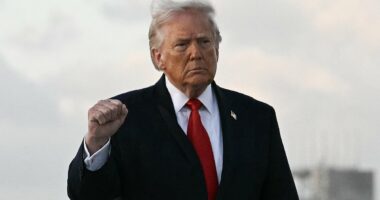
President Donald Trump during a St. Patrick’s Day event in the East Room of the White House, Tuesday, March 17, and an oil tanker burns after being hit by an Iranian strike in the ship-to-ship transfer zone at Khor al-Zubair port near Basra, Iraq, late Wednesday, March 11
The US Treasury Department separately issued a license to authorize certain transactions between established US entities and Venezuela’s state-owned oil company PDVSA.
‘This license will benefit both the United States and Venezuela, while supporting the global energy market by increasing the supply of available oil,’ said a Treasury spokesperson.
The Jones Act requires that cargo transported by water within the United States be moved on vessels that are US-built, US-owned and registered under the US flag.
Only a fraction of the world’s tankers comply with the Jones Act, said Colin Grabow, an associate director at the Cato Institute.
‘So this is a dramatic expansion in the number of ships that are able to be used’ in transporting goods within the world’s biggest economy, he said, referring to Trump’s temporary waiver.
He said it is nearly five times as expensive to build a medium-range tanker in the US than in Asia, which could explain why there are not many such vessels globally.
Grabow said the measure would bolster US supply chains, but warned that price relief could prove limited if the war drags on.
‘It can help mitigate some of the disruptions,’ he said. But moving forward, it could be less about reducing costs than ‘slowing the rate of increase’ from disruptions.
Josh Lipsky of the Atlantic Council said the shipping law waiver ‘is unlikely to have a significant impact on global energy markets and gas prices.’
‘It’s too small a move to sway the larger forces at play in the Gulf,’ he cautioned, even though it could help cool costs in the northeast or southwest.
‘The 60-day decision as opposed to the 30 we expected may signal a longer conflict however,’ Lipsky added.
Jones Act deliveries cost billions of dollars more than using a foreign vessel, S&P Global analysts estimate.