
Share this @internewscast.com
By BARBARA ORTUTAY and MICHAEL LIEDTKE
SAN FRANCISCO (AP) — Elon Musk appeared in court on Wednesday in San Francisco, where he faces allegations of issuing false and misleading statements that impacted Twitter’s stock value prior to his $44 billion acquisition of the social media giant in 2022.
The legal proceedings stem from a lawsuit filed in October 2022 in the U.S. District Court for the Northern District of California, representing Twitter shareholders who sold their shares between May 13 and October 4, 2022. This period was just before Musk completed his purchase of Twitter. The lawsuit contends that Musk breached federal securities laws by intentionally making false public statements designed to depress Twitter’s stock price.
In April 2022, Musk, the billionaire and CEO of Tesla, agreed to acquire Twitter and take it private. Yet, on May 13, he announced that his acquisition plan was “temporarily on hold” until he could ascertain the number of spam and fake accounts on Twitter, causing a drop in the company’s stock value. A few days later, he tweeted that the transaction “cannot go forward” and alleged that nearly 20% of Twitter accounts were fraudulent, as mentioned in the lawsuit.
The attorney representing the plaintiffs began by interrogating Musk about his tweets—or the absence thereof—regarding his decision to purchase Twitter and his acquisition of Twitter shares before deciding to make the company private.
Dressed in a black suit and tie, Musk stated that he did not consider it “material” when he started buying Twitter stock in early 2022 and therefore did not tweet or inform the Securities and Exchange Commission about it. He explained that he has acquired shares in “many companies” without publicly announcing his actions.
Once he did, Twitter’s stock jumped 27% in one day.
“That sounds high,” Musk said.
Musk’s May 13 tweet — “Twitter deal temporarily on hold pending details supporting calculation that spam/fake accounts do indeed represent less than 5% of users” — was “false because the buyout was not, in fact, ‘temporarily on hold,’” the lawsuit says. That’s because Twitter did not agree to put the deal on hold, and there was nothing in the merger agreement the two parties signed that allowed Musk to put it on hold, according to the lawsuit.
In the following weeks, Musk continued to try to delay or get out of the deal, which the lawsuit claims he did in the form of false, disparaging statements about Twitter’s business that drove the San Francisco company’s stock down sharply.
In July 2022, Musk doubled down on the bots issue and said he would abandon his offer to buy Twitter after the company failed to provide enough information about the number of fake accounts. That’s even though the lawsuit notes that Musk waived due diligence for his “take it or leave it” offer to buy Twitter. That means he waived his right to look at the company’s nonpublic finances.
The stock closed at $36.81 on July 8, when Musk tweeted he was abandoning the deal over the fake accounts issue. That’s 32% below Musk’s offer price of $54.20 per share.
-

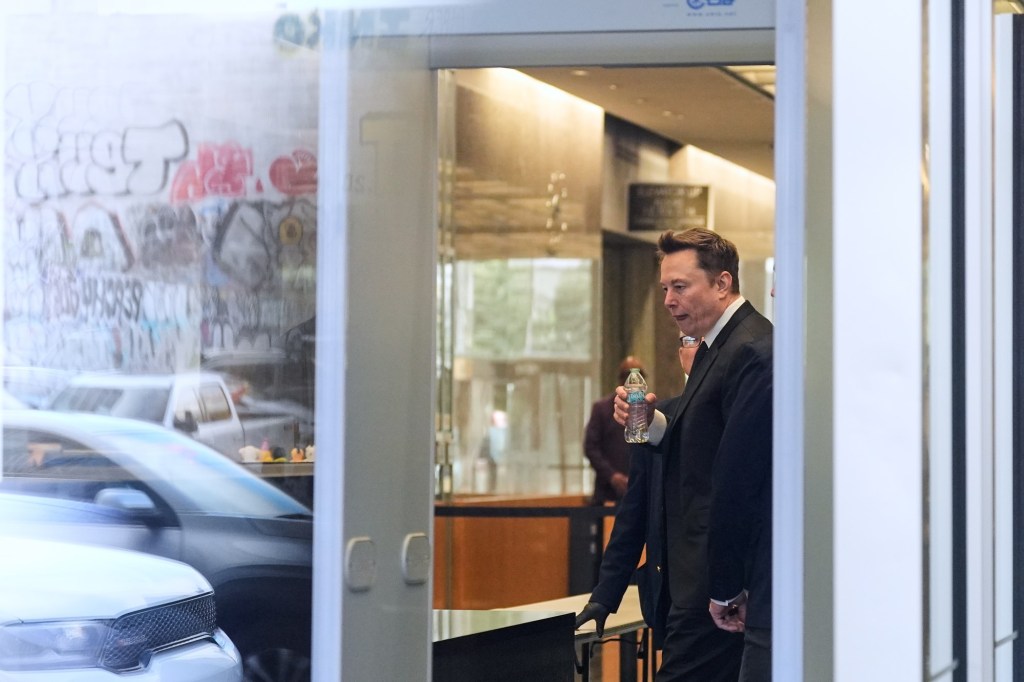
Elon Musk, center rear, arrives for a Twitter shareholder trial at the U.S. District Court for the Northern District of California, Wednesday, March 4, 2026, in San Francisco. (AP Photo/Godofredo A. Vásquez)


1 of 5
Elon Musk, center rear, arrives for a Twitter shareholder trial at the U.S. District Court for the Northern District of California, Wednesday, March 4, 2026, in San Francisco. (AP Photo/Godofredo A. Vásquez)
“To try to renegotiate the price or delay the merger, Musk made materially false and misleading statements and omissions, and engaged in a scheme to deceive the market, all in violation of the law,” the lawsuit says.
The problem of bots and fake accounts on Twitter wasn’t new. The company had paid $809.5 million in 2021 to settle claims it was overstating its growth rate and monthly user figures. Twitter also disclosed its bot estimates to the Securities and Exchange Commission for years, while also cautioning that its estimate might be too low.
Twitter sued Musk to force him to complete the deal, and Musk countersued. On Oct. 4, Musk offered to go through with his original proposal to buy Twitter for $44 billion, which Twitter accepted. The deal closed later that month. In the ensuing months, Musk slashed the company’s workforce, gutted its trust and safety team and rolled back content moderation policies. In July 2023, he renamed Twitter as X.
This isn’t the first time that Musk has been dragged into court to defend himself against allegations of duping investors with his social media posts. Three years ago, Musk spent about eight hours testifying in a San Francisco federal trial about his plans to buy Tesla — the electric automaker that he still runs as publicly traded company — for $420 per share in a proposed 2018 deal that never materialized. A nine-member jury absolved Musk of wrongdoing in that case.