
Share this @internewscast.com
Britain is facing a potential natural gas shortage, with only two days’ supply left in storage. Concerns are mounting as the Middle East conflict has led to the shutdown of the largest gas facility globally, alongside Iran’s closure of a crucial shipping route.
According to National Gas, the UK’s gas reserves have sharply decreased from 18,000 GWh last year to just 6,700 GWh, which can only sustain demand for about a day and a half. Additionally, a similar amount of gas is stored as liquefied natural gas (LNG).
In contrast, Europe is significantly better equipped to handle supply disruptions, having several weeks’ worth of gas reserves on hand.
The UK’s predicament has allowed traders to capitalize by imposing premium prices on gas, forcing the country to pay more than its European counterparts. As a result, the UK is currently facing the highest wholesale gas prices in Europe.
Contributing to the gas market’s turmoil is the near-complete closure of the Strait of Hormuz, a vital passage for approximately 20 percent of global natural gas and oil. Additionally, production shutdowns in various regions have compounded the issue.
Earlier this week, Qatar announced it had halted operations at Ras Laffan, the world’s largest natural gas facility, following an attack by Iranian forces.
Meanwhile, oil prices are set to soon hit $100 a barrel and that could rise to $150 if the war drags on, industry experts warned.
The spike in gas and oil prices came as:

Disruption to the gas market is driven partly by the near-total closure of the Strait of Hormuz, through which around 20 percent of the world’s natural gas and oil flows
Natasha Fielding, head of gas pricing at Argus Media, a leading publisher of commodity data, said: ‘The price of gas in the UK has increased by more than almost anywhere in Europe.
‘The UK gas hub price is now above the Dutch TTF [the main European gas hub] all the way from now until the end of May. Before this week, the UK was priced below the EU.
She said this was partly because the UK’s meagre gas stockpiles leave us ‘more exposed to price spikes’, and added: ‘We can’t rely on withdrawing more from storage, so we have to get that gas from abroad.’
Ms Fielding said traders would be monitoring temperatures in Britain, and that if it gets cold, the UK would be more urgently compelled to outbid other countries for gas.
The UK used to have up to 12 days worth of gas in storage, but the system collapsed after successive government ministers pulled its funding.
National Gas data showed that gas stores were at 18pc of their former capacity on Friday, while LNG stores were just over half full.
A National Gas spokesman said the UK gets most of its gas from Norway and its own North Sea.
They told The Telegraph: ‘The UK benefits from a wide range of gas supply sources. These provide the flexibility needed to balance supply and demand.’
Meanwhile, fears of a significant spike in oil prices are also growing, driven largely by disruption to the flow through the Strait of Hormuz.

Ras Laffan in Qatar, the world’s largest natural gas facility, suspended operations at the start of the week after coming under attack

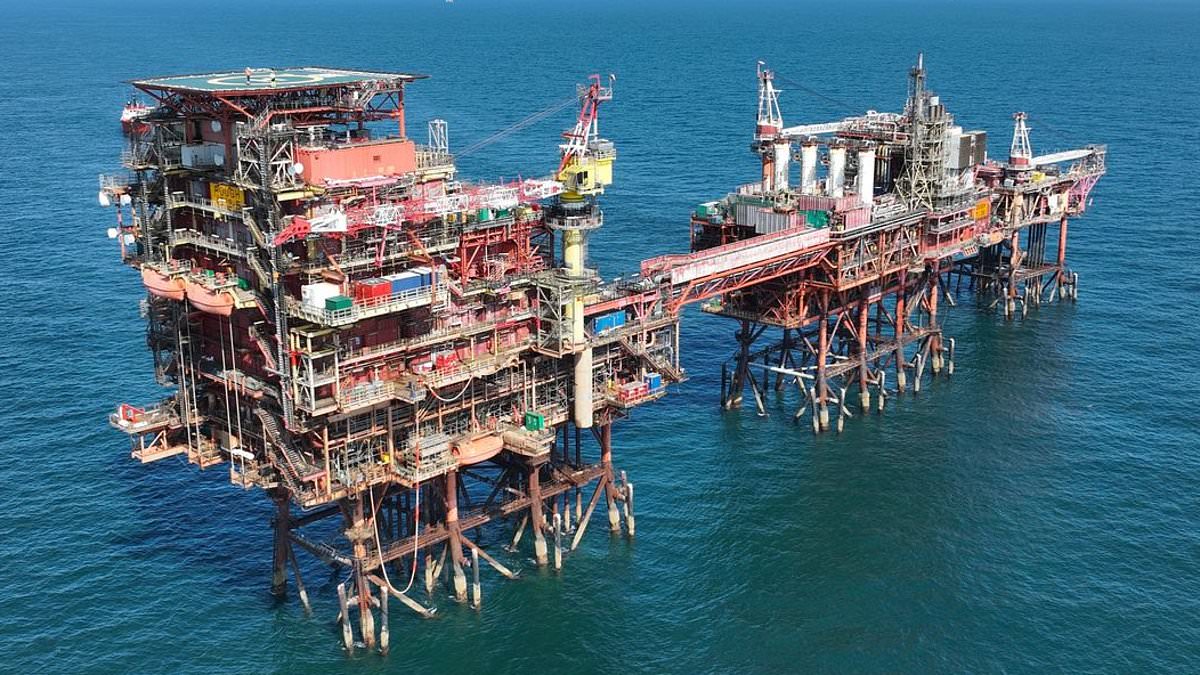
The Rough natural gas storage facility off the coast of Yorkshire, which accounts for around 50 percent of the UK’s capacity
Iran’s Revolutionary Guards vowed to ‘set ablaze’ any Western tanker attempting to sail through the strait – and hundreds have since amassed at either end.
Goldman Sachs warned that the current drop in the Middle East’s oil output is 17 times larger than the peak drop in Russia’s output after it invaded Ukraine.
Oil prices have already surged above $90, with American crude settling at $90.90 on Friday, up 36 per cent from a week ago, while Brent, the international benchmark, climbed 27 per cent over the course of the week to land at $92.69.
The bank said: ‘We now think that oil prices would likely exceed $100 next week if no signs of solutions emerge by then.

Goldman Sachs warned that the current drop in the Middle East’s oil output is 17 times larger than the peak drop in Russia’s output after it invaded Ukraine. Fire is seen at the Fujairah oil industry zone in the UAE after drone debris struck
‘We now also think it’s likely that oil prices, especially for refined products, would exceed the 2008 and 2022 peaks, if Strait of Hormuz flows were to remain depressed throughout March.’
Experts have told households in the UK to expect to be ‘hit from multiple sides’ by price rises driven by the Middle East conflict.
Professor Mohamed El-Erian of the University of Pennsylvania told BBC Radio 4’s Today programme: ‘Once again, we see the UK more vulnerable to external shocks than otherwise that in turn is going to translate into higher mortgage rates. So the average person will get hit from multiple sizes, unfortunately.
‘The average person is going to face higher energy prices, but also higher mortgage rates and slowly but surely, noticeable increases in a broad range of goods and services because of supply chain disruptions.’
Any price rise in household bills would hit in July, when a new energy price cap will be set.