Share this @internewscast.com
Residents of the UK may soon encounter unprecedented fuel prices as tensions in the Middle East trigger a surge in energy costs.
Industry analysts caution that petrol prices could reach an all-time high of £2 per litre due to a dramatic escalation in international oil prices.
Labour leader Keir Starmer is actively working to quell concerns of a cost of living crisis similar to 2022, suggesting the possibility of financial interventions despite the government’s precarious fiscal position. He is also striving to mitigate any adverse effects on UK-US relations following his criticism of Donald Trump’s decision to initiate military action against Iran.
President Trump, however, downplayed the impact of rising oil and gas costs, referring to them as a “minor sacrifice” in the effort to curb Iran’s influence.
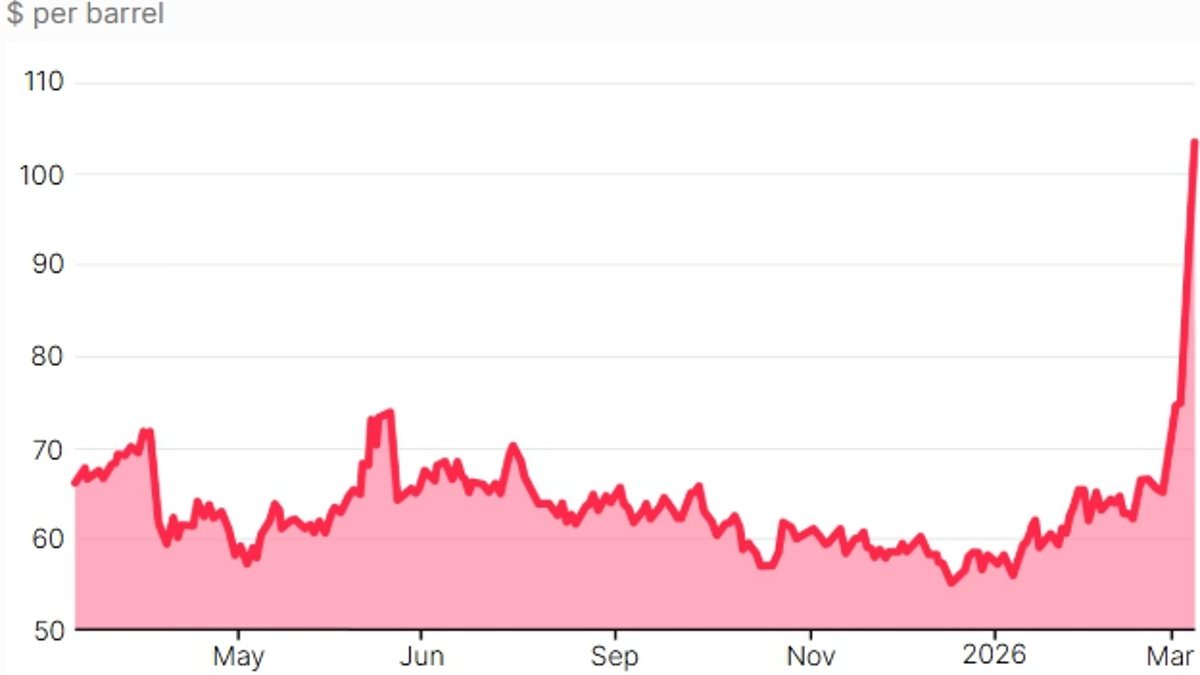
The price of oil has surged past $100 per barrel for the first time in several years, driven by threats to key production facilities in the Middle East.
Furthermore, Iran has effectively blocked the Strait of Hormuz, a critical passageway through which approximately 20% of the world’s oil supply is transported.
Analysts say there is a real risk the oil price will reach $150 a barrel, with estimates that would mean £2 a litre petrol for British drivers. The previous record was 191.4p in 2022, and they are currently running around 140p.
An emergency meeting of the G7 has been called for today, where Rachel Reeves will join other ministers discussing options including the release of oil reserves.
The FTSE 100 dropped more than 100 points on opening this morning, having lost well over a month of gains since the crisis erupted nine days ago.
In other dramatic developments today:
- Ministers are trying to quell concerns about the UK’s low gas storage, which could mean consumers are more exposed to rising prices;
- Sir Keir spoke to Mr Trump yesterday for the first time in more than a week, following a series of insults aimed at him by the president;
- Emmanuel Macron is expected to visit Cyprus amid Britain’s embarrassing inability to protect the RAF Akrotiri base from Iranian reprisals;
- HMS Dragon is still at Portsmouth and is unlikely to arrive in Cyprus to protect Akrotiri for another week;
- Fears are growing about the Chancellor needing to impose more tax increases to balance the books, as debt interest cost increase and the economy comes under pressure.

Keir Starmer is desperately trying to calm fears of another 2022-style cost of living squeeze, hinting at another bailout despite the fragile state of the government’s finances

A thick cloud of black smoke hangs over Tehran after the Shahran oil depot was hit in a fresh round of US-Israeli strikes

Explosions erupt following strikes in Tehran over the weekend
Iran’s Revolutionary Guard has threatened to ‘set ablaze’ any Western tanker that attempts to navigate the strait, and hundreds of ships laden with oil, as well as liquefied natural gas, have amassed either end of it.
Iraq and Kuwait have begun cutting output, with the UAE and Saudi Arabia expected to follow suit as they run out of oil storage.
The price of a barrel of Brent crude shot up almost 24 percent in Asian markets overnight, as traders concluded that the crisis will drag on.
It took just a minute for the price to rise by 10 percent, and 15 minutes for another 10 percent, seeing it surge beyond the $100 mark for the first time since the early days of Russia’s invasion of Ukraine in 2022.
But a defiant Mr Trump wrote on his Truth Social site: ‘Short term oil prices, which will drop rapidly when the destruction of the Iran nuclear threat is over, is a very small price to pay U.S.A., and World, Safety and Peace.
‘ONLY FOOLS WOULD THINK DIFFERENTLY!’
Oil reserves are co-ordinated by the International Energy Agency (IEA), with 32 members of the group holding stocks as part of a collective emergency system designed to mitigate oil price crises.
Three G7 countries, including the US, have so far indicated their support for a possible joint release, according to the FT.
US President Donald Trump acknowledged the economic shockwaves that the conflict is having, but insisted temporary price rises are a small price to pay for eliminating Iran’s nuclear threat.
Last week, the markets had remained relatively relaxed about impact on the oil supply.
But escalations over the weekend, alongside scenes of destruction of energy infrastructure both in Iran and across the Gulf, spooked them this morning.

Donald Trump has dismissed the soaring oil and gas prices saying they are a ‘small price to pay’ for taming Tehran

Economist Julian Jessop
A slump in the stock market also deepened on Monday, with the S&P 500 and Stoxx Europe 600 sliding 1.6 percent and 2.1 percent respectively.
And Fears emerged yesterday that Britain was also in trouble over its stocks of natural gas.
Figures suggested that, in a worst-case scenario, the country could have just two days’ worth of demand stored up.
Reserves dwindled from 18,000 GWh last year to the current 6,700 GWh, enough for just 1.5 days of demand, according to new data published by National Gas. There is a similar quantity stored as liquefied natural gas (LNG).
Meanwhile, Iran on Sunday named Mojtaba Khamenei to succeed his father Ali Khamenei as Supreme Leader.
This signals that, a week into the conflict, regime hardliners still wield control over the country.
Announcing the news, Iran’s foreign ministry said: ‘The selection of the new leader of the Islamic revolution at a time of grave challenge will reinforce national unity and safeguard the country’s independence, sovereignty and territorial integrity.’
US Defense Secretary Pete Hegseth last night guaranteed Iran will ‘surrender’ and President Donald Trump will set the terms of their defeat.
Hegseth sat down for an exclusive interview with CBS News’ ’60 Minutes,’ where he was asked what the president meant by his demand for an ‘unconditional surrender.’
‘It means we’re fighting to win. It means we set the terms,’ the Defense Secretary replied.

Oil tankers anchored outside the Strait of Hormuz