
Share this @internewscast.com
A significant investment of nearly £1 million from taxpayer funds is being allocated to create an archive of African cinema as part of a ‘reparatory justice’ initiative.
With a contribution of £850,000, the UK Arts and Humanities Research Council (AHRC) is funding researchers to delve into Africa’s cinematic legacy.
Additionally, Oxford University, King’s College, and Liverpool University are contributing £250,000 to spearhead this endeavor.
The project will concentrate on films that document the ‘decolonization’ process of African nations and the exploration of anti-colonial movements.
Another goal is to ‘repatriate’ film footage currently housed in the ‘Global North,’ making these works more accessible to audiences in Africa.
These archives are set to travel across Africa, engaging with young African creatives at various cultural events.
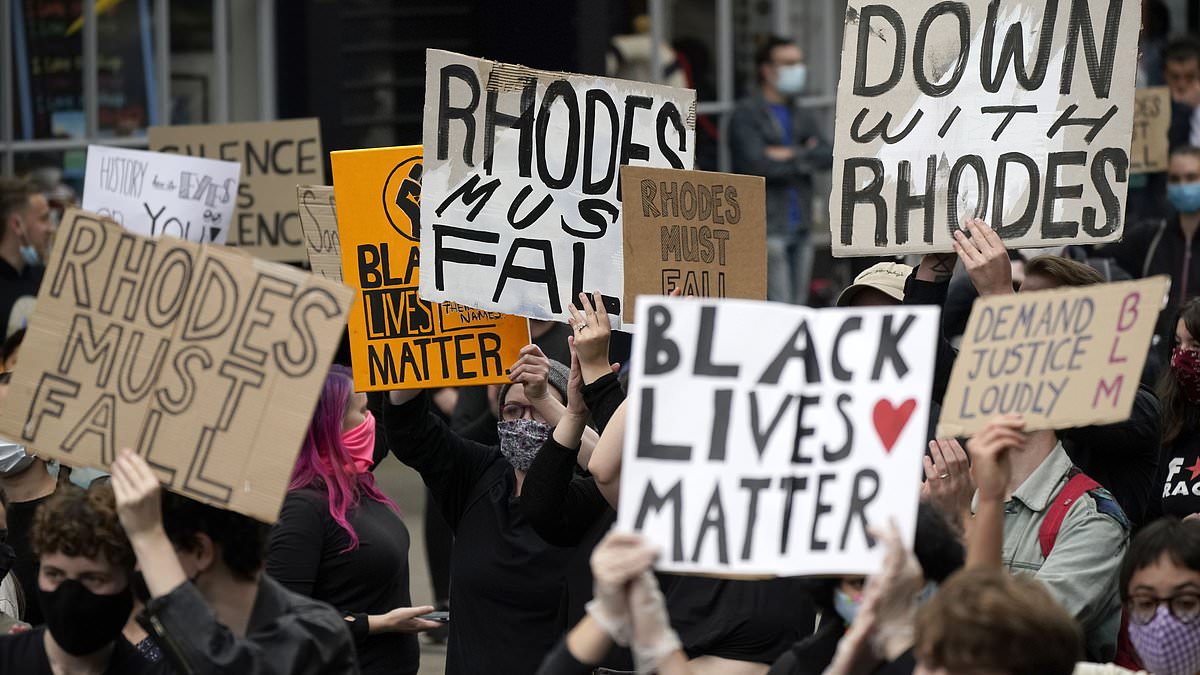
It comes following a long-running campaign at Oxford to tear down a statue of the British Imperialist Cecil Rhodes by those who want ‘decolonisation’ of the university.
The project also comes at a time when public funding is tight.

Almost £1 million of taxpayer cash is been spent on compiling an archive of African films in a ‘reparatory justice’ project (pictured: students marching in a 2020 anti-colonialism protest at Oxford, which is taking part in the research)
AHRC, which hands out £70 million a year in grants, is a subsidiary of UK Research Innovation (UKRI) which is funded by the Department for Science, Innovation and Technology.
The three universities are funded by a mixture of Government grants, taxpayer-provided tuition fee loans and some private cash.
Last night, Professor Anthony Glees, politics expert at Buckingham University, said: ‘They are funding this project for cynical political reasons. They are beyond woke.
‘It looks very like they’re trying to use the money to appease the “Rhodes Must Fall” campaigners, building on the idea of systematic racism in British institutions and the UK’s former African colonies.
‘Using films to make a political point and getting almost £1 million for doing so is hardly a sensible use of money when there’s so little of it, especially in some universities.’
William Yarwood at the TaxPayers’ Alliance added: ‘At a time when families are being squeezed from every angle, pouring almost £1 million into an academic project involving “decolonisation film archives” is staggeringly out of touch.
‘AHRC’s funding record increasingly looks like a conveyor belt for activist scholarship that delivers no meaningful benefit to British taxpayers. AHRC should be defunded and abolished.’

The UK Arts and Humanities Research Council (AHRC) is paying £850,000 for scholars to explore Africa’s ‘audiovisual heritage’ (pictured: Oxford professor Dan Hodgkinson, who is part of the research team and has campaigned on ‘decolonisation’)

It comes following a long-running campaign at Oxford to tear down a statue of the British Imperialist Cecil Rhodes (pictured) by those who want ‘decolonisation’ of the university
The two-year project looks at films spanning a period from colonial rule to the early 2000s.
It is led by Professor Erica Carter, professor of German and Film at King’s, who will work with 12 international experts including Oxford’s Dr Dan Hodgkinson, who has been involved in ‘decolonising’ activism in the past.
Dr Hodgkinson was among a group of academics at Oxford who carried out an academic boycott of Oriel College in 2021 over its decision to keep the Rhodes statue in place.
The ‘African film heritage restitution’ process will focus on two countries, Ghana and Sudan, with the researchers gathering footage to form new archives.
They will then look for ‘Africa-led solutions’ to overcome copyright and technology issues to make them more accessible to people in those countries.
Scholars, archivists and film makers in Cairo, Accra, Tamale, Berlin, Khartoum and London will develop and test new approaches to audiovisual heritage restitution.
A brief for the project says: ‘For twentieth-century anti-colonial movements and postcolonial states, cinema was a key medium for articulating and popularising decolonisation.
‘Yet years of resource poverty and political inaction have left a film heritage landscape marked by neglect and material destruction.
‘Vast swaths of newsreels, documentary and feature films—films that captured the major events and experiences of the decolonisation years—are either lost, or sequestered in the archives of the Global North.’
Project organisers said it comes in a climate of ‘demands’ for repatriation of treasures taken during ‘British colonial conquest and rule’.
This includes the Benin Bronzes, some of which have been returned to Nigeria from British institutions.
Dr Hodgekinson said: ‘There’s a lot of talk these days about redress, decolonisation, and restitution, relating to all sorts of historical artefacts and issues.
‘But there’s much less clarity on what actually needs to be done.
‘[Our project] tackles these issues head on – and all of us in the project, from Tamale to Cairo, can’t wait to get started.’
Featuring prominently in the project will be the work of Sudanese artist and film-maker Hussein Shariffe, who studied at Cambridge in the 1950s and later went on to make films touching on his both his country’s history and his experience of being in exile.
The African film project is the latest to raise questions about how British taxpayers’ money is being spent in higher education.
Other controversial AHRC grants include nearly £850,000 on a study entitled The Europe that Gay Porn Built, 1945-2000 and funding for PhDs in subjects such as lesbians living on canal boats, performance practice in sex work and the history of ‘queer fat activism’.
Meanwhile another UKRI subsidiary, the Economic and Social Research Council, awarded £668,244 in funding to Pregnant Men: An International Exploration of Trans Male Experiences and Practices of Reproduction.
A recent analysis of around 150,000 grants approved by UKRI since the early 2000s found the terms ‘equity’, ‘diversity’ and ‘inclusion’ rose four-fold in frequency from the mid-2000s to 2020 before doubling again in the four years up to 2024.
The study by Buckingham University Centre for Heterodox Social Science warned that spending on ‘explicitly activist’ research had huge political risks for UKRI given that much of the public does not share its priorities.
A UKRI spokesman said: ‘UKRI’s investments in the arts, humanities and social science research broaden our knowledge, support the growth of key sectors such as the creative industries, and find new and innovative ways to benefit citizens.
‘This includes advancing knowledge by exploring challenging subjects, asking difficult questions about our society and working with international partners to investigate our shared history.’
A King’s College spokesman said: ‘It is not true that this project is about decolonisation, the purpose… is to preserve digital archives that document major events in the 20th century and restore films and documents that may otherwise be lost to authoritarian regimes and war.’