
Share this @internewscast.com
In the past week, have you engaged in any of the following activities? Tidied up your home, cooked with a non-stick pan, applied make-up, drank tap water, picked up a takeaway coffee, or charged your phone.
It’s likely that you’ve done most, if not all, without giving them much thought.
What you might not be aware of is that each of these actions exposes you to a group of hazardous ‘forever chemicals’ known as PFAS.
PFAS, short for per- and polyfluoroalkyl substances, were created in the 1940s. These synthetic compounds are invisible and nearly indestructible.
Nowadays, they are used to make products resistant to water, grease, stains, and heat. One well-known example is Teflon, the brand commonly used for coating non-stick cookware.
However, if these chemicals are ingested or absorbed through the skin, long-term exposure to PFAS—which includes 16,000 different varieties—can be quite concerning.
Scientific studies have shown links with liver and testicular cancer, damage to the immune system, kidney disease, increased cholesterol, hormonal imbalance and pregnancy complications. Once inside the body, forever chemicals don’t break down – and can be very difficult to get rid of.
This, experts say, is one of the major health crises of our lifetime – and it’s getting worse right under our noses.
‘These “forever chemicals” are everywhere, from food packaging and furniture to outdoor gear, cosmetics and even dental floss,’ explains Stephanie Metzger, policy adviser on sustainable chemicals at The Royal Society of Chemistry.

Mum of two young children, and seven-months pregnant, Sarah Rainey discovered that all babies born today have PFAS in their bodies already, and early life exposure can affect their cognitive, motor and language development
‘They’re rarely labelled clearly, often hidden behind terms such as “non-stick” or “waterproof”, and complete avoidance is virtually impossible, since PFAS persist in food, soil, water and air.’
Such is the threat from PFAS that ministers across Europe are considering a universal restriction on their use. Last month, France became the first country to ban them outright.
Earlier this week, the British government announced increased testing for forever chemicals as part of a national plan to tackle the substances by December 2028.
‘The UK does recognise the dangers on a scientific level, but it seems we are slightly behind the US and Europe on a regulatory level,’ warns Dr Sabine Donnai, a preventative healthcare specialist and founder of the Viavi clinic in London.
As a mum of two young children, and seven-months pregnant, this worries me – even more so when Dr Donnai explains that the cumulative toxins in our body can pass through the placenta.
All babies born today have PFAS in their bodies already, and early life exposure can affect their cognitive, motor and language development, as well as making vaccines less effective.
With this in mind, I visit Dr Donnai’s clinic to get my PFAS levels tested. A level above 2ng (nanograms) per millilitre of blood is considered to bring health risks – but, as a healthy, active woman of 38, I’m confident mine will be well within range.
All that’s required is a quick finger-prick, after which my blood is sent off to be analysed.
When the results come back, I’m shocked. The PFAS in my body are 2.6ng per millilitre – not drastically above the safe level, but higher than I’d like.
Anything above 2ng is alarming, as it shows my body has already absorbed some of these toxins, and is only going to take on more. That said, it’s not the worst Dr Donnai has tested: one female journalist, of a similar age and lifestyle, recently showed PFAS levels of 9ng per millilitre.
She, by contrast, has a level of 0ng, almost certainly as a result of being aware of the danger and hypervigilant about what she allows into her home.
Shaken by the results, I pledge to cut forever chemicals from my – and my family’s – life. But simply avoiding the known sources, for a week, a month or even a year, is ‘very unlikely’ to lower my levels, says Dr Donnai. That could take decades, so for now the best option is to ‘make sensible choices and limit future exposure’.
Keen to stop my levels from going up, and to keep my children safe while they’re still young, we take on the challenge of spending seven days, PFAS-free.
So is it actually possible to live without PFAS, even for a week? Here’s how we got on…
Join the debate
Should governments do more to protect us from hidden chemicals in everyday products?
FOOD AND DRINK

Researchers have detected PFAS in foods most of us think of as being ‘healthy’ – including kale, grapes, cherries, tomatoes and cucumbers (a result of pesticides used in their production)
‘The majority of people’s exposure to PFAS is very likely to come from the food they eat,’ explains Stuart Harrad, emeritus professor of environmental chemistry at the University of Birmingham.
‘Some of this contamination occurs via the food chain, especially meat, fish and dairy produce.’
PFAS which have got into the soil and water find their way into crops that animals eat, for example.
But among the worst offenders is plastic-coated packaging – found on takeaway containers, pizza boxes and microwave popcorn bags – which puts the food inside it in direct contact with forever chemicals.
Our planned popcorn-fuelled movie marathon, and that Friday night curry, are both cancelled.
It’s not just fast food that can put you at risk, however. Researchers have detected PFAS in foods most of us think of as being ‘healthy’ – including kale, eggs, milk, rice and smoothies – as well as everyday staples: butter, ketchup, tea and juice.
Fresh fruit is another red flag: in a 2022 study, scientists found 95 per cent of strawberry samples tested contained PFAS, as did grapes, cherries, tomatoes and cucumbers (a result of pesticides used in their production).
With a four-year-old who survives mostly on fruit and ketchup, this is bad news. I try to avoid the risk by buying organic (less likely to involve pesticides), but this is costly – and not always PFAS-free.
Instead, it’s a week of frozen veg (usually washed before freezing and packaged in PFAS-free bags) and boring bananas (PFAS can’t get inside the peel).
We swap cow’s milk for oat, rice for pasta, and I forgo my hourly tea habit for a glass of water. Water, however, isn’t safe from PFAS either. Tests in 2023 found forever chemicals in tap water provided by 17 out of 18 water companies in England – including mine, Anglian Water.
Boiling it does nothing; instead, the experts advise a filter on my tap and to use this for everything, from drinking water to washing fruit, even cooking pasta.
‘Drinking plenty of PFAS-free water will support healthy kidney function,’ says Dr Donnai.
I opt for a five-stage filtration jug by ZeroWater Europe (from £33), which claims to eliminate 99 per cent of forever chemicals. The kids think it’s a noveltybut having to fill it umpteen times a day is a faff.
VERDICT: Doable but not ideal. With barely any fresh fruit or veg in their diet, I’m worried my kids will get scurvy. But the water filter – an easy fix – is here to stay.
COSMETICS AND TOILETRIES
If you use mascara, lipstick, foundation or eyeshadow, there are bound to be PFAS lurking in your make-up bag.
An investigation by the BBC in 2023 found forever chemicals in popular brands of make-up including Urban Decay, Inglot and Revolution.
Though these companies insist they have since been removed, plenty of other brands – including my Milani Waterproof Mascara – contain the dreaded toxins.
And no wonder; they help with smooth, glide-on application and render eye products waterproof.

If you use mascara, lipstick, foundation or eyeshadow, there are bound to be PFAS lurking in your make-up bag. They help with smooth, glide-on application and render eye products waterproof
But they’re not always easy to spot. ‘Unfortunately, PFAS are rarely listed as “PFAS” on labels,’ explains Stephanie Metzger.
To spot them, look for terms like ‘waterproof’ and ‘oil repellent’ on packaging, or the ingredient PTFE – polytetrafluoroethylene – in the ingredients list.
Worried about the hidden nasties I’ve been slapping on my face, I brave the bare-faced look.
Some companies, including Ilia, Axiology and High Street retailer H&M, make all their make-up PFAS-free, so long-term I plan to upgrade my cosmetics bag.
Even nail varnish is off the cards; studies have shown there are risks to absent-mindedly nibbling on your nails, and some brands – such as Sally Hansen’s Teflon Tuff – actively publicised the PFAS used in their polishes to make them longer-lasting.
When it comes to toiletries, my Olaplex shampoo is safe, but there are doubts over my children’s bubble bath (a 2009 study found toxins in popular kids’ bath products), so I reluctantly share my shampoo around for a week.
Many brands of dental floss, especially those labelled ‘glide’ or ‘smooth’, are coated in PTFE for a glossy, tear-resistant finish, so that’s a no-no, as is our usual toilet paper – Charmin Ultra Soft – which has been shown to contain low levels of fluorine, a strong indicator of the presence of PFAS. Mercifully, other brands are available.
Perhaps most annoying of all, I can’t wear my contact lenses for a week.
A 2023 study in the US found every single one of 18 brands of soft contact lenses tested contained forever chemicals. I dig around in a drawer for an old pair of glasses instead.
VERDICT: Impossible. I can’t see properly, I’m not wearing a scrap of make-up and I haven’t flossed in a week.
I may be PFAS-free but I am not fit for social contact.
KIDS’ CLOTHES AND SPORTSWEAR
Nearly 60 per cent of children’s clothing labelled ‘waterproof’, ‘stain-resistant’ or – shockingly – ‘environmentally friendly’ were found to contain PFAS in a 2022 study published in the Environmental Science and Technology Journal.
This is bad news; as any parent knows, these are the backbone of most children’s wardrobes – and as a mum of two very messy boys, almost everything they own is water and stain-proof.

In a 2022 study, nearly 60 per cent of children’s clothing labelled ‘waterproof’, ‘stain-resistant’ or – shockingly – ‘environmentally friendly’ were found to contain PFAS
Although specific brands weren’t named in the study, one that has come under fire is Mountain Warehouse. In a Panorama programme which aired late last year, PFAS were found in a children’s coat bought from the company in 2025.
Mountain Warehouse insisted the coat came from a small batch of old stock, and it has since been withdrawn from sale.
But we have countless ‘old stock’ in our house – from waterproof onesies to rain macs – and, as most of my children’s wardrobes comprise second-hand garments, there’s no telling what chemicals have been used to treat their outerwear.
We have to ditch the lot.
It’s a cold, soggy week and far from ideal sending them to school in just jumpers, but I know I’ve got their best interests at heart.
My wardrobe isn’t safe, either. Researchers have found PFAS in yoga leggings and sports bras, where chemicals are used to wick sweat and improve durability. Clearly, exercise is off the agenda – in the name of safety, of course.
VERDICT: As I don’t own a lot of sportswear, I’m less affected by this category, but confiscating my children’s coats in the depths of winter seems harsh.
FURNITURE AND HOMEWARE
It’s not simply a case of ingesting PFAS or rubbing them on your face or hair. Experts say the very fact they touch your skin could be dangerous.
Mere ‘prolonged contact with human skin’, says Prof Harrad, could mean forever chemicals are absorbed into your body.
Indeed, research at the University of Birmingham in 2024 found uptake through our skin to be a ‘significant source of exposure’ to PFAS – and at much higher levels than previously suspected. So touching, sitting on or walking over household items treated with them could be putting you at risk.
Our stain-resistant sofa – a must with young children – becomes a hazardous area for a week, relegating my husband and I to sitting on hard-backed chairs every evening.
The mattress-protector on our bed has to come off, as do the shower curtains, which could all be causing us to come into contact with PFAS.

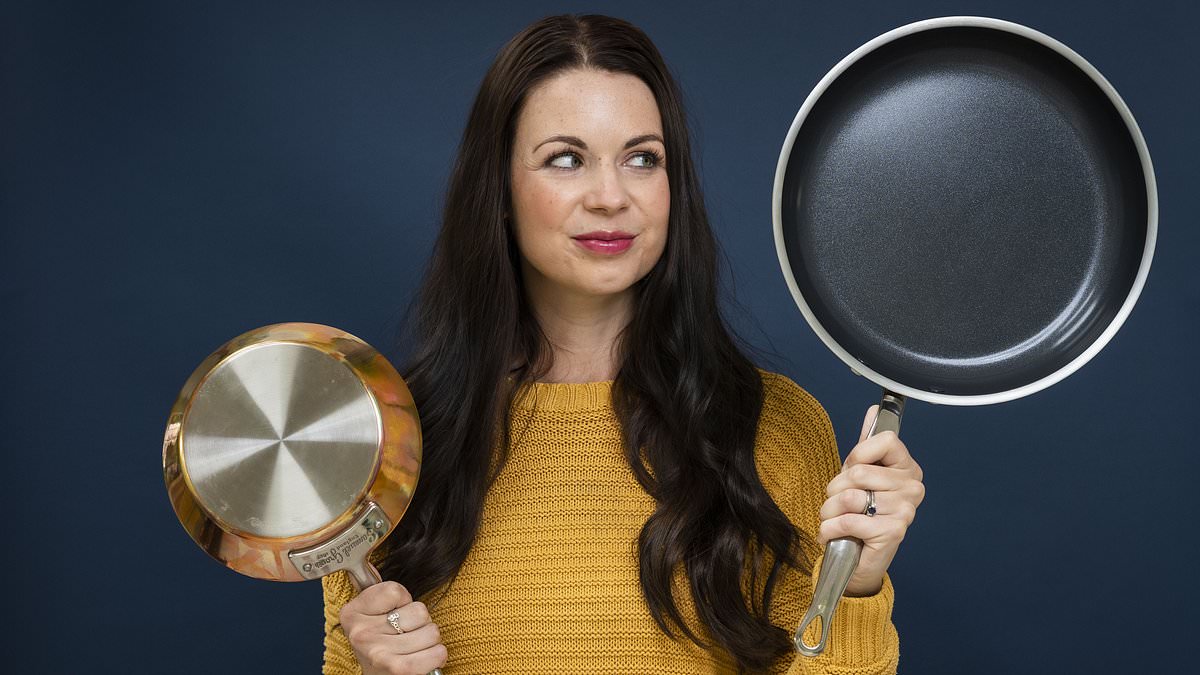
Sarah avoids her non-stick, Teflon-coated pans and does her cooking for the week in her Always Pan by Our Place, the celebrity-endorsed cookware brand
The carpets are tricky – one report found that 90 per cent of carpets had detectable levels of PFAS in them – but most of our house has wooden flooring, so I don’t feel too concerned (and the kids love playing ‘the floor is lava’ to leap around potentially contaminated rooms).
In the kitchen, I steer clear of our non-stick, Teflon-coated pans – a wedding present, including the one I use so frequently it has got scratches and dents on the base.
This, the experts say, makes them even more hazardous, as the damage makes it easier for the chemicals to bleed into your food. I push them to the back of the cupboard and do my cooking for the week in my Always Pan by Our Place, the celebrity-endorsed cookware brand.
It cost a whopping £125, so I’m delighted to be using it more regularly, and not only is it PFAS-free, but everything I cook in it (including scrambled eggs and a sticky stir-fry sauce) washes off easily.
VERDICT: Though I’m longing to lounge on the sofa again, these swaps are easy to make. And I’m already saving up for a whole set of PFAS-free cookware.
CLEANING PRODUCTS
Household dust, especially on carpets, door frames and windows, is a major source of PFAS – which can also be inhaled into the body.
With both my husband and myself working full-time, dusting often falls by the wayside, so I vow to vacuum the house top to bottom.
But this isn’t the week to start on a cleaning spree, as most cleaning products contain forever chemicals (look for the prefix ‘polyfluoro’ in chemicals on the ingredients lists).

Household dust, especially on carpets, door frames and windows, is a major source of PFAS – which can also be inhaled into the body
Stain removers and furniture polish aren’t on the safe list, but most of our cleaning fluids – by eco-friendly brand Method – state they’re PFAS-free on the labels, so they’re fine to use.
Other ‘good’ brands include Smol and Purdy & Figg, a pricey antibacterial spray. Yet experts say the best way to avoid the risks is to minimise their use entirely; instead, wipe surfaces using a damp cloth and hot water, with a squirt of soap if needed.
VERDICT: The house – and crucially the bedroom carpets, where my kids spend most of their time rolling and cartwheeling around – is cleaner than ever, thanks to some old-fashioned elbow grease.
WORK AND TECHNOLOGY
Technology is teeming with PFAS – not just laptops and TVs, but the smartphones we touch, put to our ears and scroll on for hours.
Our smudge-resistant screens (both phone and TV), our chargers, the wires that go into headphones – all are coated in a layer of forever chemicals that could be slowly poisoning our bodies.
I don’t mind going without TV for a week (although the children are less keen on this idea), but my smartphone and laptop are non-negotiables for work.
Instead, I stick to washing my hands (with that specially filtered water) every time I touch a piece of tech.

Technology is teeming with PFAS – not just laptops and TVs, but the smartphones we touch, put to our ears and scroll on for hours
Printer paper, especially glossy photo paper, can be another source of PFAS, as can the printer itself.
And my work-day coffee habit? Disposable coffee cups (as well as paper straws and plates) are proven sources, so I cancel my daily trip to the local cafe for a take-out latte and opt for instant at home.
Towards the end of the week, craving a proper caffeine fix, I order a Thermos mug (confirmed to be PFAS-free) and bring that to the cafe instead.
VERDICT: In this ultra-connected world, it’s impossible to switch off completely. But I’m determined to use my smartphone less. And takeaway coffee tastes the same – and is better for the planet – in my reusable cup.
OVERALL VERDICT
What a week. Avoiding PFAS in every-day life has not only been testing, but it’s meant many of our daily go-tos – from strawberries to smartphones, coats to contact lenses – have been off-limits.
I’ve had to rethink every instinctive decision, from going to the supermarket to washing my hair, with forever chemicals invading every part of our lives.
Wary of scaring my children, I haven’t fully explained the reasons behind our experiment, so they’re relieved it’s over – and delighted we can go back to eating ketchup.
As for me? I’m increasingly aware of the invisible, harmful toxins that have already built
up in my body, and going to do everything I can – within reason – to stop any more from creeping in.