
Share this @internewscast.com
Few images have left such a lasting and haunting impression.
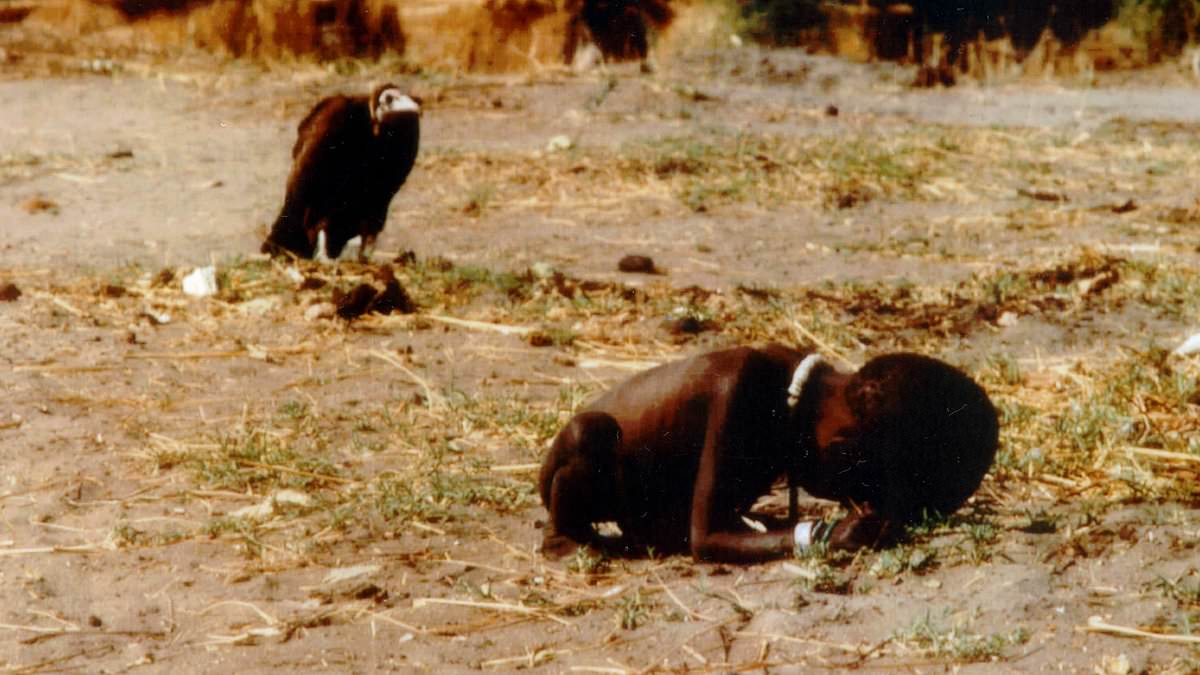
Captured in a moment of extreme desperation, a child lies on the ground, emaciated to the point of immobility.
Nearby, a vulture lands, its gaze fixed on the frail child who struggles to rise amid the barren landscape.
This powerful photograph, known as “The Vulture and the Little Girl”—though the child was later identified as a boy—was taken by South African photojournalist Kevin Carter in 1993 amidst the famine-stricken regions of Sudan.
The image drew global attention to Sudan’s dire humanitarian crisis, yet it also sparked intense criticism of Carter, who faced profound personal turmoil that ultimately led to a tragic end.
Carter, a member of the Bang Bang Club, a group dedicated to capturing the violence across Africa, traveled to Sudan in 1993 to document the effects of its brutal civil war.
After reaching the village of Ayod, Carter began photographing famine-struck people near a feeding centre.
But as he got away from the crowd and into the bush, Carter spotted an emaciated child – who was erroneously believed to be a girl until 2011 – struggling to make his way to the centre.

A vulture hovers over a starving Sudanese child. This photograph by South African photographer Kevin Carter won the Pulitzer prize for feature photography for the New York Times
The malnourished and exhausted little boy – thought to have been aged around two – collapsed suddenly, and lay motionlessly on the ground
Carter began taking photos of the child when suddenly a hooded vulture flew over to him, settling a few yards away, waiting for the youngster to die.
Careful not to disturb the animal, Carter waited 20 minutes until it was close enough to the boy and positioned himself to take a picture. Only then did the photographer scare the scavenger away.
The foreboding shot of the child and the vulture was published in The New York Times on March 26, 1993, and won a Pulitzer the following year.
But despite his professional success, Carter was unprepared for the barrage of criticism that would come his way.
After the image was published, hundreds of people wrote to The New York Times demanding to know whether the child had survived.

Despite his professional success, Kevin Carter (pictured) was unprepared for the barrage of criticism that would come his way

Kevin Carter was a South African photojournalist and member of the so-called Bang-Bang Club. He was the recipient in 1994 of a Pulitzer Prize for his photograph depicting the 1993 famine in Sudan; he died by suicide less than four months afterwards, at the age of 33

Kevin Carter’s image titled ‘The Vulture and the Little Girl’ appeared in the New York Times on March 26, 1993
As a result, the paper ran a special editor’s note the next day that said: ‘The photographer reports that she recovered enough to resume her trek after the vulture was chased away. It is not known whether she reached the [feeding] centre’.
Several others bombarded Carter with questions about why he did not help the starving child, and was flooded with angry criticism.
One paper, The St. Petersburg Times in Florida wrote: ‘The man adjusting his lens to take just the right frame of her suffering, might just as well be a predator, another vulture on the scene’.
Not only was the public horrified that Carter had not immediately chased the vulture away, but also at the fact that the photographer had not helped the weakened child afterward.
Carter often expressed regret that he had not helped the child, but the photo journalist had been told not to get close to famine victims for fear of spreading disease.
Through the image, Carter had made his mark as a commended photo journalist, and went on to win a Pulitzer Prize in 1994.
But privately, he was fighting a personal battle, and just four months after receiving the honour, Carter died by suicide, aged 33.
‘I’m really, really sorry’, he wrote in a note. ‘The pain of life overrides the joy to the point that joy does not exist.
‘I am haunted by the vivid memories of killings and corpses and anger and pain… of starving or wounded children, of trigger-happy madmen, often police, of killer executioners…’
Fellow Bang Bang Club member Joao Silva told Time magazine after Carter’s suicide that he became ‘depressed’ after his assignment in Sudan.
Meanwhile his friend Judith Matliff spoke of how Carter was ‘tormented’ by people saying he should have helped the child.
He became reliant on drugs and was arrested after crashing his car into a house, which resulted in his partner leaving him.
‘People were calling him for assignments and he just couldn’t get out of bed,’ Matliff said in a documentary about Carter’s life.
And when he was able to work, he kept slipping up, according to colleagues.
Carter visited Mozambique for a job, but after returning home, he realised he’d left the undeveloped film on the plane.
‘This is it, I can’t live, I can’t do it anymore’, he told friend Reedwan Vally after the blunder.
In a letter published in Time after Carter’s death, his sister Patricia Gird Randburg wrote: ‘The pain of his mission to open the eyes of the world to so many of the issues and injustices that tore at his own soul eventually got to him.’
Mentioning her brother’s Pulitzer award she said: ‘It was a confirmation that his work had all been worthwhile’.
The photographer’s tragic story would go on to inspire Welsh rock band Manic Street Preachers, who wrote a song titled ‘Kevin Carter’.
The lyrics were written by the band’s troubled guitarist Richey Edwards before his own disappearance in 1995. They explore Carter’s mental agony and the complex moral questions raised by his photography.
‘Hi, Time magazine, hi, Pulitzer Prize/ Tribal scars in Technicolor Bang-bang club, AK-47 hour/ Kevin Carter Hi, Time magazine, hi, Pulitzer Prize/ Vulture stalked white piped lie forever/ Wasted your life in black and white’, Edwards wrote.
Since the haunting image was first published in The New York Times, questions over the fate of the child in the photo continued to rise, even years after Carter’s death.
In 2011, a journalist finally found the answer the public hoped for – the child had made it to the feeding centre and survived.
After tracking down the child’s father in Sudan, it was revealed that the child was in fact not a girl, but a boy – as it had previously been suggested in the image’s title.
His name was Kong Nyong, and although he survived the famine, he died in 2007 from a fever.