
Share this @internewscast.com
Understanding Misconduct in Public Office
In the realm of law within this nation, the concept of misconduct in public office remains somewhat open to interpretation.
The Crown Prosecution Service characterizes it as a ‘serious and deliberate misuse or neglect of the authority or duties associated with the public office one holds.’
The scope of who may wield this authority is broad, encompassing individuals such as police officers, prison personnel, judges, and even bishops. The recent arrest of Andrew Mountbatten-Windsor suggests that the definition could extend to royal family members, although this situation ventures into uncharted waters.
This is largely due to the absence of a precise definition of what constitutes a public office.
Consequently, each instance is evaluated on a case-by-case basis, considering the role’s nature, the responsibilities involved, and the degree of public confidence entrusted to the position.
The former Duke of York may be considered to have held public office in the past due to his role as the UK’s trade envoy between 2001 and 2011, effectively representing the Government on the world stage.
He was appointed to the role by his late mother, The Queen, and not the Government. It was also formally unpaid, with CPS guidelines saying remuneration ‘is a significant factor, but not determinative’ in deciding whether someone is a public official.
Police are investigating whether Andrew shared confidential reports from that role with the paedophile financier, Jeffrey Epstein.
They are believed to relate to investment opportunities in Afghanistan and south east Asia, and were sent on following Epstein’s 2008 conviction for soliciting a minor.

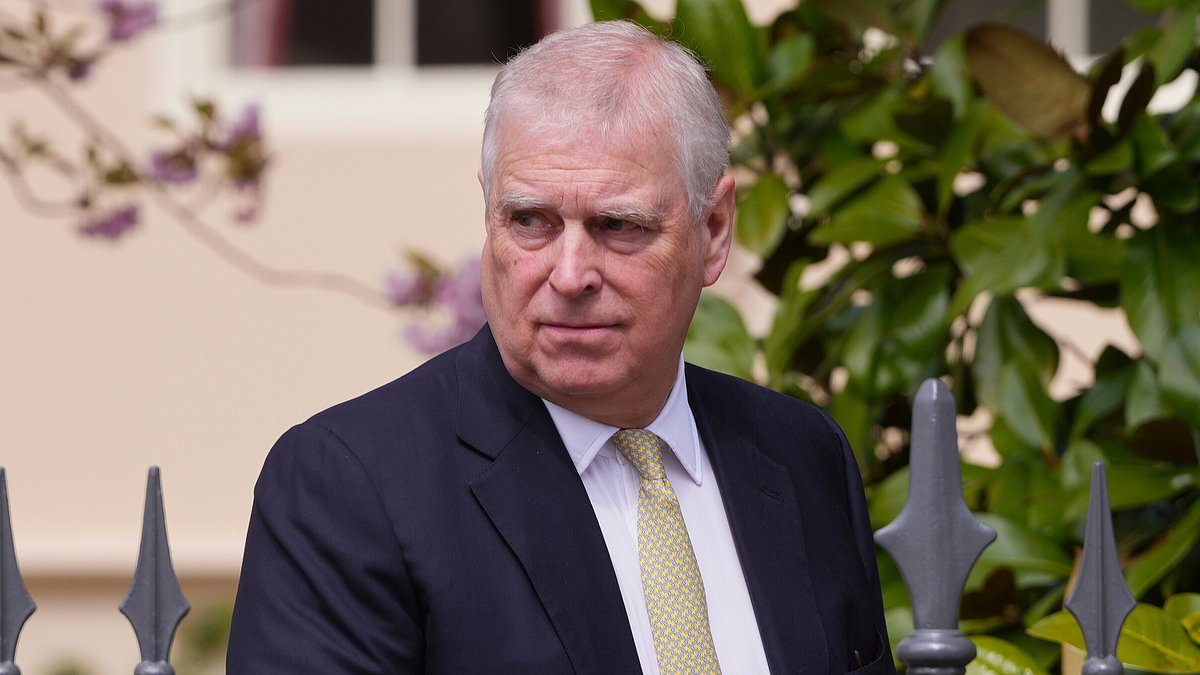
Andrew Mountbatten-Windsor (pictured in 2025) who was today arrested on suspicion of misconduct in public office

Windsor: Police officers are seen at the gates of Andrew’s former home in Berkshire, Royal Lodge

Buckinghamshire: A group of police officers in plain clothes arrive at Wood Farm this morning, where searches began
How is it proven?
In short – with difficulty, as it is open to interpretation.
Indeed only 191 people were convicted of misconduct in public office between 2014 and 2024.
Marcus Johnstone, managing director of PCD Solicitors, said authorities would ‘have to find clear evidence that Andrew knowingly abused or exploited his position’.
This, he said, ‘is easier said than done’.
For a charge to be brought, the CPS states there ‘must be a direct link between the misconduct and an abuse of those powers or responsibilities’.
Police searched Andrew’s new Wood Farm home on the Sandringham Estate and at Royal Lodge in Windsor, where he lived for more than 20 years until just over a fortnight ago.
They would have been gathering devices, files and documents they believe may be pertinent to their investigation.
Mr Johnstone added: ‘Although an investigation is now taking place, we are still a long way away from a potential prosecution.’
Can the King be called to give evidnce?
Being a member of the royal family does not offer Andrew any protection from prosecution or jail.
As the monarch, King Charles is the only royal with Sovereign immunity.
But what happens if Andrew were to later claim to have told his brother, the King, everything?
Such a defence has been used in 2002, when Paul Burrell, butler to the late Diana, Princess of Wales, was on trial for allegedly selling her possessions without her permission.
The case collapsed when Burrell said he had informed the late Queen years earlier that he was simply looking after the items – something she confirmed in a statement to police had indeed happened, collapsing the case.
If Andrew’s account were hypothetically built on the claim that ‘I told my brother everything,’ he would be effectively attempting to turn the King into a key witness for the defence.
Ruth Peters, from Olliers Solicitors, told the Mail this would present ‘a massive legal paradox’.
‘In the eyes of the law, the King is the fountain of justice,’ she said. ‘The courts are his courts – the cases are brought in his name.’
This could mean the monarch ‘cannot effectively be a witness in his own prosecution’, she said, although she admitted the legal position about whether or not it was unconstitutional for the Sovereign to give evidence in his own court was ‘unclear’.
She added: ‘If Andrew’s team can argue that the King holds evidence central to a fair trial, the court faces a Catch-22 – either uphold the ancient immunity of the Crown and potentially compromise the fairness of the trial, or break centuries of precedent by calling the Monarch to testify.
‘If Andrew asserts that he acted with the knowledge or tacit approval of his brother, he isn’t just defending a charge – he is testing the very boundaries of the British Constitution.’

Andrew Mountbatten-Windsor and Jeffrey Epstein in December 2010
What are the punishments upon conviction?
Misconduct in public office carries a maximum punishment of a life sentence, but recent examples have seen much lesser terms handed out.
This includes former Met Police officer Neil Sinclair who was sentenced to nine years in prison last year after admitting a number of serious corruption offences.
The court heard Sinclair unlawfully accessed police systems and disclosed sensitive information to members of an organised crime group.
And prison officer Linda De Sousa Abreu was sentenced to 15 months in jail after she was filmed having sex with an inmate at HMP Wandsworth.
A decade earlier, retired Bishop Peter Ball was handed a sentence of just under three years’ imprisonment after admitting indecent assault and misconduct in public office by ‘misusing his position in authority to manipulate and prevail upon others for his own sexual gratification’ involving young men.
What happens next?
The allegations date back to when Andrew was a trade envoy – a period of many years. This means police will potentially have millions of documents, messages and files to go through.
It also likely suggests it may be some time before investigators are able to piece everything together and decide whether or not there is cause to charge him.After gathering and poring over evidence, if police believe they have enough evidence to charge, they present a case file to the CPS.
The Director of Public Prosecutions, Stephen Parkinson, would then likely decide whether or not to authorise a charge against the King’s brother.

King Charles pictured with his brother in September. He has said that the police investigating his brother will have his ‘wholehearted support and co-operation’
What happens if police find evidence of other wrongdoing?
While he was arrested on suspicion of misconduct in public office, investigators may use this opportunity to look at further allegations.
The arresting force, Thames Valley Police, is also looking at an allegation that Epstein sent a woman to have sex with Andrew at Royal Lodge in 2010.
Andrew has not addressed such an accusation but has always denied wrong-doing in regards to Epstein victims.
Solicitor Mr Johnstone said police may use the raid on Andrew’s properties ‘as the basis to scrutinise his relationship with Epstein even further’.
‘His home can now be searched, and formal questions can now be put to him at interview,’ he said.
Police could spend months going over the evidence. But just because they have arrested him on suspicion of one offence, this does not mean they cannot investigate him for another. It depends where the evidence points to.