Share this @internewscast.com
After over seven decades of mystery, a scientist has successfully deciphered one of the last remaining undecoded writing systems found within the Dead Sea Scrolls.
The breakthrough involves the Cryptic B manuscripts, specifically two severely damaged fragments known as 4Q362 and 4Q363. These fragments had long been deemed ‘impossible’ to interpret due to their use of an unfamiliar alphabet.
Emmanuel Oliveiro, a researcher from the University of Groningen in the Netherlands, discovered that each cryptic symbol consistently matched letters in the Hebrew alphabet.
Once translated, the fragments unveiled recognizable biblical phrases and themes concerning the end times, including divine judgment, the arrival of a Messiah, and Israel’s ultimate fate.
Among the notable phrases are “Yisrael” (meaning ‘Israel’), as well as references to Judah, Jacob, and “Elohim” (meaning ‘God’).
These manuscripts were created by the Qumran community, a Jewish sect residing near the Dead Sea over 2,000 years ago. Renowned for preserving religious texts, their writings provide insight into early Jewish beliefs, ritual practices, and prophetic traditions.
The Dead Sea Scrolls, uncovered in caves near the West Bank between 1947 and 1956, include some of the oldest surviving biblical manuscripts, written in Hebrew, Aramaic, and occasionally Greek.
While Cryptic A was successfully deciphered in 1955, Cryptic B remained a mystery for decades. Its strange symbols, inconsistent handwriting, and tiny surviving fragments made it exceptionally difficult to decode.

The Dead Sea Scrolls, uncovered in caves near the West Bank between 1947 and 1956, include some of the oldest surviving biblical manuscripts, written in Hebrew, Aramaic, and occasionally Greek
Only two manuscripts, 4Q362 and 4Q363, use this cipher exclusively, and many pieces of these texts are damaged, with some fragments measuring just a few millimeters across.
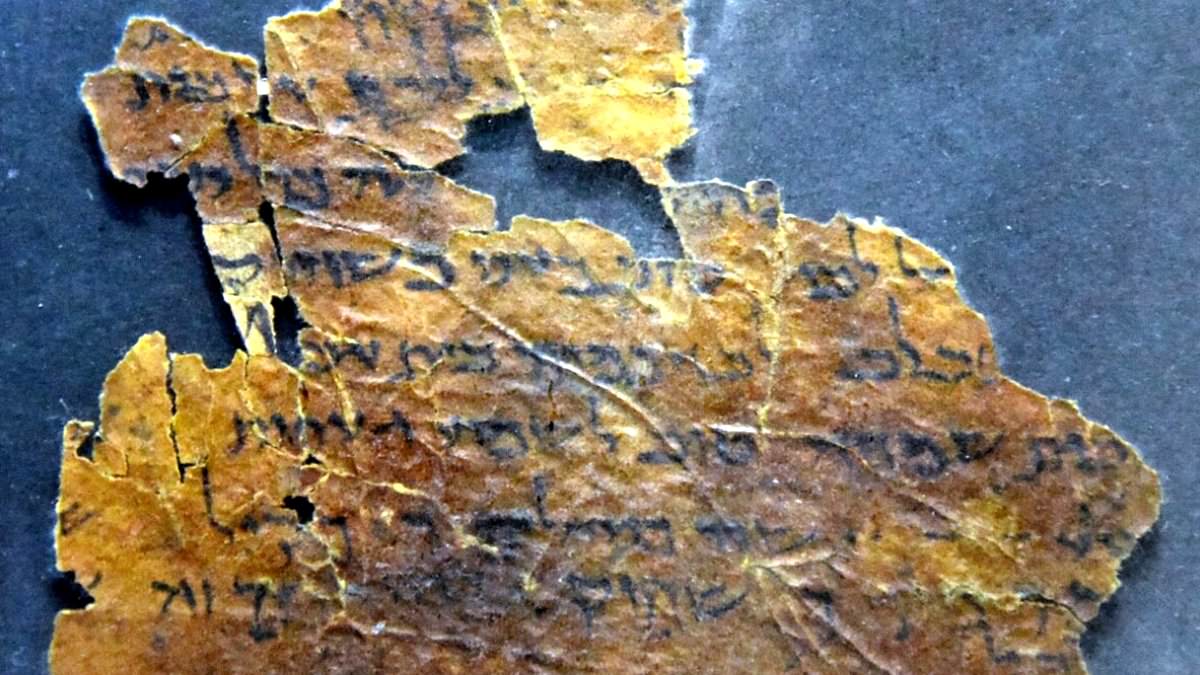
The surviving fragments are tiny, fragile and worn. The leather is cracked, darkened or frayed, and some pieces show margins, stitching holes or wrinkles.
Letters were written in black ink using fine- or medium-tipped pens, but their shapes, proportions, and spacing are inconsistent, with occasional corrections or double-tracing.
Overall, the manuscripts show significant variation both within each fragment and between the two texts, highlighting the irregular scribal execution of Cryptic B.
The content of 4Q362 appears religious in nature, employing several biblical idioms.
Fragment 21 references ‘Elohim’ and ‘your glory,’ while fragment 18 mentions ‘the tents of Jacob,’ echoing phrases found in Jeremiah 30:18 and Malachi 2:12.
In these passages, Judah also plays a role. Jeremiah 30:18, for instance, promises the restoration of Israel after judgment, with God bringing back their fortunes and rebuilding their cities, signaling hope and future renewal.
Malachi 2:12 warns against unfaithfulness in marriage, emphasizing the importance of remaining loyal to the Hebrew community.

The breakthrough centerson the so-called Cryptic B manuscripts, two heavily damaged fragments labeled 4Q362 and 4Q363 that were long considered ‘impossible’ to read because they used an unfamiliar alphabet. Pictured are pieces Pieces of Dead Sea Scroll with Cryptic B

Among the phrases is Yisrael, meaning ‘Israel’,’ (PICTURED) along with references to Judah, Jacob, and Elohim (meaning ‘God’)
While 4Q362 does not directly quote these passages, its idiomatic language and thematic focus suggest an affinity with prophetic judgments and eschatological promises in biblical traditions.
The fragments also included references to dates and rulers.
For example, the use of ‘the second year’ and ‘the fifth month’ may reflect specific historical or prophetic dating conventions, similar to those found in other biblical and sectarian texts.
One of the most enigmatic features of 4Q362 is the mention of a grave in fragments 2 and 14.
While graves appear elsewhere in the Bible, none match the details described here. Oliveiro suggested that the word for ‘signposts’ in fragment 14 could also mean a tombstone, hinting at a possible connection.
4Q363 is even more fragmentary and difficult to interpret, as a repeated phrase appears twice, though it is unclear whether it refers to ‘her daughters’ or ‘her villages.’
A common name, Benayahu, also appears, but its frequency in other texts prevents a precise identification.

Pictured is a fragments of 4Q363
The reason these messages were encoded remains uncertain, but Oliveiro proposed that the unusual scripts may have served a symbolic or ritual purpose.
By writing in an unfamiliar alphabet, the scribes could indicate that the content was intended for a select audience, such as priestly elites or scribal initiates, enhancing the text’s sacred status without altering its meaning.
The complexity of Cryptic B lies less in the cipher itself, which is relatively simple, and more in the deliberate distortion of letter shapes, which made it appear undecipherable for decades despite containing no hidden or mystical messages.