
Share this @internewscast.com
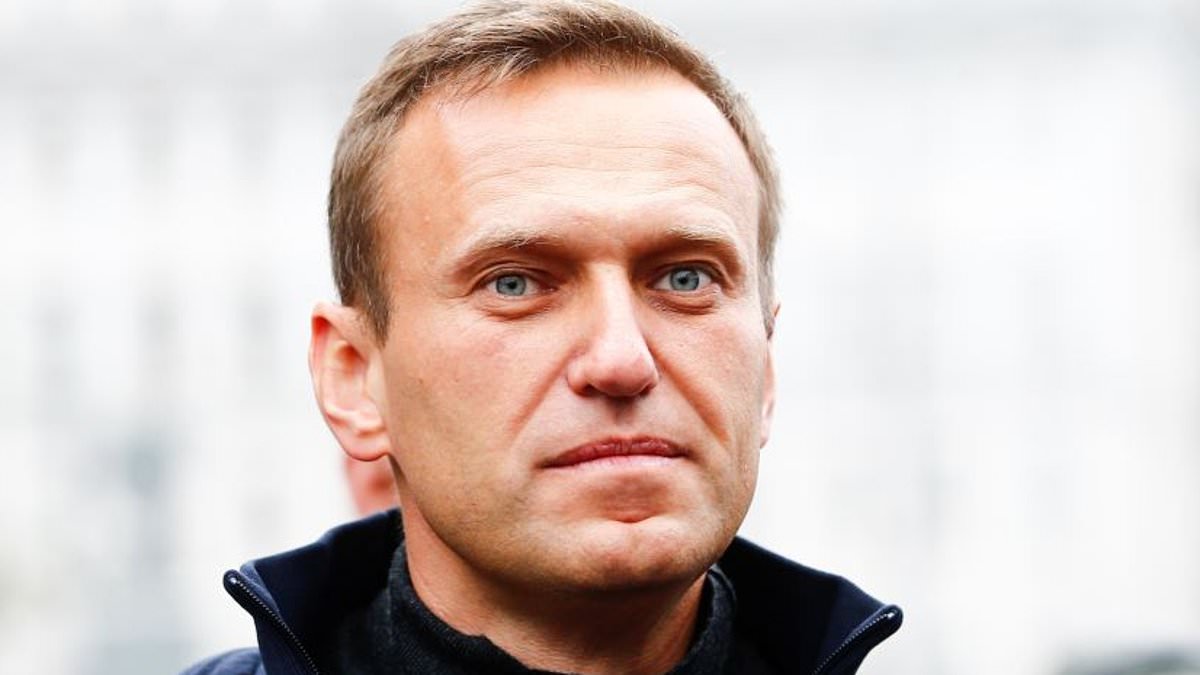
In the final images of Alexei Navalny, a thin frame and hollow eyes told the story of his time in an Arctic penal colony. Yet, the Russian opposition leader maintained a light-hearted demeanor, even quipping with the judge about needing more money during a court appearance via video link.
Tragically, just a day later in February 2024, Navalny was found dead on the floor of his prison cell, succumbing to violent vomiting in his final moments.
Contrary to the Russian authorities’ claims of a ‘natural’ death, recent revelations have confirmed what many suspected all along.
Navalny was the victim of murder—a chilling and grotesque act involving an extraordinarily potent neurotoxin derived from South American poison dart frogs.
This assassination stands out as particularly exotic, even by the dramatic standards of Vladimir Putin’s regime.
The truth emerged after Navalny’s family and allies discreetly collected samples from his body. These samples were then clandestinely transported out of Russia and analyzed in laboratories across multiple countries, ultimately shedding light on the grim reality of his demise.
Both identified the neurotoxin epibatidine, which does not occur naturally in Russia, and causes respiratory failure in tiny doses.
The use of dart frog poison raises two chilling questions. First: why use such an exotic method of murder? Second: why allow it to be discovered at all?

Russian opposition leader Alexei Navalny’s death while in detention was announced on February 16, 2024

Prior to his death, Vladimir Putin had already ordered Navalny’s assassination once before, in August 2020
Putin had already ordered Navalny’s assassination once before, in August 2020.
A team from Russia’s secret service, the FSB, poisoned him with Novichok – the same chemical agent used against Sergei Skripal in Britain.
Navalny survived only because his plane made an emergency landing and Russian doctors, unaware that he had been poisoned deliberately, treated him.
Yet Putin let Navalny and his family leave for Germany to recover, perhaps hoping that he would stay there.
Perhaps hoping, too, that the publicity the poisoning would generate in the West would sow the seeds of paranoia in those of his enemies living there.
Navalny bravely returned to Russia in January 2021 and was duly sentenced to decades in prison in a series of show trials that echoed those of the 1930s.
If the Kremlin wished to kill Navalny while imprisoned, it had easier options.
He could have been beaten to death by ‘overzealous’ guards. He could have been slowly starved. He could have been left to deteriorate physically until his body failed.
Such an outcome would have amounted to a grim, slow death. Instead, Putin – and the order for Navalny’s death would only have come from Putin – had his nemesis murdered in a uniquely theatrical and gruesome way.
This was pure, sadistic pleasure from the Russian dictator. Navalny was not merely another critic, a lawyer turned investigator whose reports into corruption cut close to Putin’s inner circle.
Navalny represented another path for Russia, broadly pro-Western and law-governed, so different from the corrupt fusion of secret police, organised crime and crony power that defines the country.

Navalny bravely returned to Russia in January 2021 and was duly sentenced to decades in prison in a series of show trials that echoed those of the 1930s. (Pictured during his imprisonment)
Putin’s murder of Navalny was a final show of disrespect, hatred and contempt, killing not only a man but also an alternative future for Russia.
Like Ivan the Terrible or Vlad the Impaler, he wants the deaths of his enemies to be special. It says much about the Russian leader’s state of mind.
But there must have been a risk that the means of death would leak? Perhaps, as with Navalny’s earlier escape to Germany, Putin was relaxed – or even wanted it.
If so, the message is blunt: if Russia cannot be loved, it will be feared.
Putin’s outlook is summed up in a Russian proverb: ‘Beat your own, so that others fear you.’
However, the announcement from Britain and European countries also sends a message.
First, the findings were revealed at the Munich Security Conference – a location heavy with symbolism.
It was here, in 2007, that Putin declared that the post-Cold War order was over and signalled Russia’s confrontational path.
To Putin, Europe is saying: we see you, we understand your chemical weapons, and we see what you represent.
We know you are breaking the Chemical Weapons Convention by developing these toxins.
To sceptics within the US, whose commitment to European security cannot be taken for granted, it reminds Donald Trump of the pernicious nature of Putin’s regime; a threat to individuals as well as to nations.
- Dr Bob Seely MBE is the author of The New Total War