
Share this @internewscast.com
As the great-grandson of one of the last iconic Inuit storytellers, James Dommek Jr knew he had a compelling narrative on his hands. Yet, he was uncertain whether it should be shared with the world.
The story was a captivating mix—a “modern-day Alaskan survival story” interwoven with local folklore and elements of true crime. It involved an attempted murder, mythical beings, and a man drawn away from his isolated Alaskan residence.
However, the tale also touched upon the deeply held beliefs of his community regarding mythical sprites, known as ‘Inukun,’ which many felt should remain undisclosed. To navigate this sensitive issue, Dommek sought and received the blessing of the community elders to share the story.
“It’s just a different world up here in the north,” Dommek explained from his home in Anchorage. “I don’t expect people from highly urbanized areas to fully grasp what I’m talking about, because they likely haven’t experienced true wilderness.”

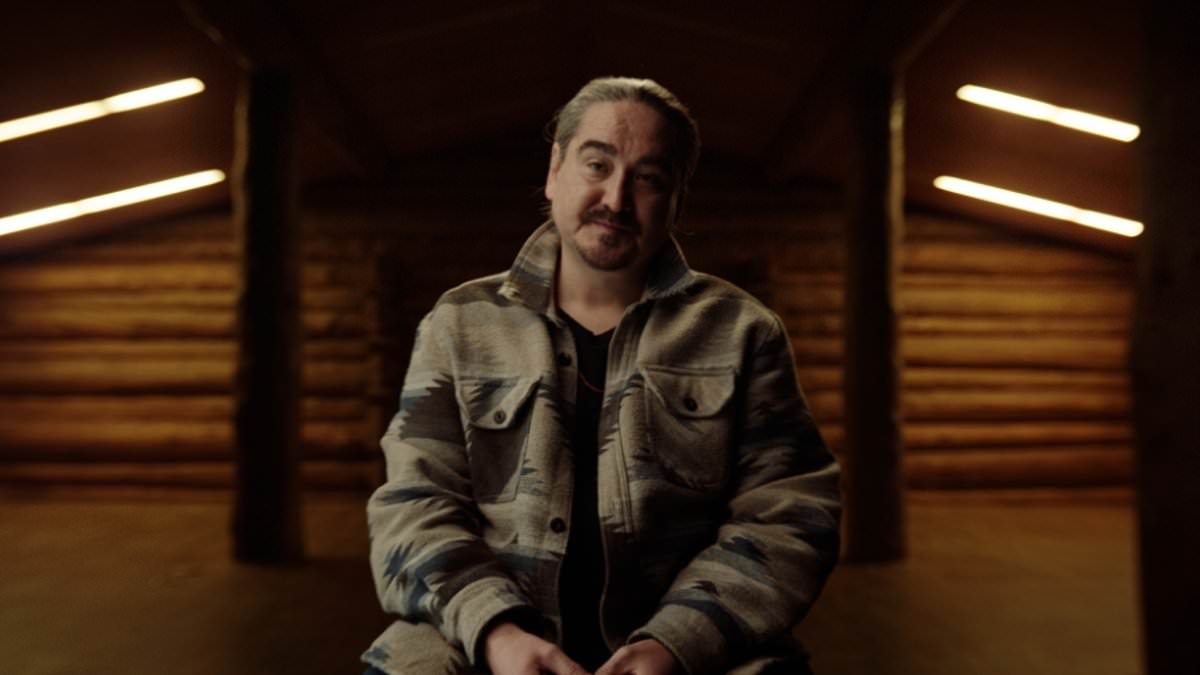
James Dommek Jr, a Native Alaskan filmmaker, said he does not expect most people to believe his story of ‘Inukuns’, or Little People

Dommek’s story is set in the Brooks Range – a vast wilderness 500 miles north of Anchorage

Pictured: Eskimos at Cape Prince in Wales, Alaska in 1925
Dommek’s documentary, “Blood and Myth,” debuted on Hulu this fall.
The documentary recounts the story of renowned local actor Teddy Kyle Smith, who was discovered near the cabin where his 74-year-old mother was found dead in 2012. He then disappeared into the sprawling forest surrounding Kiana, a small Arctic Circle village with a population of about 400, located 500 miles north of Anchorage.
Smith, 45 at the time, was known to have issues with alcohol, but insists to this day his mother died of natural causes.
Alone in the Alaskan wilds, he spent 10 days in the unforgiving terrain before encountering two hunters, who he shot and critically wounded. Arrested, Smith told police the Inukun made him to do it – and claimed he had seen them with his own eyes.
‘I finally got to see them,’ he said during his interrogation. ‘There was a lot of them out there.’
Smith told the police: ‘I didn’t want to shoot them. I had to go along with what they wanted me to do.’
The officer asked: ‘Who’s that?’
‘The wild people out there,’ Smith replied.

Teddy Kyle Smith was arrested and charged with attempting to kill two hunters in 2012

An ‘Inukshuk’, or cairn, created by Inupiat in Alaska. The land is dotted with the arrangements
Dommek believes him. And he believes in the Inukun, or ‘Little People’, as they are otherwise known. Since making the film, he has been inundated with calls and messages from others who claim, like Smith, to have actually encountered the Inukun, but have been too scared or embarrassed to admit it.
‘I’ve had so many people reach out to me – respectable, sane, intelligent, college-educated people – who have said, I’ve had this encounter, I’ve never been able to talk about it, I don’t want to lose my job, don’t use my name,’ said Dommek. ‘They’ve sent me photos.’
One particular photo, shown to the Daily Mail on the agreement not to publish it, shows a small spec of a creature in otherwise empty tundra. Dommek said it was sent to him by a family of Inupiaq, as his tribe is called, who spotted the strange sight while on their annual month-long caribou hunt in the far reaches of the Brooks Range, and took a photo with their iPhone through their rifle scope.
Dommek also spent years researching historical accounts of Inukun sightings, catalogued by outsiders who could not believe their own eyes. Europeans, lured by whaling and gold prospecting, did not arrive in Inupiaq land until the late 1880s, and to this day the region remains one of the least understood and documented of all the US.
‘I found these journals from missionaries, who are talking about the Inukun in the late 1800s,’ said Dommek. ‘I’m finding these accounts of white bush pilots who are flying these little planes. They land in the village, and they say, I saw something I can’t explain. There’s even military accounts of having encounters with, in their words, little wild men in the hills, shooting arrows at us.
‘And so my thing is: They all can’t be lying.’

Dommek, after years of trying, finally gets Smith to speak to him inside Wasilla prison

The Franklin Mountains, part of the Brooks Range, are pictured: where the Inukun may live
For over 10,000 years before the first Europeans arrived, Native Alaskan people – and their Inuit cousins in Canada, Greenland and Siberia – have told stories of the Inukun.
Known by different names among different tribes, the Inukun, as the Inupiaq call them, are said to live in cave dwellings in extremely remote reaches of the territory, but occasionally interact with modern humans.
Some claim they possess superhuman strength, and the ability to move at lightning speed. Dommek was told they are ‘shorter than a bow’ – around four feet tall.
Pygmy tribes are well documented in central Africa: a letter written by an Egyptian Pharoah, Pepi II, in 2276 BC referenced a ‘dancing dwarf of the god from the land of spirits’, and a 2016 study by researchers from University College London, Manchester Metropolitan University and the University of Malaga concluded that around 920,000 live across nine countries.
Most pygmy men are around 4ft 9 tall while the women are around three inches shorter according to an Italian geneticist, Luigi Luca Cavalli-Sforza, who spent time in the Congo Basin in the 1960s.
Dommek, for his documentary, spoke to a tribal liaison officer, Mary Black, who was helping federal Bureau of Land Management officials survey the Brooks Range for a possible new road through the area. She says she and two colleagues saw from their helicopter evidence of Inukun residences, and told the team to turn back and leave them alone – fearing the fate of uncontacted tribes in the Amazon. She refuses to say where exactly the spot was.
Dommek doesn’t worry about hoardes of tourists turning up in Kiana, hoping to catch sight of the Inukun. For one thing, he said, it’s extremely remote and expensive to get to. For another, most people would die while wandering the wilderness.
His film, he insisted, is not to convince anyone of the Inukun’s existence – even though he himself is certain. It is more to open people’s eyes to Native stories, and storytellers.
And it is bordering on arrogance, Dommek says, for us to assume everyone looks the same.
‘It almost is a genetic memory of our culture,’ he said. ‘Because at one point on this earth, there were things that were like us, but not us. I’m talking about Denisovian, I’m talking about Neanderthals.
‘A lot of the belief depends on materialism. You need material evidence. That is the Western model: I’ll believe it when I see it. The Indigenous mindset is different. We realize that there are parts of this world we do not understand all the way.
‘And we allow for that mystery.’