
Share this @internewscast.com
An Egyptologist is presenting a bold new theory suggesting that the Great Pyramids were constructed by an advanced civilization, thousands of years earlier than the commonly accepted timeline.
António Ambrósio, an independent researcher affiliated with the Autonomous University of Barcelona, has uncovered intriguing evidence that suggests the three iconic pyramids at Giza could be as old as 12,000 years, far predating the era of the ancient Egyptians.
If Ambrósio’s hypothesis is validated, it could transform our understanding of human history, revealing the presence of a mysterious ‘supercivilization’ capable of building pyramids and other monumental structures across the globe.
Central to Ambrósio’s argument are several discrepancies that he and like-minded scholars cite as evidence that the ancient Egyptians might have merely replicated the original pyramids after discovering these enigmatic structures at Giza.
This new study, which has yet to undergo peer review, points out that no royal mummies or burial artifacts have ever been discovered inside the Giza pyramids, despite claims by the ancient Egyptians that these were the final resting places of Khufu, Khafre, and Menkaure.
Furthermore, the Giza pyramids, traditionally thought to have been constructed 4,600 years ago, exhibit remarkable engineering prowess. They are aligned with star constellations, feature impeccably precise stonework, and have a base that is astonishingly level on all sides.
Ambrósio explained that these incredible engineering feats were never matched by any of the smaller pyramids confirmed to have been built during the time of the Egyptians between 2500 and 2150 BC.
The researcher added that the nearby statue of the Sphinx has shown signs of water erosion from heavy rain, which hasn’t happened in Egypt since around 5000 to 3000 BC, suggesting that the entire site was already ancient and eroding at the dawn of the Egyptian civilization in 3100 BC.

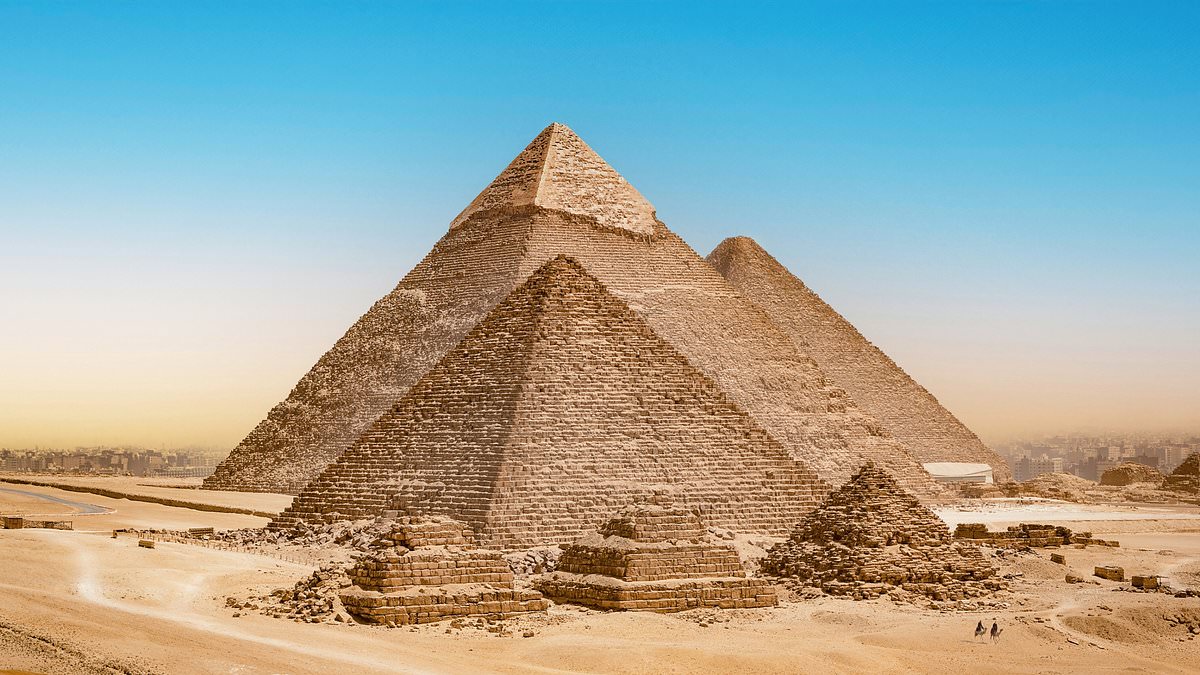
A new paper has claimed that the ancient Egyptians did not build the three main pyramids at Giza (Pictured) and only claimed them millennia after their construction

Egyptologist António Ambrósio added that erosion patterns in the Sphinx (Pictured) suggest it suffered damage from heavy rain, but the climate in Egypt has not been able to produce that kind of rain in 7,000 years
‘The pyramids of Giza were not built by the pharaohs of the Fourth Dynasty, but rather appropriated by them,’ Ambrósio stated in the paper entitled ‘The Pyramids of Giza: Legacy of an Unknown Civilization.’
‘Subsequent pyramids (and earlier ones, according to the conventional timeline) would represent imperfect attempts to imitate preexisting structures.’
Ambrósio claimed that there are no definitive ancient writings from the time directly tying the pharaohs to the construction of the pyramids.
One main link is called the Khufu cartouche, a red-ochre painted hieroglyph containing the name ‘Khufu’ inside one of the hidden chambers above the King’s Chamber in the Great Pyramid of Giza.
While many mainstream Egyptologists have concluded the painted hieroglyph is genuine, skeptics, including authors Scott Creighton and Zecharia Sitchin, have claimed this mark was faked by Colonel Howard Vyse in 1837.
‘No mummy has ever been found in the pyramids of Giza. The discovery of a supposed sarcophagus of Khufu, found empty, does not prove that he built the pyramid – only that he claimed it,’ Ambrósio declared.
While the origins of the main pyramids of Giza are still disputed, multiple studies have concluded that some of the knowledge and skill to build these mega structures was lost during Egypt’s Fifth and Sixth Dynasties.
The new paper noted that Egyptian pyramids built after Giza were noticeably smaller, contained multiple construction flaws, were made with weaker building materials and did not align with the stars.

Recent studies have measured erosion at 12 points around the base of the Great Pyramid of Khufu, suggesting it could be over 12,000 years old

Italian engineer Alberto Donini from the University of Bologna said erosion patterns at the pyramid’s base suggest it may have been built between 20,000 and 40,000 years ago, far earlier than the conventional timeline
Meanwhile, Ambrósio pointed out that mega structures similar to the Great Pyramids have been discovered across the globe, which point to the same civilization sharing their advanced building techniques with other early human cultures.
The paper specifically mentions megalithic structures that share characteristics with the Giza pyramids, including the ancient Incan citadel Sacsayhuamán in Peru and the city of Baalbek in Lebanon.
‘The pyramids of Giza may be the legacy of an unknown earlier civilization, an advanced culture that mastered lost technologies,’ Ambrósio theorized.
‘The Fourth Dynasty would have reutilized these structures, while subsequent dynasties attempted, unsuccessfully, to replicate them.’
The researcher added that the ancient Egyptians had their own mythological concept known as Zep Tepi, or ‘the First Time.’
It referred to an initial golden age when the world was created, the gods emerged from chaos, established a cosmic order, and ruled directly on Earth before human kings took over.
However, researchers such as Graham Hancock and Robert Schoch have championed the fringe theory that Zep Tepi was a real historical period where this lost civilization thrived approximately 12,000 years ago, in 10,500 BC.

Ancient symbols have been discovered in locations ranging from Turkey’s Van region to South America and Cambodia, suggesting an ancient supercivilization spanned the globe
Independent researcher Matthew LaCroix told Daily Mail that this advanced culture may have hidden a sophisticated code through geometry, symbolism, and monument design across the globe to preserve its knowledge ahead of catastrophic events.
Sparked by another recent find in Egypt, the discovery of recurring giant T-shapes, three-level indents and step pyramids carved into ancient stones worldwide, the symbols have been linked across continents to a time even older than Zep Tepi, dating back 38,000 to 40,000 years.
According to LaCroix, this civilization tracked cosmic cycles and embedded teachings about the structure of the universe into monuments and sacred sites, just as the pyramids at Giza perfectly line up underneath Orion’s Belt.