Share this @internewscast.com
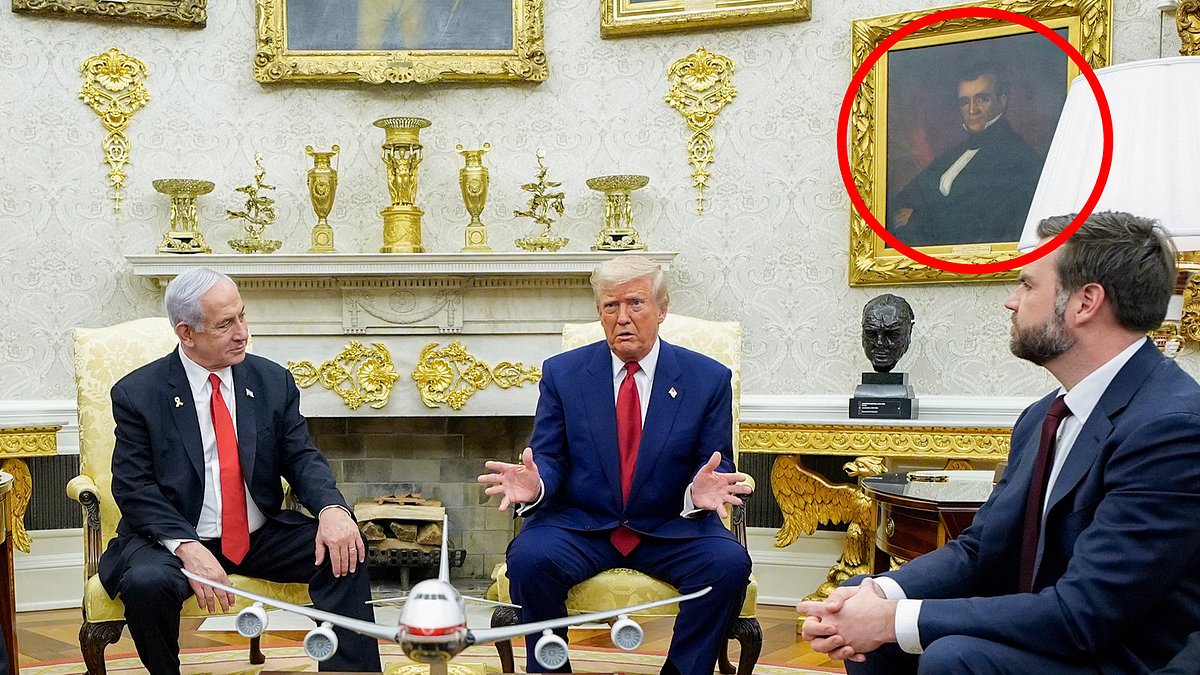
Inside the Oval Office, there lies a subtle nod to Donald Trump’s interest in acquiring Greenland.
A portrait of James Polk, the president responsible for the largest territorial expansion of the United States in the 1800s, is prominently displayed.
Last year, Trump negotiated with Speaker Mike Johnson to exchange a Thomas Jefferson portrait from the White House for a painting of Polk that was housed in the Capitol.
“He was kind of a real-estate guy,” Trump mentioned to visitors regarding his choice of decor. “He acquired a lot of land.”
This portrait, depicting a somber Polk against a shadowy background, was crafted in 1911 by Rebecca Polk, a distant relative.
Though Polk is not widely known today, much like William McKinley who is remembered for an 1890 tariff act that Trump admires, he embodies the bold expansionist spirit that the current administration hopes to highlight for Americans.
Trump on Saturday threatened eight European allies, including the UK, Germany and France, with tariffs unless they agree to let him buy Denmark’s territory Greenland.
The president perhaps believes this acquisition would be admired by Polk, who was known as the ‘Napoleon of the stump’ for his imperious style of oratory often delivered atop a tree stump.

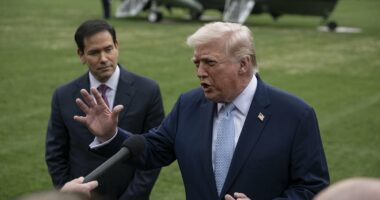
Hanging in the Oval Office is a hint at Donald Trump’s ambition to acquire Greenland. A portrait of James Polk, who oversaw the largest expansion of US territory in history during the 1800s PICTURED: Trump and Benjamin Netanyahu at a meeting on April 7, 2025

General Scott’s entrance into Mexico in the Mexican-American War

Battle of San Pasqual, a Californio victory led by General Andrés Pico against a superior American force led by General Stephen W. Kearny
Polk, the son of a wealthy Tennessee farmer, was a close friend of Andrew Jackson, who convinced him to run as the Democratic Party’s nominee in the 1844 presidential election.
Like Trump, Polk was the first dark horse nominee in American history.
During the campaign the Whigs taunted Democrats with the slogan: ‘Who is James K. Polk?’
But Polk ran an aggressive campaign, stunning the country by demanding the annexation of Texas, which had been independent of Mexico since 1836.

The portrait, featuring a brooding Polk against a dark backdrop, was painted in 1911 by Rebecca Polk, a distant relative
He also backed the annexation of Oregon, which was jointly occupied by the English. He pushed for seizure of the entire territory which extended as far north as latitude 54°40′ with the cry: ‘Fifty-four forty, or fight.’
At age 49, Polk became the youngest president up to that time.
The administration was marked by sweeping territorial gains.
The annexation of Texas sparked a two-year war with Mexico that resulted in the United States seizing a vast swath of the continent, today’s California, Nevada, Utah, Arizona, New Mexico, and parts of Colorado and Wyoming, under the 1848 Treaty of Guadalupe Hidalgo.
Polk added roughly 1.2 million square miles of land to the US, more than any other president.
The haul eclipsed even Thomas Jefferson, whose Louisiana Purchase doubled the nation’s size by acquiring around 800,000 square miles from France in 1803.
It also dwarfed William McKinley, whose turn-of-the-century empire-building added overseas islands, Puerto Rico, Guam, the Philippines, while Hawaii was annexed separately in 1898.
Polk did all this at breakneck speed in a single four-year term and never ran again.
A year into his final term, Trump appears to see Greenland as his own Polk moment, the chance to enlarge the United States in a way not seen for more than a century.

Mapa de los Estados Unidos de Méjico by John Disturnell, the 1847 map used during the negotiations for the 1848 Treaty of Guadalupe Hidalgo that officially ended the the Mexican–American War

Danish soldiers during shooting practice at an undisclosed location in Greenland on January 18
The Danish territory is bigger than Mexico and believed to sit atop reserves of oil, gold, graphite, copper, iron and rare-earth minerals.
Trump argues the island is vital to US national security, reviving the logic of predecessor Harry Truman, who called Greenland a ‘military necessity’ and quietly offered to buy it in 1946.
That logic has only sharpened as China and Russia pour resources into the Arctic, where melting ice has opened new shipping lanes and exposed vast reserves of natural resources.
Where Polk used cannon and cavalry to seize land, Trump is wielding tariffs and brinkmanship, betting he can bend NATO allies before his tenure ends.
The president has not ruled out military force.
If Trump succeeds he would eclipse every gain since Alaska in 1867 and cement his place at Polk’s side in the territorial history books.