Share this @internewscast.com

A candidate aiming to become California’s chief financial auditor has criticized a $114 million wildlife crossing project, labeling it a “bridge to nowhere” and highlighting it as a prime example of fiscal waste, cautioning taxpayers about future financial burdens.
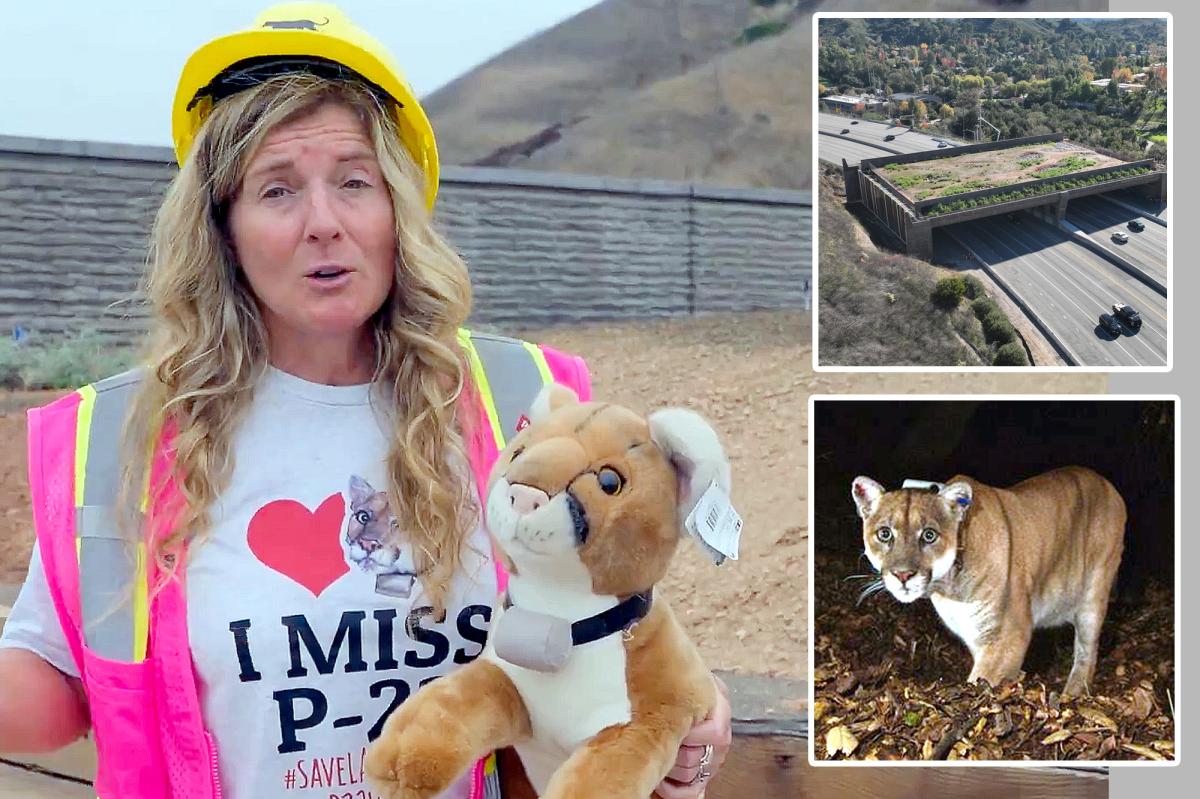
Originally introduced as a groundbreaking conservation initiative, the Wallis Annenberg Wildlife Crossing seeks to provide a safe route for animals traversing the 101 Freeway between the Santa Monica Mountains and Simi Hills.
At the project’s commencement in 2022, Governor Gavin Newsom announced California’s $54 million commitment, with an additional $10 million anticipated from philanthropists to finalize the venture.
The idea for the bridge gained momentum following the death of the “Hollywood Lion,” known as P22, who became famous after being photographed near the Hollywood sign in 2012 and later died from injuries sustained while trying to cross the 101 Freeway.
By 2025, the project’s cost had escalated to $92 million, and projections suggest it could reach $114 million, with taxpayers already shouldering $77 million—a $21 million excess.
The crossing recently gained renewed attention after an opinion piece by Christopher F. Rufo, a senior fellow at the Manhattan Institute, and investigative journalist Kenneth Schrupp went viral, exposing the project’s significant cost overruns.
Herb Morgan, who is a candidate for state controller, Californiaâs chief fiscal watchdog responsible for auditing government spending and tracking taxpayer dollars, said the bridge was a case study in Sacramento’s runaway spending.
âIf itâs not the bridge, itâs the train to nowhere. If itâs not the train to nowhere, itâs homelessness spending,â he said.
Morgan, an investment professional with nearly four decades in financial markets, says the issue goes far beyond a single bridge.
âThe bridge is just this weekâs example,â he told The Post.
The Post contacted Controller Malia Cohen for details on any audits or oversight tied to the project, but did not receive a response.
A request for comment was also sent to the governorâs office.
While not dismissing the value in the wildlife crossing, Morgan zeroed in on both the price tag, and the lack of accountability about spending, with the bridge set to be the most expensive ever built in California.
âIf the legislature believes a wildlife bridge is a good thing, I actually agree,â he said. âBut you donât need to spend $114 million.â
Wallis Annenberg Wildlife Crossing’s spokeswoman and environmental activist Beth Pratt took to Facebook to argue that commentary about the bridge missed ”missed key facts and painted an incomplete picture.”
âThe cost increases we experienced are consistent with increases construction projects are facing across the country,â she wrote, citing federal data showing highway construction costs have jumped 67% since 2021.
She also rejected alternatives like relocating mountain lions and downplayed delays, saying the project had faced setback tied to record flooding but was ”now back on track.”
However, Morgan says the spending oversight gap is statewide and needs to be closely looked at.
âWeâre pretty good at pushing money out the door in California,â he said. âBut what we fail to do is hold the recipients of that money accountable.â
Morgan said he recently spoke with two mayors from mid-sized cities and pressed them on oversight.
âHave you ever been audited or contacted by the State Controllerâs Office?ââ Morgan said. âBoth said no.â
He says nonprofits receiving state money are operating under the same radar. âIâve talked to several NGOs,â Morgan said. âNever verify. Never required proof.â
âIn the private sector, if Iâm on a board and serve on the audit committee, it takes six to eight months working with management and auditors to ensure the books are clean,â he said.
âIn the public sector, that doesnât happen.â
Morgan says the authority to crack down already exists, but isnât being used.
âWhat we lack is the will to stop theft.â
He points to fraud cases tied to public spending, arguing the pattern is bigger than any one project.
âWhen I looked at recent cases, none were prosecuted by the state attorney general, all were federal,â he said. âOn average, about 70% of the funds were taken.â
To Morgan, the wildlife crossing isnât just a bridge. Itâs a spotlight. A high-profile project. A ballooning price tag. And, he says, a system that spends first, and asks questions later.
âIâm sure labor agreements and special interests were all over that bridge project,â he said. Itâs a broken business model.â