
Share this @internewscast.com

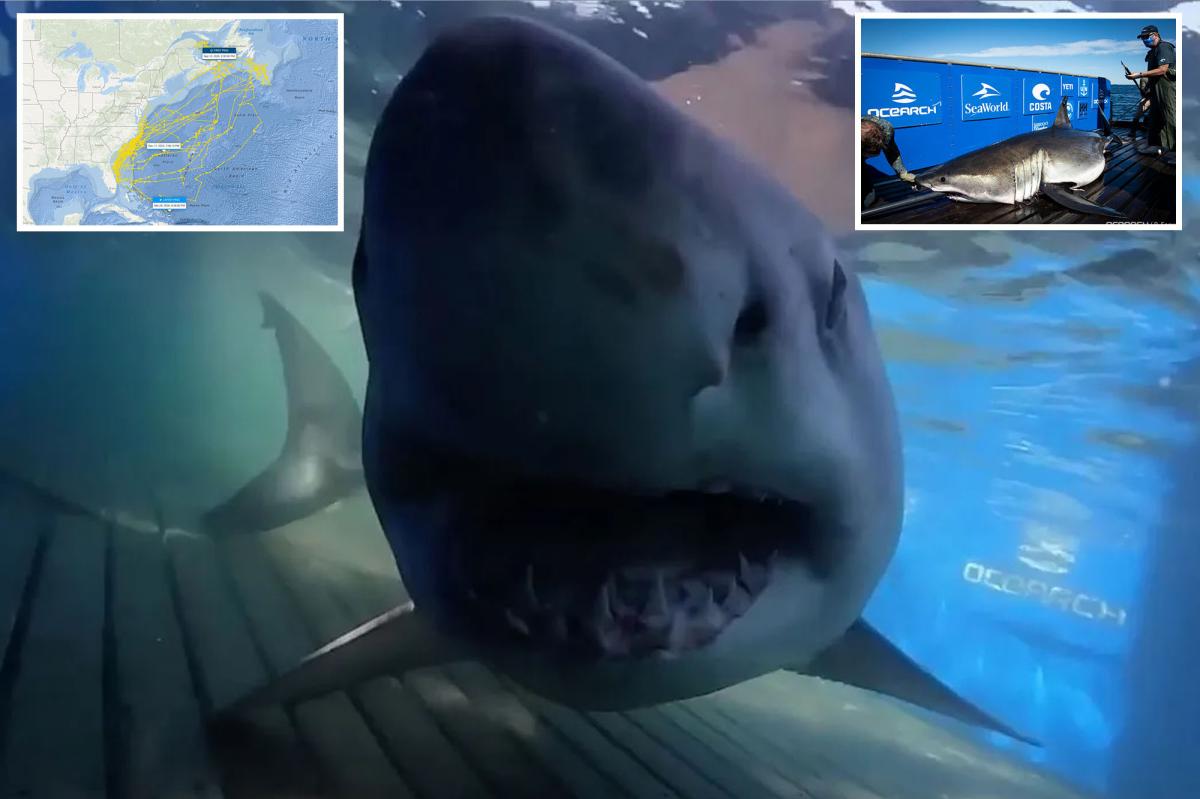
In a remarkable journey that has captivated marine researchers and enthusiasts alike, Breton, a great white shark monitored by OCEARCH, has traveled a staggering distance since his tagging in September 2020. Recently, Breton made headlines with a ping on March 29th that positioned him roughly 104 miles from Grand Turk Island in the Turks and Caicos, marking his venture into uncharted waters.
This latest milestone is significant as it marks the farthest southern point reached by any great white shark tagged by OCEARCH from the western North Atlantic population, venturing into the West Indies region.
Breton’s journey began during OCEARCH’s Expedition Nova Scotia, where he was tagged off Scatarie Island on September 11, 2020. At the time of his tagging, Breton measured an impressive 13 feet, 3 inches, and tipped the scales at 1,437 pounds.
On social media platform X, OCEARCH celebrated this achievement, noting, “His SPOT tag is still sending locations, well beyond the typical lifespan of most tags.” This is noteworthy because SPOT tags, which are affixed to the shark’s dorsal fin, provide near real-time location data but generally have a lifespan of around five years.
Breton holds the distinction of being the first shark tagged during the 2020 Expedition Nova Scotia and was named in tribute to the people of Cape Breton, reflecting the area where he was tagged. His extraordinary journey continues to shed light on the migratory patterns of these majestic creatures.
Breton was the first shark tagged during OCEARCH’s 2020 Expedition Nova Scotia and was named in honor of the people of Cape Breton, near where he was tagged.
He is the fifth shark OCEARCH has tagged on the Island over two years of research in the area, supporting evidence that the region may provide consistent access to white sharks.
His name, chosen by OCEARCH partner SeaWorld, honors the people of Cape Breton and reflects the organization’s support for wildlife rescue, rehabilitation, and ocean health initiatives.
Before his southernmost trek, he was spotted off the coast of Georgia on March 3, but over the past five years, he has also been tracked throughout the North Atlantic, from New Brunswick to Newfoundland, Canada, among other locations.