
Share this @internewscast.com
Here’s everything you need to know about the crew’s return to Earth on Friday, April 10.
WASHINGTON — As the Artemis II mission draws to a close, the four astronauts are gearing up for their journey back to Earth on Friday, April 10.
With this groundbreaking mission setting records and capturing breathtaking images of our lunar neighbor, NASA’s ground teams are meticulously preparing for the splashdown.
The crew, consisting of NASA astronauts Reid Wiseman, Victor Glover, Christina Koch, and Canadian Space Agency astronaut Jeremy Hansen, went over re-entry procedures on Thursday. They are set to make a trajectory correction burn in the evening.
According to NASA, Orion’s thrusters will perform a second correction burn at 9:53 p.m. ET, ensuring the crew’s precise path back to Earth.
NASA officials have been cautious about sharing risk assessments for the nearly 10-day mission, citing the launch and re-entry as the most significant challenges.
“We’re down to the wire now,” said NASA’s Lakiesha Hawkins. “We’re down to the end of the mission, and obviously getting the crew back home and getting them landed safely, is a significant part of the risk that’s still in front of us.”
What time will Artemis II splashdown?
NASA expects Orion’s re-entry and splashdown off the San Diego Coast at 8:07 p.m. ET.
How will Artemis II return? A breakdown of the dynamic and dangerous re-entry
Orion’s re-entry to Earth will be as dynamic and dangerous as liftoff, as Mission Control pays close attention to how the capsule’s heat shield holds up.
The recovery ship, USS John P. Murtha, was already at sea off the coast of San Diego, with a squadron of military planes and helicopters poised to join the operation.
It’s the first time that NASA and the Defense Department have teamed up for a lunar crew’s reentry since Apollo 17 in 1972. Their Orion capsule will come screaming back, hitting the atmosphere at a predicted 34,965 feet (10,657 meters) per second — or 23,840 mph (38,367 kph) — not a record but still mind-bogglingly fast.
During the only other Orion test flight to the moon — in 2022 without a crew — the heat shield suffered considerably more damage than expected from the 5,000 degrees Fahrenheit (2,760 degrees Celsius) of reentry. Instead of replacing Artemis II’s heat shield, which would have forced another lengthy delay, NASA tweaked the capsule’s descent through the atmosphere to reduce the blisteringly hot exposure. Next year’s Artemis III and beyond will fly with redesigned heat shields.
Here is the key timeline for re-entry, descent and splashdown:
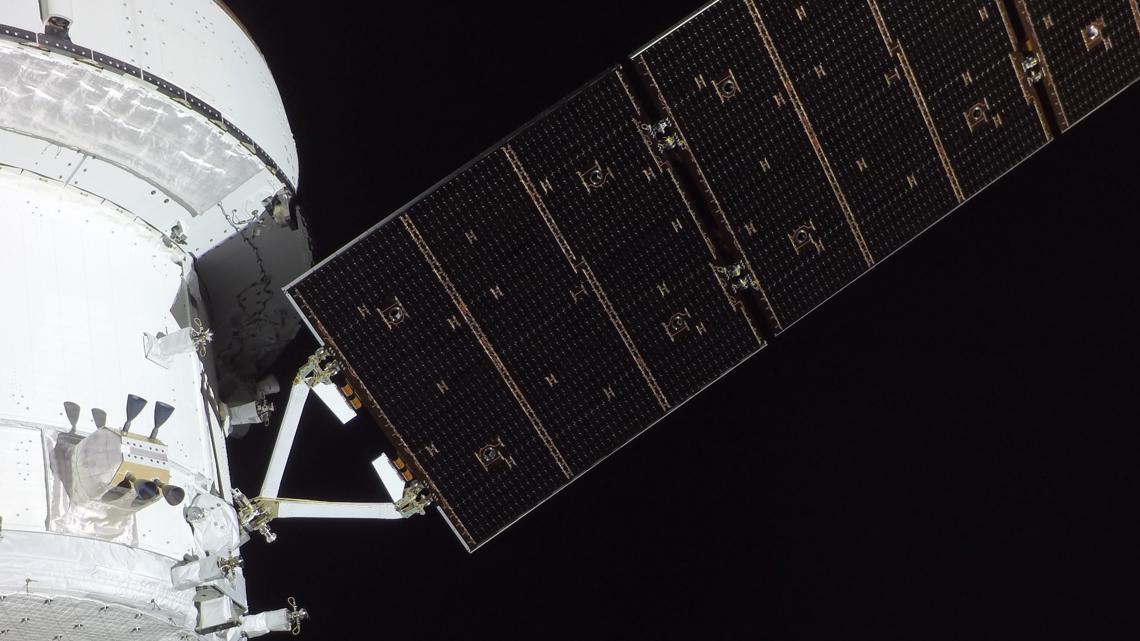
About 42 minutes before splashdown, the crew module and service module will separate. After the separation, the crew will do a final trajectory-adjustment burn, if needed, to fine-tune the path for re-entry
Orion will enter the Earth’s atmosphere at about 400,000 feet high, just 13 minutes before splashdown. During this period, the spacecraft will enter a six-minute communications blackout as it reaches peak heating.
According to NASA, the team will experience up to 3.9 Gs in a nominal landing profile, meaning if everything goes according to plan. The crew will feel 3.9 times their normal body weight during this period.
Following the six-minute communication loss, the spacecraft will deploy its drogue parachutes near 22,000 feet and then three more main parachutes around 6,000 feet to slow the capsule for its splashdown in the Pacific Ocean.
Two hours after splashdown, the U.S. military will extract the Orion spacecraft via helicopter and fly it to the USS John P. Murtha. Once aboard the ship, the four astronauts will undergo medical evaluations before returning to shore to head to NASA’s Johnson Space Center in Houston.

How to watch Artemis II crew return to Earth?
NASA will stream live coverage of the crew’s return on Friday, April 10, starting at 6:30 p.m. Coverage will also be aired on Amazon Prime Video, Apple TV, Netflix, HBO Max, Discovery+, Peacock and Roku.
Live mission coverage is also available on NASA’s official YouTube page.
What’s next for the Artemis missions?
Artemis III will see astronauts practice docking their capsule with a lunar lander or two in orbit around Earth. Artemis IV in 2028 will attempt to land two astronauts near the moon’s south pole, setting the stage for what NASA hopes will be a sustainable lunar base.
The Associated Press contributed to this report.