Share this @internewscast.com

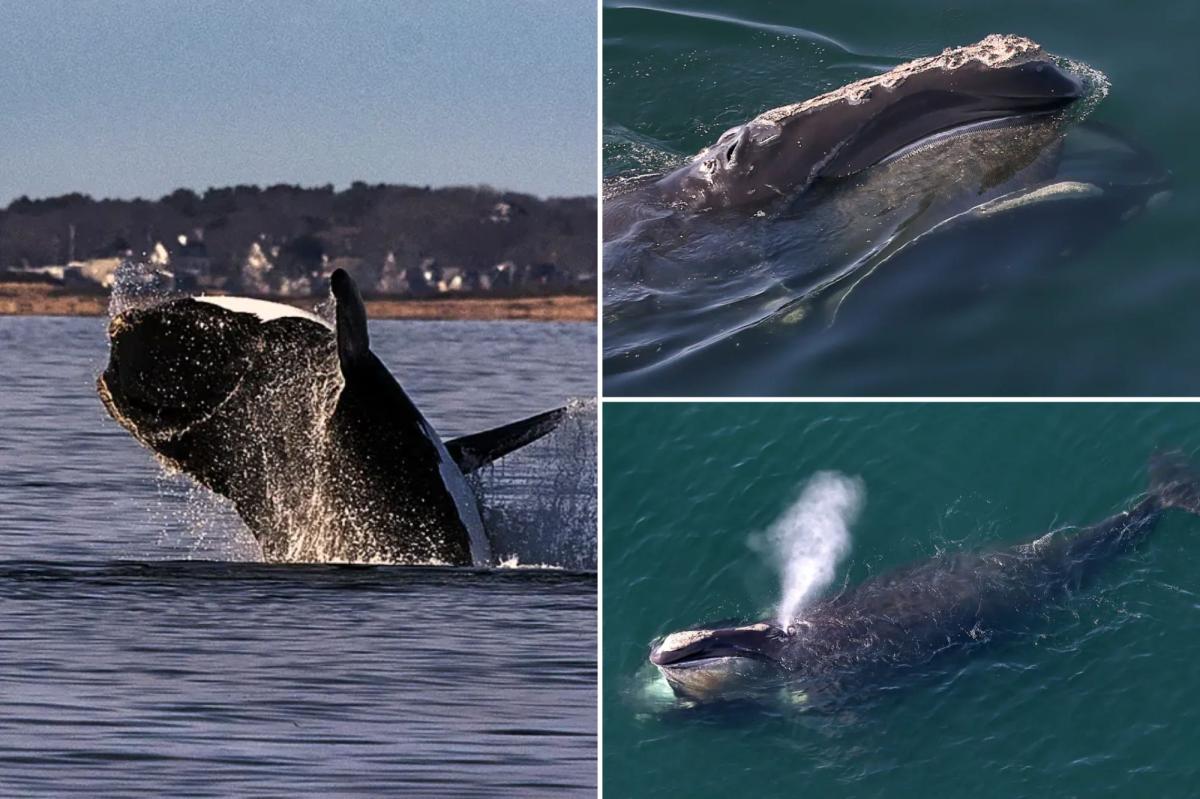
This week, the rare and endangered North Atlantic right whales made an appearance off the shores of Ocean City, Maryland, prompting officials to issue a crucial advisory.
The majestic creatures were sighted to the east of this popular beach destination.
As a response, Maryland’s Fishing and Boating Services has urged locals and seafarers alike to exercise heightened vigilance when navigating these waters.
The National Oceanic and Atmospheric Administration (NOAA) Fisheries highlights that these whales are particularly vulnerable to collisions with vessels, as they frequently linger near the water’s surface.
NOAA identifies vessel strikes and entanglement in fishing gear as the most significant threats to these whales, noting that approximately 86% of them encounter entanglement at least once in their lives.
Spotting right whales from a boat can be challenging due to their dark skin and the absence of a dorsal fin. Additionally, adverse environmental factors such as inclement weather, choppy seas, cloudy water, and dim lighting can further hinder a boater’s ability to detect these marine giants.
To help prevent injuries and deaths, NOAA has implemented vessel seasonal management plans in several states along the East Coast to reduce the likelihood of collisions with these animals.
These collisions can lead to serious injury or death.
During these periods, vessels measuring 65 feet or longer must travel at speeds of 10 knots or fewer in designated areas.
Each region has different timeframes when the plan is in effect.
For example, the Cape Cod Bay and Mid-Atlantic seasonal management areas run from Jan. 1 through May 15, while the Southeast region is in effect from Nov. 15 through April 15.
In addition to these measures, certain areas follow the Slow Zones program created by NOAA Fisheries. These zones notify vessel operators to reduce speeds after a right whale has been detected nearby.
For a period of 15 days after a sighting, boaters are encouraged to avoid the area or reduce speeds to 10 knots or fewer while traveling in the area.
The Ocean City slow zone is currently in effect through March 23.
According to the New England Aquarium, the North Atlantic right whale is one of the rarest whale species in the world.
In the early 1890s, commercial whalers had hunted the animal to the brink of extinction, according to NOAA.
They are typically seen off the coast of New England and Canada, but during the fall, they can be found swimming off the coast of South Carolina, Georgia, and northeastern Florida.