
A Democratic representative is facing criticism after revealing she communicated with foreign diplomats about providing oil to Cuba, despite existing U.S. sanctions. She defended her actions, asserting it was both “our right and responsibility” to engage in such discussions.
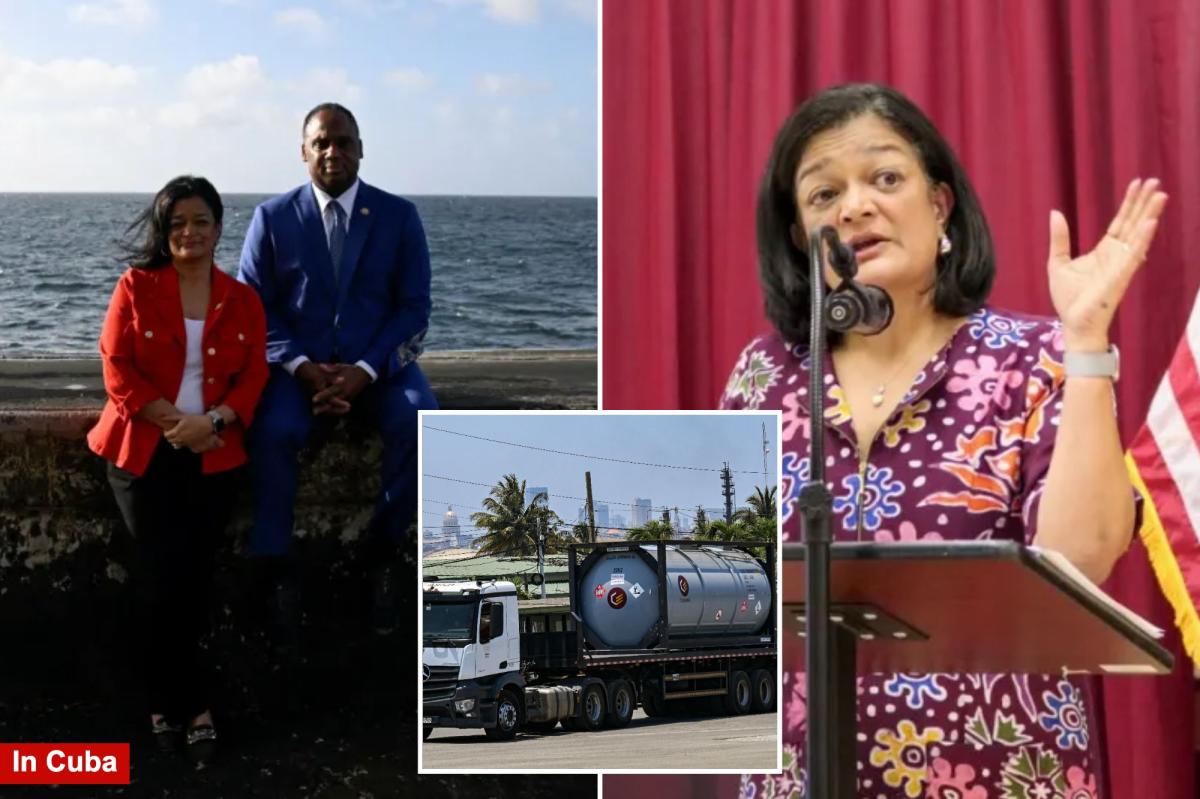
Rep. Pramila Jayapal, who represents Washington, made these comments during a recent briefing in Seattle. This followed her participation in a congressional delegation’s visit to Cuba, where she addressed the island nation’s escalating fuel shortages and the impact of U.S. policies on the communist government.
In the briefing, Jayapal shared, “I had conversations with ambassadors from Mexico and other countries, exploring ways to supply oil to Cuba.” She described the fuel crisis in Cuba as “a crisis beyond imagination.”
The briefing was part of Jayapal’s efforts to shed light on the humanitarian conditions in Cuba, following her visit to the country.
“As you’re aware, I visited Cuba last month with a congressional delegation,” she stated. “It’s part of my duty to assess how U.S. foreign policy affects the inhabitants of nations where such policies are enacted.”
During her trip, Jayapal engaged with various stakeholders, including Cuban President Miguel Díaz-Canel, high-ranking government officials, political dissidents, civil society organizations, and international diplomats.
Video of the remarks circulated widely on X, where users criticized the progressive lawmaker’s comments and raised legal concerns.
Conservative accounts amplified the clip, including End Wokeness, which claimed she was “conspiring against the US” and suggested her actions could constitute a federal felony.
Libs of TikTok wrote that her actions “seems a little like treason to me.”
Social media users also pointed to potential legal implications. “Traitor. She should be prosecuted,” wrote “The Charlie Kirk Show” executive producer Andrew Kolvet on X.
Those claims are political commentary and have not been independently verified, and no investigation or charges have been publicly announced.
Jayapal responded to the backlash in a post on X, writing, “Breaking news: Members of Congress meet with ambassadors of other countries every day. That’s literally our right and responsibility.”
Her remarks came as she sharply criticized US sanctions on Cuba, describing them as “economic bombing of the infrastructure.”
“It is illegal. It is against the law,” she said. “This is essentially doing the same thing. It is bombing the infrastructure of Cuba with economic sanctions that essentially ensure that the infrastructure collapses.”
The controversy has also prompted discussion of the Logan Act, a rarely used federal law that bars unauthorized individuals from negotiating with foreign governments in disputes involving the United States.
Andrew McCarthy, a former federal prosecutor, told Fox News Digital the statute has never resulted in a conviction and has been used only sparingly in US history.
“There has never been a conviction under it — in fact, there have only been two indictments, the last one about 174 years ago,” McCarthy said.
He added that any potential legal exposure would depend on whether a lawmaker took concrete action that violated US sanctions.
“There would be no criminal case … unless it can be shown that she took some action that violated, or aided and abetted a violation of, the sanctions,” McCarthy said.
He argued disputes over engagement with foreign governments are more appropriately handled through political accountability rather than criminal law.
The Trump administration has previously described the Cuban government as a national security concern due to its ties to adversarial countries and actors, including relationships with Iran and alleged links to groups such as Hezbollah.
The Cuban government has also faced longstanding criticism over political repression and restrictions on free speech.
The island’s economic conditions have contributed to a surge in migration, with hundreds of thousands of Cubans arriving in the United States in recent years.
Jayapal, who traveled to Cuba in April with Rep. Jonathan Jackson, D-Ill., has argued US policy is worsening conditions for civilians on the island while also acknowledging concerns with the Cuban government.
“I do also have criticisms of the Cuban government … In our meetings, I have always raised those,” she said, referencing issues including political prisoners and limits on dissent.
“The Cuban government has sent many signals that this is a new moment for the country,” Jayapal said in a statement following the trip, adding that US restrictions on fuel amount to “cruel collective punishment.”
She has called for lifting the US embargo and removing Cuba from the State Sponsor of Terrorism list, while backing legislation to block potential US military action against the country.
Fox News Digital has reached out to Jayapal’s office, the White House and the State Department for comment.