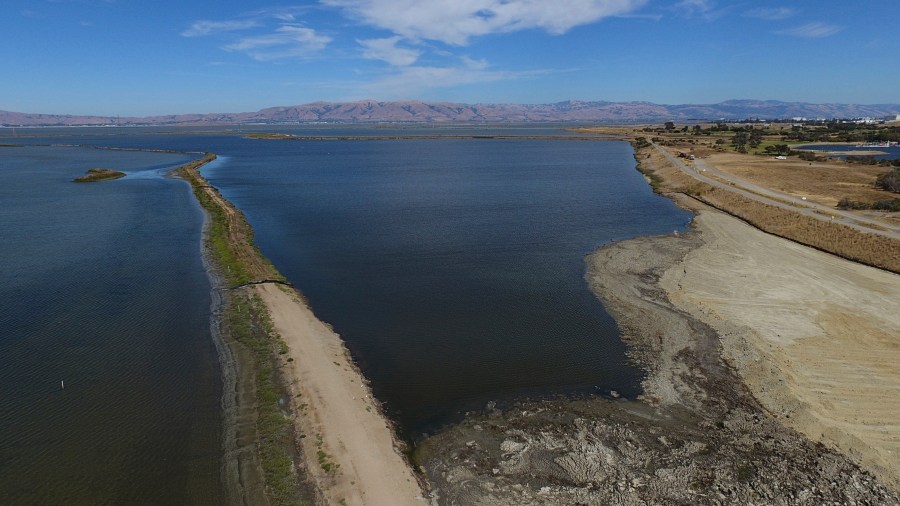


In San Francisco Bay, salt ponds established over a century ago are transforming back into marshland. Meanwhile, the coasts of New York and New Jersey have seen beaches battered by Superstorm Sandy undergo substantial restoration. Similarly, in Alabama, a reconstructed landform is serving as a protective barrier for a historic town while also offering a habitat for wildlife.
Across the nation, coastal communities are intensifying their efforts to combat the threats posed by rising seas, higher tides, and more powerful storm surges that are eroding coastlines, encroaching saltwater further inland, and endangering ecosystems and communities.
This month, the urgency of coastal restoration was highlighted when Louisiana officials halted a $3 billion initiative due to opposition from the fishing industry and escalating costs. The Mid-Barataria endeavor was intended to restore over 20 square miles (32 square kilometers) of land in roughly 50 years by redirecting sediment-rich water from the Mississippi River.
Nevertheless, numerous other projects persist in Louisiana and throughout the nation, focusing on barrier islands, saltwater marshes, shellfish reefs, and other natural features that initially provided defense before being eliminated or degraded by development. Communities are also constructing flood walls, berms, and levees to safeguard regions lacking sufficient natural defenses.
The necessity of this work has become increasingly urgent as climate change generates more severe and destructive storms and contributes to sea-level rise that endangers hundreds of communities and tens of millions of individuals, according to scientists.
“We need to enhance the resilience of these coastlines as quickly as possible,” stated Doug George, a geological oceanographer at the National Oceanic and Atmospheric Administration.
Gulf Coast
In the U.S., perhaps nowhere is more vulnerable than the hurricane-prone Gulf Coast. Louisiana alone has lost more than 2,000 square miles (5,180 square kilometers) of coastline — more than any other state — over the past century, according to the U.S. Geological Survey.
Historically, sediment deposited by the Mississippi and other rivers rebuilt land and nourished shore-buffering marshes. But that function was disrupted by the construction of channels and levees, along with other development.
The dangers were magnified in 2005 when Hurricane Katrina breached flood walls and levees, submerging 80% of New Orleans and killing almost 1,400 people — followed closely by Hurricane Rita.
Afterward, the state formed the Coastal Protection and Restoration Authority to lessen risks from storm surges and stem land loss.
Most of the almost $18 billion spent in the past 20 years was to shore up levees, flood walls and other structures, the authority said.
Dozens of other projects are completed, planned or underway, including rebuilding marshes and other habitat with sediment dredged from waterways and restoring river flow to areas that have lacked it for years.
On Louisiana’s Chandeleur Islands, a barrier island chain, the state will pump in sand to help rebuild them, which will dampen storm surges and benefit sea turtles and other wildlife, said Katie Freer-Leonards, who leads development of the state’s 2029 coastal master plan.
The authority is digging a channel to allow water and sediment from the Mississippi River to flow into part of Maurepas Swamp, a roughly 218-square-mile forested wetland northwest of New Orleans that has been “dying for over a century” because of levees, project manager Brad Miller said.
Sediment dredged from elsewhere also has been pumped into thousands of acres of sinking marshes to nourish them and raise their levels.
The same is happening in other states.
In Bayou La Batre, Alabama — a fishing village built in the late 1700s — The Nature Conservancy built breakwaters offshore, then pumped in sediment and built ridges, now covered with vegetation. That created a “speed bump” that has helped protect the town from erosion, said Judy Haner, the Alabama Nature Conservancy’s coastal programs director.
The conservancy and others also have been creating miles of oyster reefs, and are acquiring tracts of land away from the coast to allow habitats to move as seawater encroaches.
Such efforts won’t prevent all land losses, but in Louisiana, “cumulatively, they could make a big difference,” said Denise Reed, a research scientist who is working on Louisiana’s coastal master plan. “It could buy us some time.”
Pacific Coast
On the West Coast, communities vulnerable to sea-level rise also could see more flooding from increasingly intense atmospheric rivers, which carry water vapor from the ocean and dump huge amounts of rain in a short period of time.
So tidal marshes and estuaries drained for agriculture and industry are being restored along the entire coast, both for habitat and coastal protection.
Habitat restoration, not climate change, was the primary consideration when planning began about 20 years ago to restore marshland along the south end of San Francisco Bay, destroyed when ponds were created to harvest sea salt.
But as sediment naturally fills in ponds and marsh plants return, “we’re realizing that … marshes absorb wave energy, storm surge and the force of high tides,” said Dave Halsing, executive project manager at the California State Coastal Conservancy.
That helps protect whatever is behind them, including sea walls and land that otherwise could be inundated or washed away, including some of California’s most expensive real estate, near Silicon Valley.
Projects also are underway along Alaska’s coast and in Hawaii, where native residents are rebuilding ancient rocky enclosures originally intended to trap fish, but which also protect against storm surge.
Atlantic Coast
Thirteen years after Superstorm Sandy swamped the Atlantic coast, communities still are restoring natural buffers and building other protective structures.
Sandy began as a fairly routine hurricane in the fall of 2012 before merging with other storms, stretching for a record 1,000 miles and pushing enormous amounts of ocean water into coastal communities.
But the threat of future storm surges could be even greater because sea levels in some areas could rise as much as three feet within 50 years, said Donald E. Cresitello, a coastal engineer and senior coastal planner for the U.S. Army Corps of Engineers.
The Corps rebuilt beaches, dunes and human-made structures from Massachusetts to Virginia and now is turning to areas farther inland that are increasingly vulnerable to more powerful storm surges, Cresitello said.
“If there’s a river coming to the coast, that storm surge has the potential to just ride up that river,” depending on the storm, he said.
A “phenomenal amount” of the U.S. population lives and works along its coasts, so protecting those areas is important to the U.S. economy, said George, the NOAA scientist. But it is also important to preserve generations of culture, he said.
“When you think about why people should care … it’s a whole way of life,” George said.
___
Associated Press Video Journalist Stephen Smith contributed to this report.
___
The Associated Press’ climate and environmental coverage receives financial support from multiple private foundations. AP is solely responsible for all content. Find AP’s standards for working with philanthropies, a list of supporters and funded coverage areas at AP.org.


