
Share this @internewscast.com
Jeffrey Epstein’s death on August 9, 2019, remains a stark symbol of institutional corruption. The official narrative of suicide crumbles under the weight of relentless inconsistencies.
The Department of Justice (DOJ) has unveiled a disturbing revelation regarding the night Jeffrey Epstein died: a mysterious “orange-colored shape” was observed ascending the stairs toward his cell. This isn’t merely an odd incident; it represents a stark admission that raises suspicions about a potential cover-up, highlighting how federal agencies might undermine public confidence and the justice system.

The Unanswered Questions: Suicide, Murder, or Escape?
Understandably, Americans remain skeptical of the official narrative surrounding Epstein’s death. Three predominant theories circulate: Epstein committed suicide; under Bill Barr’s leadership, the DOJ orchestrated his murder while in custody; or Epstein was clandestinely replaced with a stand-in. Bill Barr had a historical connection to Epstein, having hired him to teach in the 1970s. Critics highlight inconsistencies between Epstein’s body and his known physical traits. This recent DOJ disclosure only magnifies the public’s discontent.
The Orange Flash: DOJ’s Latest Contradiction
Dan Bongino, a former FBI director, claimed, “There’s video clear as day, he’s the only person in there and the only person coming out. You can see it.” However, the DOJ’s newly released documents describe surveillance footage from the night Epstein died. This footage reveals an “orange-colored shape” advancing up a staircase toward Epstein’s secluded cell at approximately 10:39 p.m. Initially reported last August, the DOJ now offers a questionable explanation for this “orange flash.”

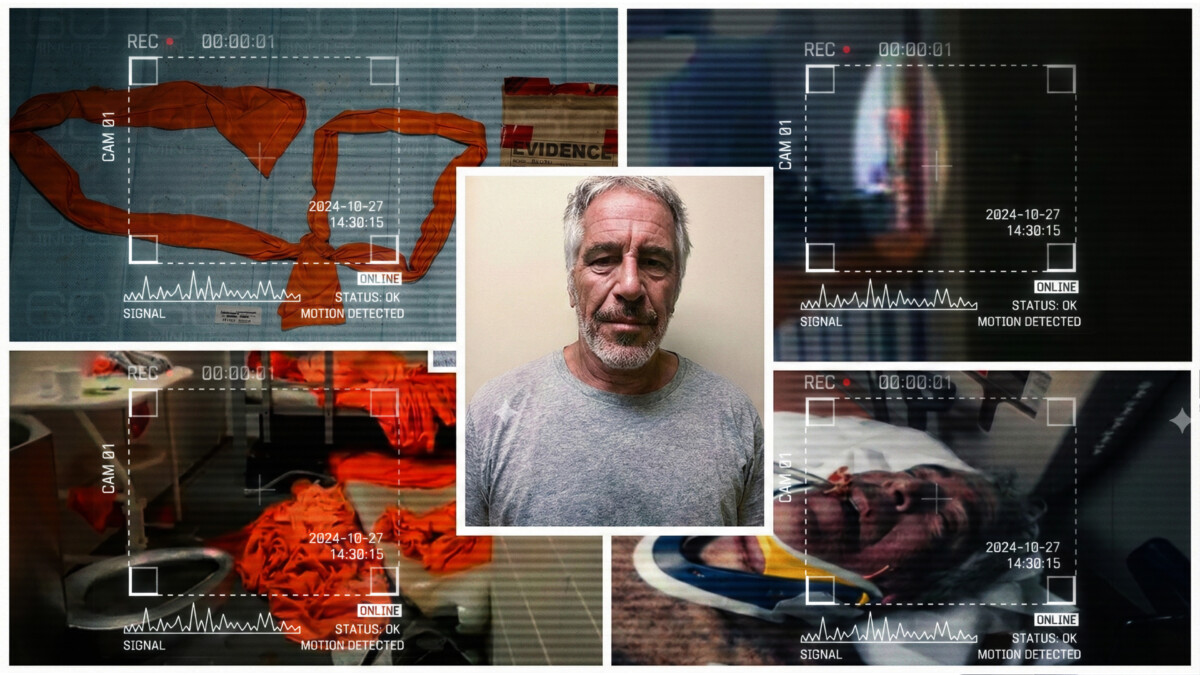
An entry in the observation log from the Metropolitan Correctional Center discloses a detail previously kept from the public: “A flash of orange looks to be going up the L Tier stairs — could possibly be an inmate escorted up to that Tier.” After examining the video, FBI and DOJ’s Office of Inspector General investigators reached different conclusions.
The FBI memorandum documented this observation, while the inspector general described the shape as an officer carrying orange “linen or bedding,” identifying the individual as an “unidentified [corrections officer].” Yet, the officers on duty asserted they did not change any linens, as the previous shift had managed that task. Such discrepancies cast doubt on the official account, suggesting a cover-up effort. CBS News also highlighted these inconsistencies.

The Missing Noose and Falsified Records: A Systemic Deception
Although officially Epstein’s death was ruled a suicide before 6:30 a.m., the noose he allegedly used was never recovered. Investigators inquired about the noose with the officers involved. One officer admitted, “I don’t recall taking the noose off. I really don’t. I don’t recall taking the thing from around his neck.”

Another officer saw a colleague lower Epstein to the floor but confirmed no noose was visible. The noose Epstein allegedly used remains unidentified. The inspector general’s report even states a noose collected at the scene was not the ligature used in Epstein’s death. This evidence dismantles the suicide narrative and exposes a systemic deception.

A Cascade of Failures: Institutional Betrayal
Many other disturbing irregularities surround Epstein’s death. First, he had no cellmate assigned. A July 30, 2019, directive required Epstein to have an “appropriate cellmate” due to suicide risk. However, his cellmate transferred on August 9 without replacement. Staff knew this, but did nothing, violating clear policy. This alone signals a profound institutional failure.
Furthermore, Nicholas Tartaglione, Epstein’s former cellmate, made explosive claims. Tartaglione begged a New York judge for a prison transfer after guards threatened him following Epstein’s death. He also claimed James Comey’s prosecutor daughter offered Epstein a deal to frame Donald Trump.

Tartaglione, a convicted murderer, stated Epstein had a chance to save himself by implicating the sitting president. “Prosecutors told Epstein that if he said President Trump was involved with Epstein’s crimes he would walk free,” Tartaglione claimed. “Epstein told me that Maurene Comey said that he didn’t have to prove anything, as long as President Trump’s people could not disprove it.” He added, “According to Maurene Comey, the FBI were ‘her people, not his [President Trump’s].’” This testimony reveals a chilling political motive behind the cover-up, a direct betrayal of justice. The New York Post also reported on Tartaglione’s conviction.
Another critical issue involves an unmonitored phone call. On August 9, Epstein made a 20-minute call from the SHU shower area using a non-inmate phone. He claimed it was to his deceased mother but spoke to a personal associate about press and his case. The call violated policy requiring monitoring, recording, and logging. The unit manager left midway, instructing no oversight. This blatant disregard for rules points to deliberate negligence or, more likely, complicity.

Moreover, staff falsified records. SHU staff falsified over 75 entries on count slips and round sheets. No inmate counts happened after 4 p.m. on August 9, and no 30-minute rounds after about 10:40 p.m. Records were pre-filled or signed without duties performed, using “ghost counting” that included transferred inmates. This systematic deception screams cover-up, a deliberate act to conceal the truth.
Adding to the chaos, Epstein had no monitoring overnight. He was alone and unmonitored from around 10:40 p.m. on August 9 until staff found him around 6:30 a.m. on August 10. Staff stayed at the officers’ station, with no entries to his tier. A sign mandating 30-minute rounds for Epstein was ignored. This negligence allowed whatever happened to occur without witnesses, a critical lapse in security.
His cell also contained excess linens and safety hazards. Epstein’s cell had too many blankets, linens, and clothes, some ripped into nooses or clotheslines. No cell search was documented on August 9, a day when searches are required. Mattresses and blankets were on the floor, violating housekeeping and security policies. Crucially, they never found the actual noose.
Then there was a convenient security camera malfunction. One of the SHU’s DVR systems failed on July 29 due to disk issues, stopping recordings. Staff reported it on August 8 but didn’t fix it until after Epstein’s death, blaming staffing shortages. This convenient malfunction limited a full review, raising more questions than answers about deliberate obstruction.

Finally, staff fatigue and dozing played a role. Officers worked excessive overtime; for example, one officer worked a 22-24 hour shift, his third in a row. Video showed staff idle or appearing asleep between 1-3 a.m. on August 10. Supervisors violated union agreements by assigning extended shifts, contributing to skipped duties. This systemic failure created the perfect conditions for a cover-up, a dereliction of duty at every level.
An ambiguous prior incident also stands out. On July 23, staff found Epstein on the floor with an orange cloth around his neck. It was unclear if it was a suicide attempt or an assault. Investigations were inconclusive, with conflicting statements. Staff placed him on suicide watch but removed him after just 31 hours. This early incident should have triggered extreme caution, but instead, the system failed him again, setting the stage for the final act.
Ultimately, Epstein “died by apparent suicide” indeed. The DOJ’s latest admission about the “orange shape” only adds another layer to this grotesque betrayal of justice. The American people deserve the truth, not more convenient lies and obfuscation from institutions that clearly prioritize political agendas over accountability. This demands a reckoning.