
Share this @internewscast.com
The issue of cartel drones flying across the U.S.-Mexico border, with estimates of 40,000 to 60,000 incidents annually, was largely overlooked during the Biden Administration. However, a recent airspace shutdown over El Paso on February 10 highlights the urgent challenges the Trump administration now faces as it prioritizes addressing these drone threats to national security.
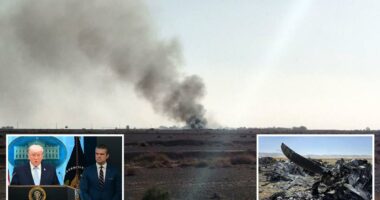
On February 10, a drone linked to drug cartels prompted a Notice to Airmen (NOTAM), restricting aircraft operations in El Paso and parts of eastern New Mexico. This effectively halted all air traffic to and from the border city. This unprecedented move, which included a total ground stop at El Paso International Airport, sparked frustration among local, state, and federal officials due to the lack of prior communication.
The NOTAM was lifted in under eight hours. Transportation Secretary Sean Duffy announced via social media that the issue had been resolved, stating, “The threat has been neutralized, and there is no danger to commercial travel in the region.”
Secretary Duffy’s brief statement did not elaborate on the Trump administration’s substantial efforts to tackle the drone threats posed by Mexican cartels over recent years.
Efforts to address these drone threats intensified after President Trump signed an executive order in June 2025, titled “Restoring American Airspace Sovereignty.” The order emphasized the dangers from criminals, terrorists, and hostile foreign entities using unmanned aircraft systems (UAS) against the U.S.
The President underscored the risk in his order, noting, “Drug cartels use UAS to smuggle fentanyl across our borders, deliver contraband into prisons, surveil law enforcement, and otherwise endanger the public. Mass gatherings are vulnerable to disruptions and threats from unauthorized UAS flights. Critical infrastructure, including military bases, is subject to frequent — and often unidentified — UAS incursions. Immediate action is needed to ensure American sovereignty over its skies and that its airspace remains safe and secure.”
The order compels administration officials, among other things, to increase counter-UAS capability and cements ongoing efforts at the southwest border as part of the President’s efforts to secure the border after his inauguration.
Part of the President’s initiatives to that end included sending military units to the southwest border to help U.S. Customs and Border Protection (CBP) detect UAS threats and any to identify any ground targets associated with UAS incursions.
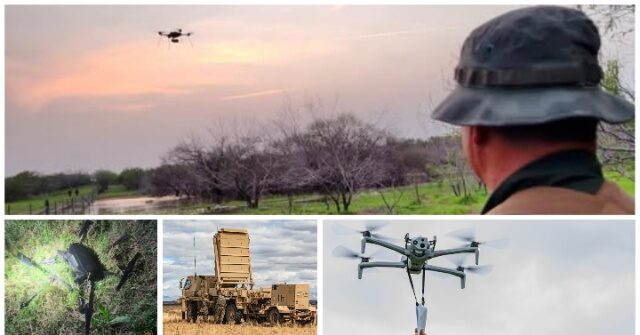
The 10th Mountain Division radar unit was specifically deployed to the southwest border to provide a capability previously unheard of in a homeland defense environment. Specifically, the platoon deployed the AN/TPQ-53 Quick Reaction Capability Radar, which can identify the origin and impact location of weapons such as rockets and mortars, and the AN/MPQ-64 Sentinel radar system, which tracks low-flying aircraft and UAS threats across wide areas. The highly sophisticated equipment, historically used only on the battlefield under previous administrations, has now been adapted for homeland defense.
The efforts to detect drone incursions serve as the starting point for what has been exposed by the El Paso airspace shutdown as an extremely challenging quandary: how to take down a suspect drone without threatening legitimate air traffic near border airports and military installations.
In April, Principal Deputy Assistant Secretary of War for Homeland Defense and Americas Security Affairs Mark Roosevelt Ditlevson testified before the House Committee on Oversight and Government Reform, addressing the challenges of conducting counter-drone operations in civilian airspace.
In his testimony, Ditlevson remarked on the challenges telling committee members, “The systems that have proven effective at countering UAS in the Middle East are not appropriate for the homeland given the intelligence collection required to enable these mitigation operations and the potential for collateral damage.” Ditlevson told committee members that the Department of War’s understanding of the threat and unique mitigation dynamics related to the UAS threat against the homeland has improved greatly, and recommended continued shared government efforts to combat and resolve these threats.
The Cartel-specific UAS threats range from counter-surveillance activity against U.S. law enforcement, incursions to deliver illicit narcotics by air, and ominously include the ability to deploy weaponized drones that have recently been used in Mexico to attack the military and law enforcement, as reported by – Texas.
One way the Trump administration’s Department of War is hoping to solve the challenge of addressing the UAS threat at the border and beyond is through the Drone Dominance Program, an initiative to improve UAS and counter UAS capabilities.
In a July 2025 memorandum to senior leaders at the Pentagon, U.S. Department of War Secretary Pete Hegseth referred to drones as the “biggest battlefield innovation in a generation, accounting for most of this year’s casualties in Ukraine.”
As part of the program, the U.S. Department of War announced an invitation to 25 vendors to compete in phase one of the Drone Dominance Program (DDP), an acquisition reform effort to rapidly procure low-cost, unmanned attack drones. The Department of War will also use the program to quickly acquire innovative counter-UAS solutions that may serve to reduce or eliminate the threat of UAS incursions at the southwest border, attacks abroad, and within the homeland.
Although miscommunication may have marred the short-lived closure of El Paso airspace to address a cartel drone incursion, the episode underscores how the Trump administration is finally building real momentum in confronting a cartel drone threat the previous administration largely ignored for years.
Randy Clark is a 32-year veteran of the United States Border Patrol. Before his retirement, he served as the Division Chief for Law Enforcement Operations, directing operations for nine Border Patrol Stations within the Del Rio, Texas, Sector. Follow him on X @RandyClarkBBTX.