

When the Environmental Protection Agency’s chief revealed plans to significantly scale back environmental regulations, he claimed it would deliver a critical blow to what he dubbed the “climate-change religion” and usher in a prosperous era for America’s economy.
What Lee Zeldin didn’t mention: how ending the rules could have devastating consequences to human health.
According to an analysis by the Associated Press, along with past assessments from the agency and other research, the regulations targeted by the EPA have the potential to prevent around 30,000 deaths annually while saving $275 billion a year during their implementation.
However, the rules’ complete removal is far from assured. Altering these regulations requires a federal rulemaking process that can span several years, necessitating public feedback and credible scientific validation.
But experts say the numbers are conservative and that even a partial dismantling of the rules would mean more pollutants such as smog, mercury and lead — and especially more tiny airborne particles that can lodge in lungs and cause health problems. It would also mean higher emissions of the greenhouse gases driving Earth’s warming to deadlier levels.
“More people will die,” said Cory Zigler, a professor of biostatistics at Brown University who has studied air pollution deaths from coal-fired power plants. “More of this type of pollution that we know kills people will be in the air.”
What went into AP’s examination of the pollution rules
The AP set out to look at what could happen if all the rules were eliminated, by first examining exhaustive assessments the EPA was required to produce before the rules were approved. Though the agency’s priorities can change as presidential administrations change, the methods for the assessments have been largely standard since Ronald Reagan’s presidency and are deeply rooted in peer-reviewed scientific research.
The AP used those and eight different government and private group databases for its estimate of financial costs, some death estimates and analysis of pollution trends. AP performed additional analysis of potential deaths by drawing on peer-reviewed formulas and scientific research on the impacts of increased heat and pollution. And AP vetted its work with multiple outside health experts, who said it is scientifically justified, but likely an undercount.
Multiple experts say the science behind the rules is strong, and they pointed to the rigorous process that must be followed to change them, including requirements for public comment.
Zeldin acknowledged as much last month.
“I’m not going to prejudge outcomes with what will be a lot of rulemaking,” Zeldin said in April.
Virtually all the benefits from the rules come from restricting the burning of coal, oil and natural gas. The fossil fuel industry was a heavy contributor to President Donald Trump’s 2024 presidential campaign and Republicans overall. In announcing the proposed changes, the EPA repeatedly cited the costs of the rules and omitted the benefits in all but one instance.
Calculating costs and benefits is contentious
Asked for comment on the AP findings, an EPA spokesperson said the agency’s plans would “roll back trillions in regulatory costs and hidden ‘taxes’ on U.S. families.”
“Unlike the Biden EPA attempts to regulate whole sectors of our economy out of existence, the Trump EPA understands that we do not have to choose between protecting our precious environment and growing our economy,” spokesperson Molly Vaseliou said.
Scott Segal, an attorney at Bracewell LLP who represents energy and manufacturing interests, suggested that EPA analyses under the Biden administration emphasized worst-case scenarios, inflated health benefit claims and missed the big-picture economic benefits of booming industry.
“If you only count lives saved by regulation, not lives harmed by regulation, the math will always favor more regulation,” Segal said. “This framing misses the larger point: public health isn’t just about air quality — it’s also about job security, housing, access to medical care, and heating in the winter.”
The EPA regulatory analyses are immense documents that numerous health and environment researchers and former officials say are grounded in science, not politics. For example, in January 2024, the EPA produced a 445-page analysis of tightening standards on dangerous particle pollution that cited more than 90 different scientific publications, along with scores of other documents. The Biden EPA presented four different regulatory scenarios and ultimately chose one of the middle options.
Two experts who reviewed AP’s work said the EPA documents that underpinned the analysis were themselves conservative in their estimates. University of Washington health and environment professors Kristi Ebi and Howard Frumkin said that’s because EPA looked at added heat deaths and air pollution mortality, but did not include climate change’s expected deaths from increased infectious disease, flooding and other disaster factors.
“This is a rigorous, compelling and much-needed analysis,” said Frumkin, who was appointed director of the CDC’s National Center for Environmental Health during George W. Bush’s administration. ”It makes clear that regulatory rollbacks by the Trump administration will have major, direct consequences for health and well-being. Because of these regulatory rollbacks and funding cuts, Americans will die needlessly.”
That’s a sentiment echoed by two former Republican EPA administrators, William Reilly and Christine Todd Whitman, who served in the George Bush and George W. Bush administrations respectively.
“This administration is endangering all of our lives — ours, our children, our grandchildren,” said Whitman, who led EPA under George W. Bush.
How regulations helped clear the air
A visit to Evansville, Indiana, helps show how EPA regulations have made a difference.
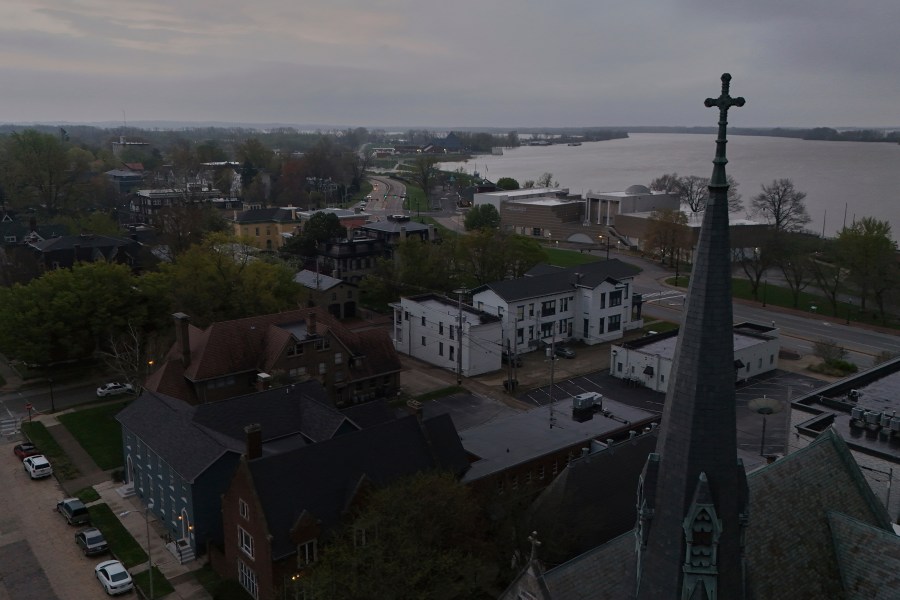
The city of about 115,000 lies where the state’s southwest tip meets Kentucky at the curving Ohio River. Industry lines the banks and coal barges float past carrying loads destined to fuel power plants.
Kirt Ethridge, 30, grew up in Evansville and still lives there. As a child, he recalls looking down from high ground into the bowl-shaped valley where the heart of the city lies and seeing a haze of pollution atop it. He thought that was normal.
He didn’t think much of the looming smokestacks of the coal-fired power plants and factories that ringed the city, nor the line of inhalers waiting on a bench before he and his classmates ran the mile. He suffered asthma attacks in class, sometimes more than once a week, that sent him to the nurse’s office. Once, he was rushed to the hospital in an ambulance.
“It’s a very scary feeling, particularly as a kid, to not be able to get enough air in your lungs,” he said, describing it as like “breathing through a straw.”
In southwestern Indiana, coal-fired power plants were to blame for between 19,000 and nearly 23,000 deaths from 1999 to 2020, according to work by Zigler published in the journal Science that examined death rates among Medicare recipients and modeled where plants’ pollution would spread.
Nationally, he and his team found a sharp decline in air pollution deaths from coal-fired power plants after the mid-2000s, from an average of 43,000 a year to just 1,600 a year in 2020, with a similar cut in particle pollution. That’s when two different forces came into play: Cheaper and less polluting natural gas pushed aside dirtier and costlier coal, while at the same time stricter regulations required more pollution control devices such as scrubbers.
Duke Energy operates its biggest power plant near Evansville — Gibson Station, which can power about 2.5 million homes. Emissions have declined significantly as the company installed scrubbers that pull unwanted chemicals out of smokestacks, along with other pollution control technology. Duke Energy spokeswoman Angeline Protegere said the scrubbers were a response to “regulations over the years as well as market factors.”
Put simply, the air got cleaner around places like Evansville. Vanderburgh County and neighboring counties violated national annual air standards for fine particles from 2005 to 2010, but no longer do, even as standards have tightened.
The same is true across the United States. The amount of tiny airborne particles in the last 10 years nationwide is one-third lower than 2000-2009, EPA statistics show. Smog pollution is down nearly 15% and sulfur dioxide has plunged 80%.
“The Clean Air Act, the EPA’s founding legislation, has been a powerful engine for improving public health as our air has grown visibly clearer and cleaner,” said Gina McCarthy, who headed the EPA under President Barack Obama and served as Biden’s White House climate adviser. “Millions of Americans have avoided illnesses, hospital visits, and premature deaths thanks to EPA’s cleaner car and truck standards in concert with rules that limit industrial pollution.”
Five rules saving more than $200 billion a year
Five rules together were estimated to have more than $200 billion a year in net benefits, based on EPA documents that estimated reduced illnesses and deaths and the costs for companies to comply.
Three rules dealt with cars and trucks. The “clean car rule” is a tightening of EPA emission standards for vehicles that was supposed to take effect for 2027 model years and eventually have annual net benefits of more than $100 billion a year, according to the agency’s 884-page regulatory analysis. The EPA estimated that over the next three decades this rule alone would prevent 7.9 billion tons of heat-trapping carbon dioxide, 8,700 tons of particulate matter and 36,000 tons of nitrogen oxides.
Two other proposed rules — one that deals with car models from 2023 to 2027 and another aimed at heavy trucks and buses — are estimated to save nearly $38 billion a year combined through reduced health problems from air pollution, according to EPA’s own detailed calculations.
EPA plays up costs, plays down benefits of targeted rules
Almost none of those benefits are to be found in 10 fact sheets the EPA produced in conjunction with Zeldin’s announcement. Nine make no mention of benefits from the rules, while eight mention the costs.
In 17 of the 20 rules with explicit cost-benefit analyses, AP found that estimated benefits are larger than the costs — and sometimes far larger.
For example, Biden’s proposed power plant rule was designed to save more than $24 billion a year, prevent about 3,700 annual premature deaths and 3 million asthma incidents from fossil fuel-powered plants, according to EPA documents last year and work by the Environmental Protection Network. Under Trump, the EPA’s fact sheet on that rule notes nearly $1 billion in costs but nothing about the far higher estimated benefits.
Another rule the EPA updated last year sets standards for pollution permitted in the air, called National Ambient Air Quality Standards. The update, required by the Clean Air Act, cuts allowable soot particles by 25% to reflect new science on the harms from such pollution. The EPA in Biden’s time calculated the change would annually save as much as $46 billion, 4,500 premature deaths and 800,000 asthma incidents.
But the new EPA fact sheet only mentions the estimated costs of the change — about $614 million — and not benefits estimated at 76 times that amount.
“The human body count and human health toll of particulate matter alone is just absolutely massive,” said K. Sabeel Rahman, a Cornell law professor who was a top federal regulatory officer from 2021 to 2023. “Literally tens of thousands of people will lose their lives” if the standard is rolled back, he said.
A penguin-shaped nebulizer
In southwest Indiana, many people have noticed a positive difference from the EPA regulations. And they’re concerned about changes.
In Bloomfield, Jessica Blazier’s 11-year-old son Julian has multiple health conditions that make him more sensitive to air quality, including nonallergic rhinitis, which inflames his nasal passage and makes breathing “feel like a knife sometimes,” in his words. Jessica Blazier said the proposed EPA rule rollbacks are “almost adding insult to injury in our particular circumstance.”
In Evansville, Ethridge is now raising kids of his own, including a 5-year-old daughter who was born early and doesn’t tolerate respiratory illnesses well. Whenever Eliza gets sick, she uses a children’s nebulizer that is shaped like a penguin and stored in an igloo-shaped case.
“I want to raise my kids in Evansville,” he said. “I don’t want to raise my kids in a bowl of pollution.”
___
Borenstein and Daly reported from Washington, Walling and Bickel from Evansville, Indiana, and Wildeman from Hartford, Connecticut.
___
The Associated Press’ climate and environmental coverage receives financial support from multiple private foundations. AP is solely responsible for all content. Find AP’s standards for working with philanthropies, a list of supporters and funded coverage areas at AP.org.