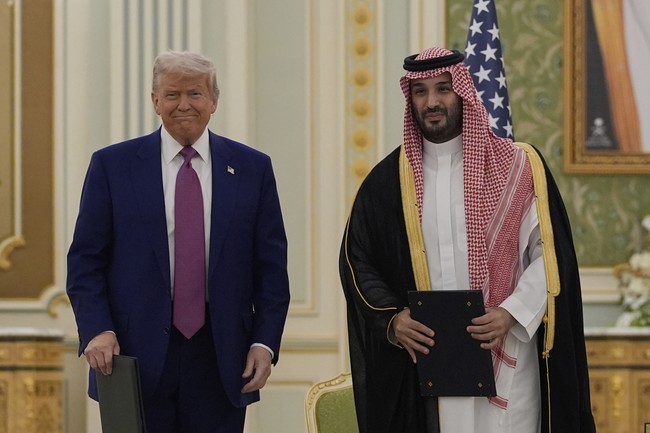


In the last five years, Saudi Arabia has seen an impressive transformation, shifting from a strictly conservative kingdom to a more open and modern society. This change has been led by Crown Prince Mohammed bin Salman (MBS), who has 추진 [The change has been driven by ambitious social and economic reforms designed to diversify the economy, empower women, and ease ultra-conservative religious norms.]
Nevertheless, the sustainability of this moderate course is still uncertain. If the United States were to withdraw its enduring support, there is a potential risk that radical Islamist groups might leverage the instability to challenge or even topple the Saudi government, possibly undoing these significant advancements.
This speech that Trump delivered in Saudi Arabia is exactly the kind of speech that Western libs should be celebrating.
It comes as a remarkable critique and rejection of imperialism and neoconservatism, acknowledging the people of the region themselves for their massive transformation… pic.twitter.com/SAiBmZs62I
— Melissa Chen (@MsMelChen) May 14, 2025
Since 2017, Crown Prince Mohammed bin Salman has pursued a bold agenda under the Vision 2030 initiative, which seeks to modernize Saudi Arabia’s economy and society. Over the last five years, the kingdom has implemented sweeping reforms that have reshaped its social landscape:
Women’s Rights and Empowerment: In 2018, Saudi Arabia lifted its decades-long ban on women driving, a landmark step toward gender equality. Women have also gained greater access to the labor market, with female workforce participation rising from 19% in 2016 to over 35% by 2023. Public spaces, once heavily segregated, now see men and women mingling more freely, and women are increasingly visible in roles ranging from government ministers to business leaders.
Social Liberalization: The conservative grip of the religious establishment has loosened significantly. The once-powerful religious police, who enforced strict dress codes and behavior, have been sidelined. Music concerts, movie theaters, and international sporting events—previously unthinkable in the kingdom—are now commonplace. Posts on X highlight this shift, with users noting that Saudi Arabia has “come a long way” since 2016, describing an “unparalleled social revolution” under MBS.
Saudi Arabia is changing, it’s not the Saudi Arabia we knew 15 years ago.
This is GOOD. pic.twitter.com/k5NYJtp6hb
— Brigitte Gabriel (@ACTBrigitte) May 14, 2025
Crackdown on Extremism: The Saudi government has taken decisive steps to dismantle the infrastructure of religious extremism. In a rare 2025 interview, the head of Saudi State Security, Abdulaziz Al-Huwairini, emphasized that one of MBS’s key challenges was “dismantling the industry of extremism.” This included curbing the influence of Wahhabism, the ultraconservative Islamic ideology that has historically shaped Saudi society and inspired global jihadist movements.
Economic Diversification and Global Engagement: Vision 2030 has prioritized reducing Saudi Arabia’s reliance on oil by investing in tourism, technology, and entertainment. The kingdom has opened its doors to international visitors, with relaxed visa policies and events like the Riyadh Season festival drawing global attention. These efforts have positioned Saudi Arabia as a potential “magnet for tourism,” according to CNN reports from 2020.
These changes have not been without controversy. Critics argue that MBS’s reforms are partly a public relations campaign to deflect from human rights concerns, including the 2018 killing of journalist Jamal Khashoggi and ongoing restrictions on free speech. Nevertheless, the societal shifts are tangible, with many Saudis—especially younger generations—embracing the newfound freedoms.
Posts on X reflect this sentiment, with one user noting in 2025 that Saudi Arabia’s cultural shift is “seismic” and has opened the kingdom to the West.
When Biden visited Saudi Arabia, the Crown Prince made him come to him. No welcome, no respect, just an awkward fist bump.
Today? He broke protocol to meet Trump on the tarmac.
That’s not politics. That’s power.
The world knows who’s strong and who’s not. pic.twitter.com/BD4UQvegrm
— Desiree (@DesireeAmerica4) May 13, 2025
Despite these advances, Saudi Arabia’s transformation remains vulnerable. The kingdom’s history of religious conservatism, combined with regional instability, creates a precarious environment. The Al Saud ruling family has long balanced its legitimacy between modernizing impulses and the expectations of a conservative religious establishment. While MBS has sidelined hardline clerics, their influence lingers, particularly among segments of the population wary of rapid Westernization.
Moreover, Saudi Arabia faces external pressures from radical Islamist groups like Al-Qaeda and the Islamic State, both of which have historically viewed the Saudi monarchy as a corrupt puppet of the West. These groups have exploited grievances over economic inequality, foreign influence, and perceived moral decay to gain traction.
The Muslim Brotherhood, a transnational Sunni Islamist organization, also poses a potential ideological challenge, with its history of advocating for political Islam that could resonate with disaffected Saudis.
The United States has been a critical ally of Saudi Arabia since the 1940s, providing military, economic, and diplomatic support. This relationship has been particularly vital in counterterrorism efforts. A 2016 U.S. House hearing underscored the U.S.-Saudi counterterrorism partnership, which includes intelligence sharing, joint military operations, and efforts to curb terror financing. The U.S. has also armed Saudi Arabia extensively since the 1990s, bolstering its ability to maintain internal security and deter external threats.
This support has been instrumental in enabling MBS’s reforms. The stability provided by U.S. backing has allowed the Saudi government to focus on domestic modernization while suppressing extremist elements. For instance, Saudi Arabia’s crackdown on Wahhabist clerics and institutions was supported by U.S. intelligence and counterterrorism expertise, which helped neutralize potential backlash.
If the United States were to significantly reduce or end its support for Saudi Arabia, the consequences could be dire. Several factors suggest that radical Islamists could exploit such a vacuum to destabilize the kingdom:
Security Vacuum: Without U.S. military aid and intelligence support, Saudi Arabia’s ability to counter terrorist groups like Al-Qaeda or the Islamic State could weaken. These groups have a history of targeting the kingdom, viewing it as a key prize due to its religious significance and oil wealth. A weakened Saudi security apparatus might struggle to contain resurgent extremist networks.
Economic Instability: U.S. withdrawal could disrupt Saudi Arabia’s economy, particularly if it leads to reduced foreign investment or sanctions. Economic hardship could fuel discontent, providing fertile ground for radical ideologies. The 1979 Iranian Revolution, where economic and political grievances led to the overthrow of a U.S.-backed monarchy, serves as a cautionary example.
Ideological Backlash: Rapid modernization has already sparked resistance from conservative factions within Saudi Arabia. A reduction in U.S. support could embolden these groups, potentially rallying around figures like the Muslim Brotherhood or rogue clerics to challenge the monarchy. The Brotherhood’s history of organizing across the Middle East makes it a particular concern.
Regional Rivalries: Without U.S. backing, Saudi Arabia could face heightened threats from regional adversaries like Iran, which supports Shia militias and has long sought to undermine the Sunni-led kingdom. This could exacerbate internal divisions, creating opportunities for radical Sunni groups to position themselves as defenders of the faith.
Saudi Arabia’s transformation into a more open society over the past five years is a testament to the ambitious vision of Crown Prince Mohammed bin Salman. Reforms empowering women, liberalizing social norms, and curbing extremism have reshaped the kingdom, earning praise from many Saudis and international observers.
However, these gains are not irreversible. The United States’ support has been a cornerstone of Saudi Arabia’s ability to maintain stability while pursuing modernization. If this support were withdrawn, the kingdom could face a perfect storm of security, economic, and ideological challenges, potentially allowing radical Islamists to gain ground and threaten the moderate government. For now, the U.S.-Saudi partnership remains a critical bulwark against such a scenario, but the fragility of Saudi Arabia’s progress underscores the need for continued vigilance and strategic engagement.