
Share this @internewscast.com

David Wright appears poised to secure enough votes to stay on the National Baseball Hall of Fame ballot for an additional year, granting voters more time to assess his Hall of Fame credentials. The former third baseman for the Mets has seen an increase in votes over the past three years, yet he remains well short of the 75% needed for induction.
His extended presence on the ballot could bolster his case, though evaluating Wright’s Hall of Fame potential is complicated by a career prematurely ended by spinal stenosis. His prime years were marred by this condition, affecting his overall achievements.
After the 2017 season, Wright underwent shoulder surgery, having missed the entire season due to injuries. By the close of the 2018 season, he retired, unable to consistently throw a baseball as he once did. This left fans contemplating the “what ifs” surrounding his career.
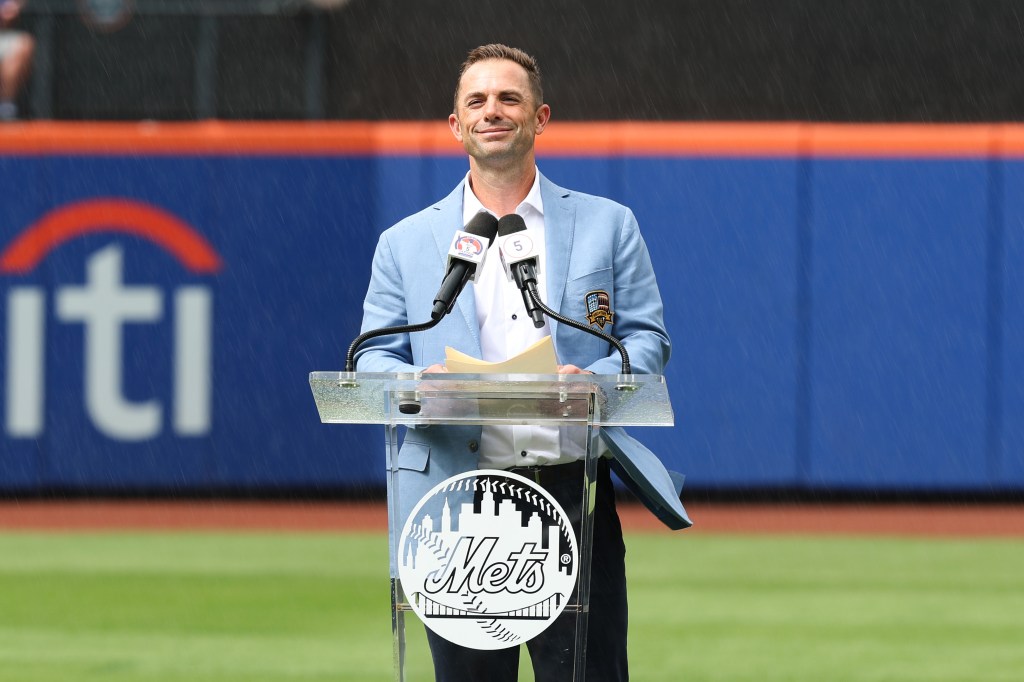
Regardless of his Hall of Fame fate, Wright’s legacy is already enshrined by the Mets. Last season, he was inducted into the team’s Hall of Fame, with a ceremony that also retired his jersey number, 5. This honor reflects his iconic status within the franchise, but does he merit further recognition?
The answer lies in one’s perspective.
Drafted in the first round straight out of high school, the Virginia-born Wright quickly became the Mets’ franchise face and one of their most successful homegrown talents. Although he retired at 35, Wright still holds the club records in numerous categories, including position player WAR (49.1), offensive WAR (51.9), at-bats, plate appearances, runs, hits, total bases, singles, doubles, RBIs, walks, and runs created. A seven-time All-Star and two-time Gold Glove winner, Wright was not only a dominant player on the field but also a steadfast leader during some of the organization’s most challenging eras.
It’s the Mets, so turbulence can always be expected, but his leadership extended well past Flushing. Given the moniker “Captain America” as the captain of Team USA during the 2013 World Baseball Classic.
Wright was an exemplary player in every way, authoritative when needed, accountable always, kind and courteous to fans, and ready to give more than 100% every night his name was written onto the lineup card. His discipline came from his father, Rhon, a former police officer who introduced him to the Mets when the club had a minor league team near his Norfolk, Virginia home. His compassion came from his mother, Elissa, and his competitiveness from having three older brothers.
The character clause that BBWAA voters are instructed to consider isn’t something that even needs to be considered. Wright’s character is so high that it’s tough for other players to even measure up.
But so often, Hall of Fame voting is by the numbers. The average WAR for third basemen is around 80.5. Wright couldn’t get there in parts of 14 seasons, mostly because of the injuries. He’s short of the JAWS standard at the position. He never won an MVP Award, though he did finish in the top-5 once and in the top-10 four times.
However, his WAR per 162 games is 5.0, which is higher than two Hall of Fame third basemen, Paul Molitor (4.6) and Brooks Robinson (4.4), the latter being the namesake of his son Brooks. When he was at his best, Wright was one of the best in baseball.
Does that make him a Hall of Famer? Maybe. It’s not a strong case, but there is a case to be made, nonetheless. It’s subjective. As time passes, some voters could decide to place a higher value on what he was when he was able to play, and not what could have been when he wasn’t able to.