
Share this @internewscast.com

With the United States easing sanctions, hopes are rising among Venezuelans, yet they continue to grapple with issues such as corruption, the suppression of free speech, and rampant hyperinflation.
In Caracas, Venezuela’s capital, the cost of a bag of flour now equates to about half a year’s salary, and those who publicly rejoice at the departure of former President Nicolas Maduro still face arrest, according to residents who spoke to The Post.
This week, the US lifted sanctions on Delcy Rodriguez, the country’s current leader and former Vice President, who took office after the US detained Maduro on drug-related charges in January. This move is seen as a preliminary step toward facilitating aid and investment in Venezuela.
In addition, US diplomats have reopened the American embassy in Caracas, which had been shuttered since 2019, marking a significant diplomatic gesture on Monday.
“This indicates that Delcy is planning a visit to the US, which necessitated the lifting of personal sanctions against her,” explained Daniel DiMartino, a Senior Fellow at the Manhattan Institute. He pointed out that Rodriguez is the sole member of Maduro’s administration to have her sanctions lifted.
“This is an initial move towards normalization, signaling a potential shift towards democracy. Without such a transition, any foreign investment would likely be squandered,” DiMartino added.
Venezuelans interviewed by The Post said they were cautious about hoping any real change would happen quickly.
“Lifting the sanctions is a positive move,” said a 49-year-old high school chemistry teacher in Caracas. He did not want to be identified because he had been jailed for 18 months for opposing the Maduro regime and says he is currently under surveillance by authorities.
“We are all very grateful to Donald Trump for getting rid of Maduro, but it’s the same Maduro organism that’s still in charge,” said the teacher. “They are an organism of corruption, and they are responsible for the suffering of the people. They are all like Judas for the Venezuelan people,” he said, referencing the biblical traitor.
Still, the teacher sees the positives from this week.
“Now the government can’t use the excuse that US sanctions are to blame for everything that goes wrong in this country — power outages and the economic crisis. They can’t hide behind the US anymore.”
Trump administration officials have said that they plan to implement a three-pronged plan to stabilize the economy, create a favorable investment environment for US companies and later work towards a democratic transition, according to reports.
Rodriguez had been sanctioned by the US Treasury since 2018, along with other members of Maduro’s inner circle.
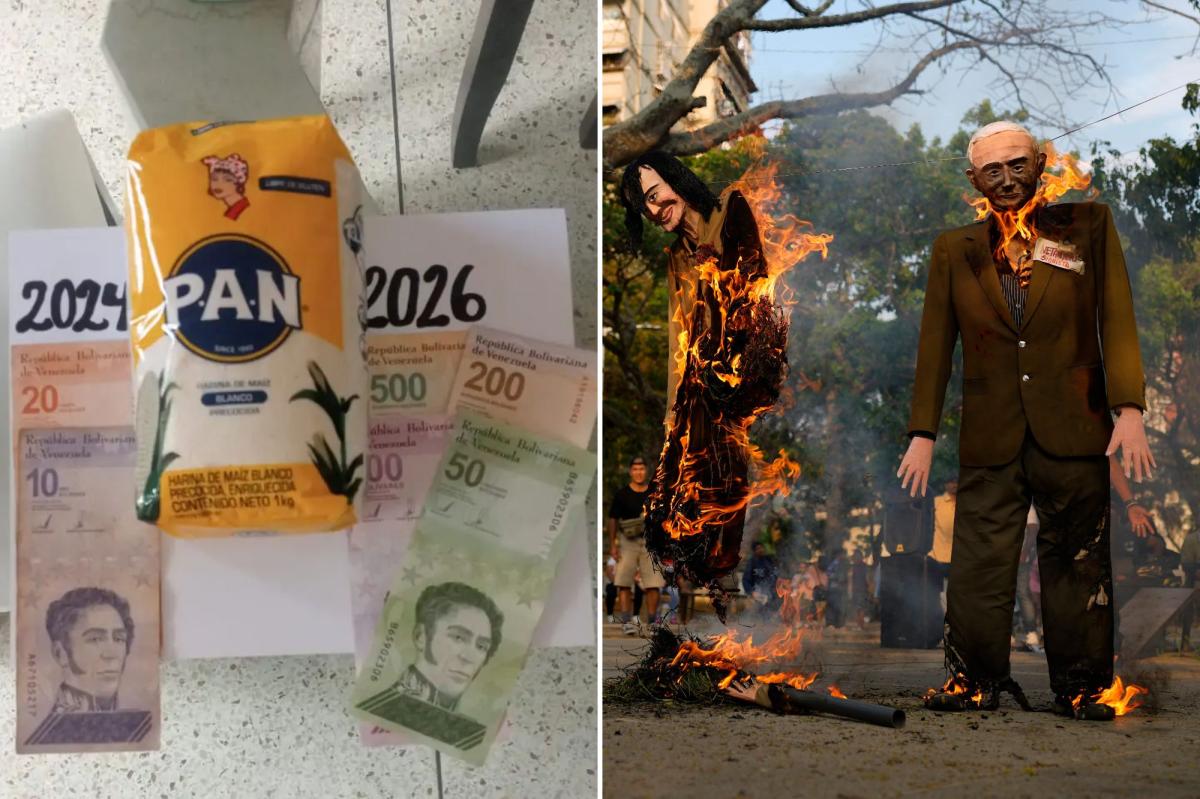
Despite a sense of cautious optimism, the teacher still expects members of the current regime will be a target of ordinary Venezuelans’ anger at the annual “burning of Judas” ritual this Easter Sunday, when residents of working-class neighborhoods in Caracas burn life-size effigies of politicians they feel betrayed them.
“We’re all wondering if anyone is going to be arrested for the Judas burning, since the government has continued to crack down on opposition,” he said.
Although once scarce food items, such as meat, and fuel have returned to local markets in the four months since the US intervention, residents have little purchasing power, according to Alexander Contreras, 61, a telecommunications engineer who lives outside Caracas.
“We are concerned with the most basic issues of survival,” he told The Post, adding the education and health care systems are in crisis due to corruption and mismanagement.
Contreras explained teachers and doctors at public hospitals are in short supply and don’t show up for work because they don’t get paid a living wage. Many of the social programs that promised impoverished residents monthly government stipends for food have all but disappeared due to hyperinflation, which stands at 700 percent, the highest in the world, according to Bloomberg.
The monthly minimum wage is currently 130 bolivars, now equivalent to just $3 with inflation, leaving it with little purchasing power. On Thursday morning, a kilo of flour cost 850 bolivars, but the price increased to nearly 900 bolivars by the afternoon, after the Central Bank announced the new rate of inflation.
In 2024, the same bag of flour cost just 30 bolivars, according to the teacher.
As a result, many are forced to take up side jobs that pay hard currencies — either US dollars or Euros — in order to make ends meet, said Contreras.
The chemistry teacher told The Post he survives by selling pieces of his art and conducting private classes. Despite being released from detention in a prisoner swap in December 2023, he can’t find a regular job because he is still considered a “terrorist” under Venezuelan law. He is waiting for an amnesty that he said would clear his name.
Perceived enemies of the state, such as dissidents, trade unionists and journalists who have denounced the government are subject to financial restrictions, such as government monitoring and seizure of assets. Prospective employers are loathe to hire such people as they could then face reprisals from the state themselves, the teacher said.
Contreras said he was upset that among the first laws that were passed in the country after Maduro’s ouster was legislation allowing foreign companies to exploit the country’s vast oil reserves.
Venezuela holds the world’s largest proven oil reserves — more than 300 billion barrels — although corruption and mismanagement under Marxist leaders Hugo Chavez and Maduro have stalled extraction, according to reports.
President Trump promised a prosperous economic future for Venezuelans in January, pledging US investment of billions of dollars into the country that would make Venezuela “very successful.”
He called on American oil companies to “rip out the old crap” and invest in new drilling infrastructure to extract the oil.
DiMartino told The Post US officials have already focused on repairing hydroelectric facilities in the country to prevent frequent blackouts.
“The first step is to have a better situation than before,” he said. “Now you have to force the regime to stop stealing money and improve the life of ordinary Venezuelans and prevent people from starving. Things are already better after three months, and they will be much better a year from now.”
For Contreras, real change will only come when Venezuelans are free to complain about their own government, he told The Post.
“When Trump took Maduro, one of the first laws approved was for oil, not for freedom, not for justice for the people,” said Contreras. “We were all really disappointed.”
And despite an amnesty for political prisoners and other opponents of the regime, security forces continue to crack down on dissent, the teacher told The Post.
“If you organize a celebration for the ouster of Maduro, you can still go to prison,” he said, adding many Venezuelans were appalled when government forces arrested a group of teenagers over a water balloon fight in northeastern Venezuela on January 5, two days after the US arrested Maduro and his wife Cilia Flores.
Twenty five youths between the ages of 13 and 25 who were participating in a water balloon fight in the eastern city of Barcelona were arrested. Fifteen of the young men and teenagers were arraigned on “treason to the homeland” and accused of celebrating the capture of Maduro, according to a report. Many were released three days later after their families uploaded videos to social media protesting their detention.
The Maduros both remain at the Metropolitan Detention Center in Brooklyn. Last week, their bid to dismiss the drug trafficking charges against them was denied by a federal judge in Manhattan.
Since Maduro’s ouster, authorities have released some 400 political prisoners, but about 600 still remain behind bars. There, they have been subject to torture and denied lawyers, according to Human Rights Watch.
“They are going to say that they are more open, that there is more liberty after Maduro’s arrest,” said the teacher.
“But in reality, we still can’t speak up. There is no liberty, and we still don’t have the ability to go to a clinic when we’re sick or send our kids to school.”