
Share this @internewscast.com
A former sheriff from Kentucky has confessed to shooting a judge inside the courthouse, as revealed in recent court documents. As the trial approaches, his legal team is preparing to argue an insanity defense.
Shawn “Mickey” Stines, who stepped down as Letcher County sheriff following the September 2024 incident, admitted to shooting District Judge Kevin Mullins during a confrontation in the Whitesburg courthouse. This admission was outlined in documents obtained by the Lexington Herald-Leader.
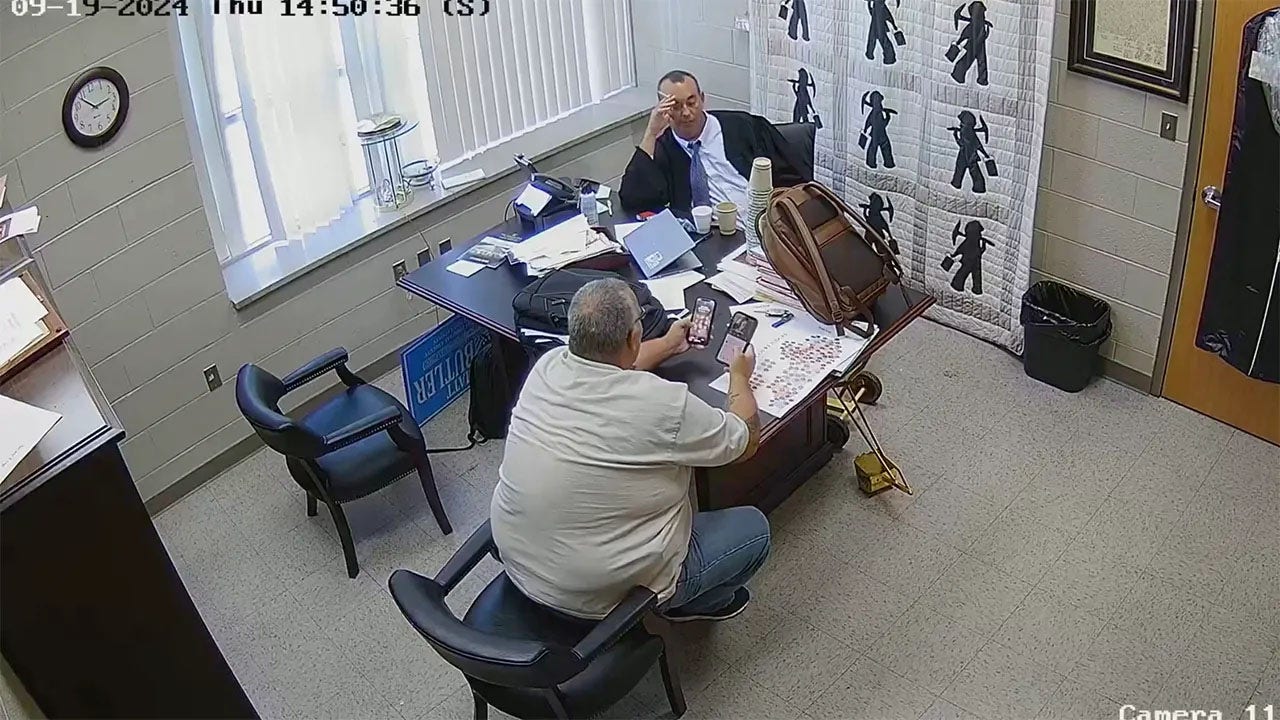
Surveillance footage, devoid of audio, captured a man identified as Stines drawing a firearm and shooting at Judge Mullins, who was seated at his desk. The man then circled the desk and fired repeatedly at the judge. Stines faces charges of first-degree murder and the murder of a public official.
Stines’ admission coincides with his defense team’s strategy to argue that he was under “extreme emotional disturbance” at the time of the incident, indicating a reliance on an insanity defense, as reported by the Lexington Herald-Leader.
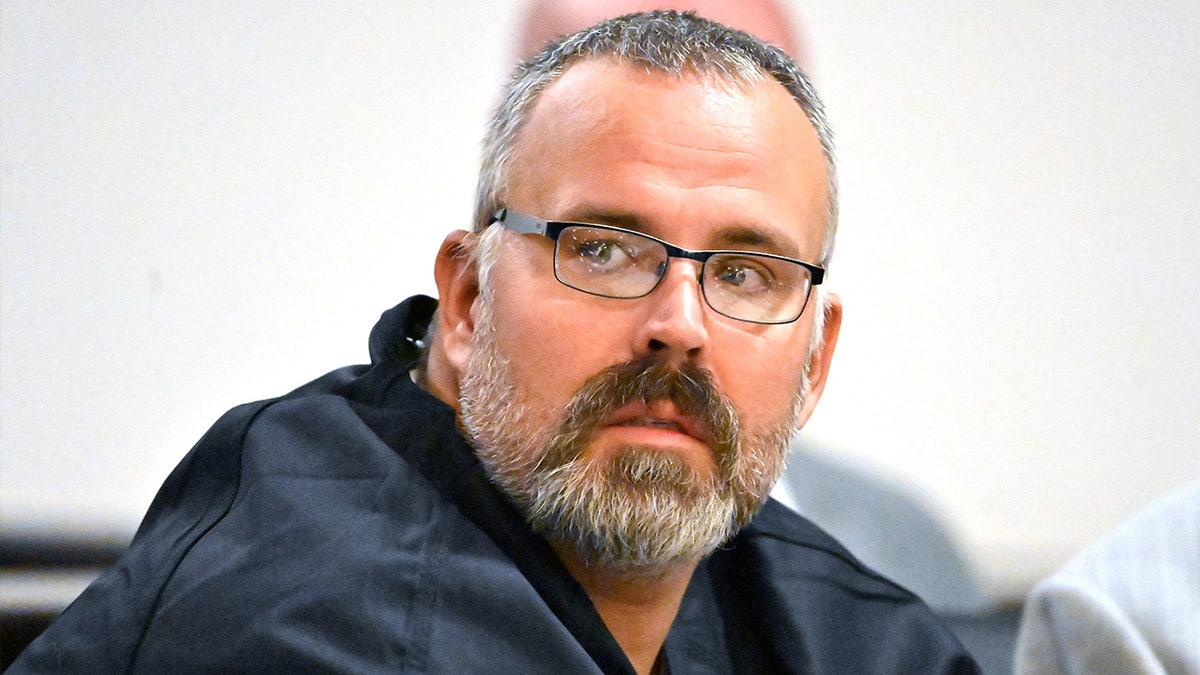
During his arraignment at the Morgan County Courthouse in West Liberty, Kentucky, Stines was observed glancing towards the prosecution. The arraignment took place on October 1, 2024, and Stines stands accused of murdering District Judge Kevin Mullins. (AP Photo/Timothy D. Easley)
In a report penned shortly after the shooting, a social worker who visited Stines in jail noted that he was in “an active state of psychosis” and seemed unable to comprehend the charges against him. The Associated Press reported that Stines had exhibited “episodes of combativeness” that necessitated the use of pepper spray.
In a deposition Stines gave investigators in the days leading up to the shooting, he claimed to have been suffering from dizziness, headaches, sweating and memory loss brought on by California encephalitis, a neurological disease resulting from bug bites, the Herald-Leader reported.
Prosecutors have not commented on the latest filings. Stines’ legal team has argued that a portion of his mental evaluation should remain sealed, a position that the judge recently upheld.
Stines resigned as sheriff days after the shooting and is being held without bond in eastern Kentucky.
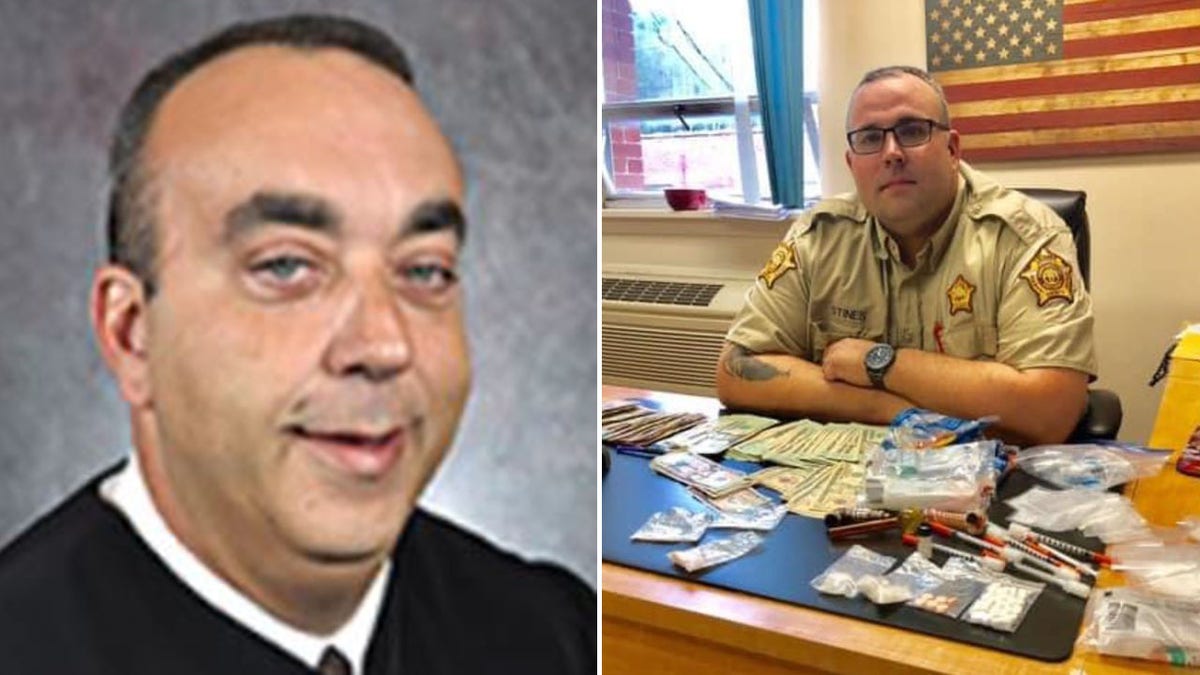
District Judge Kevin Mullins was killed by Letcher County Sheriff Shawn M. Stines in his judge’s chambers, authorities said. (Kentucky Court of Justice ;Letcher County Sheriff’s Office)
Under Kentucky law, proof of mental incapacitation or extreme emotional distress could take the death penalty off the table in Stines’ case, the Herald-Leader reported. However, a defendant’s standards of intent reportedly differ in civil cases, with Mullins’ widow filing a wrongful death lawsuit against Stines and three other Letcher County Sheriff’s Office employees in September.
Kimberly Mullins and the couple’s two children are reportedly accusing Stines of assault and battery, while alleging that three other sheriff’s employees did not warn or protect the judge from Stines, who was showing signs of being anxious, violently paranoid and psychotic.
On Nov. 12, Stines admitted to shooting Mullins in his answer to the civil lawsuit, adding that he was “exhibiting paranoid and psychotic conduct,” according to the Herald-Leader.
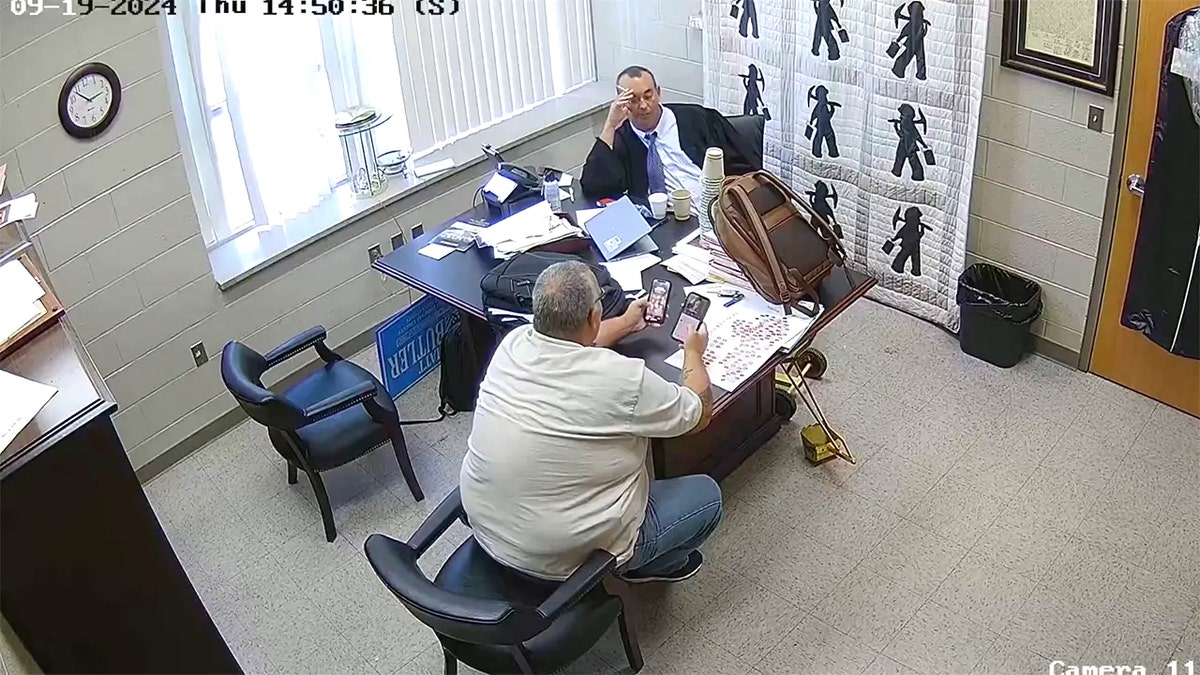
Judge Kevin Mullins, sitting at his desk dressed in a suit, hands his phone over to Letcher County Sheriff Mickey Stines shortly before being shot dead in his own chambers. (Kentucky State Police)
Stines’ attorneys reportedly moved to dismiss the case under the sovereign immunity doctrine, which shields government officials from civil liability claims while acting in their official capacity. They also asked a judge to dismiss the negligence claims against him, citing the accusation must show proof of intent.
“As Sheriff, he was a county employee and, therefore, is entitled to the same sovereign immunity granted to the County itself,” his attorneys wrote, according to the Herald-Leader. “Based on this, the official capacity claims against Shawn Stines must be dismissed.”
Additionally, Stines’ attorneys reportedly detailed a possible defense they could use to portray their client’s state of mind during the alleged killing, insisting that he “had no control,” and was suffering from “pre-existing conditions.”
Stines’ attorneys did not immediately respond to Fox News Digital’s request for comment.
Last week, a judge reportedly denied two motions to dismiss the criminal charges against Stines, with his attorneys saying prosecutors never informed the grand jury of their client’s mental state when the crime was committed and that the proceeding was intentionally not recorded.