
Share this @internewscast.com

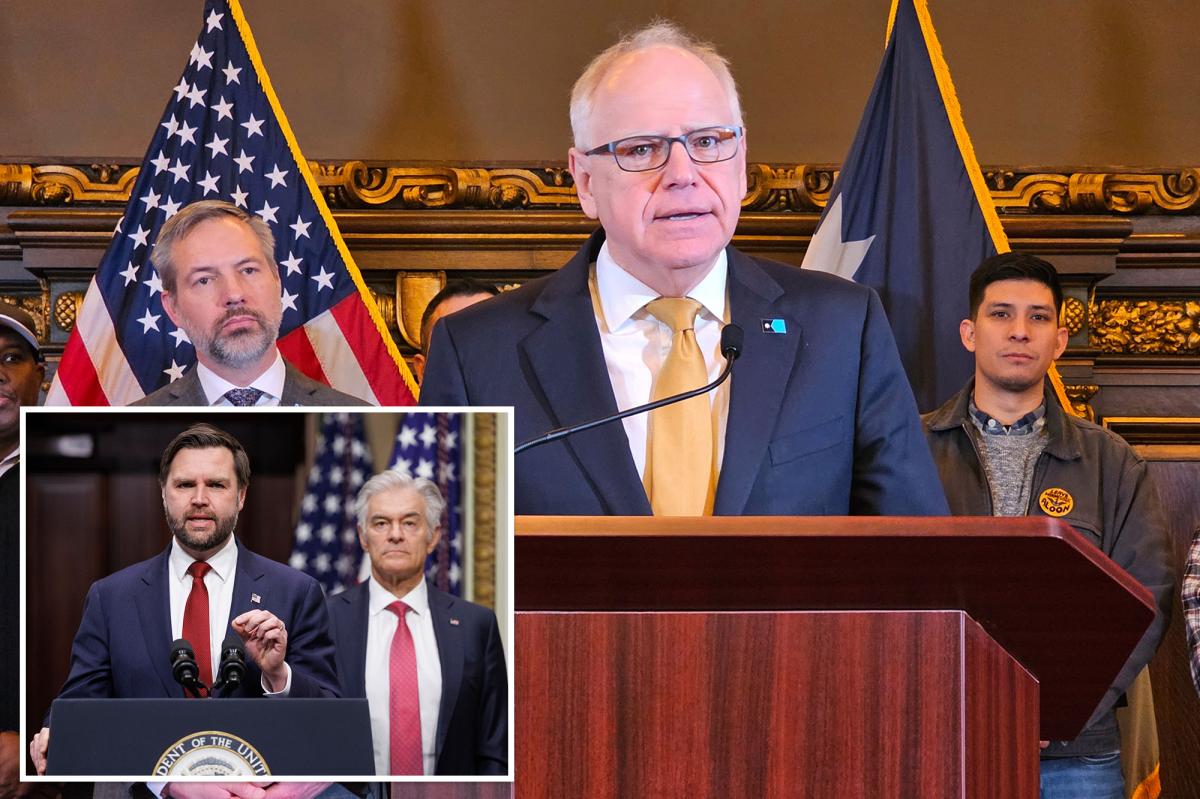
Minnesota Governor Tim Walz has criticized the Trump administration’s recent threat to cut federal funding to the state, describing it as part of a campaign of “retribution.” On Thursday, Walz introduced a legislative package designed to combat fraud in public programs, an issue that has been a significant factor behind the federal government’s immigration crackdown in Minnesota.
The announcement came a day after Vice President JD Vance revealed plans to “temporarily halt” certain Medicaid funds to Minnesota due to fraud concerns. Vance characterized this move as part of a broader initiative to aggressively address the misuse of public funds.
Governor Walz’s legislative proposals had been in development well before Vance’s statement was made.
These measures are a continuation of Walz’s previous efforts to tackle a problem that ultimately influenced his decision not to pursue a third term.
In a news conference, Walz asserted, “This is targeted retribution against a state the president dislikes.” He accused the administration of using “false information” about fraud as a “pretext,” similar to the rationale behind Operation Metro Surge, during which the Department of Homeland Security deployed over 3,000 federal officers to Minnesota.
The governor’s extensive proposals focus on enhancing fraud detection and oversight, granting stronger investigative and enforcement powers, and imposing tougher criminal penalties.
One of them is the creation of a centralized Office of the Inspector General to lead fraud prevention efforts.
The state Senate passed a bipartisan inspector general bill last year.
But it remains stalled in the House amid disagreements over whether it should have law enforcement authority or, as the Walz administration prefers, just focus on investigations and leave enforcement up to the existing state Bureau of Criminal Apprehension.
Dr. Mehmet Oz, the administrator for the Centers for Medicare and Medicaid Services, said at a news conference Wednesday with Vance that the government would hold off on paying $259.5 million to Minnesota for Medicaid, the health care safety net for low-income Americans.
Oz said the money would be delivered only after Minnesota implements “a comprehensive corrective action plan to solve the problem.”
And he gave Walz 60 days to respond.
“How does taking and punishing children and elderly have anything to do with fighting fraud?” Walz countered.
He added that the Trump administration has given his team no guidance for how to address its concerns, nor any opportunity to show the work that Minnesota has already done over the years to fight fraud.
His administration estimates that 1.2 million Minnesotans could be hurt.
The Trump administration’s move was part of a larger effort to spotlight fraud around the country, following allegations of fraud involving day care centers run by Somali residents in the Minneapolis area that prompted the massive enforcement surge in the Midwestern city, resulting in widespread protests.
One Minnesota federal prosecutor last summer estimated that the total fraud across several programs could exceed $9 billion.
But John Connolly, the state’s Medicaid director, told reporters Thursday the state has no evidence to substantiate such a high figure.
Officials at the Minnesota Department of Human Services, which administers Medicaid, noted that withholding $259.5 million — retroactive to the fourth quarter of 2025 — follows earlier federal action to withhold more than $2 billion in annual Medicaid funding to the state.
The agency said the state submitted a corrective action plan earlier, and is still in the process of appealing that decision.
The state agency said it has implemented several new processes and reforms to prevent and detect Medicaid fraud since 2024.
The changes included identifying areas at high risk of fraud, imposing stricter controls such as criminal background checks on providers, and more unannounced site visits.
Walz and Minnesota Attorney General Keith Ellison are both scheduled to appear before the U.S. House Oversight Committee next Wednesday for a hearing on misuse of federal funds in Minnesota’s social service programs.