Share this @internewscast.com
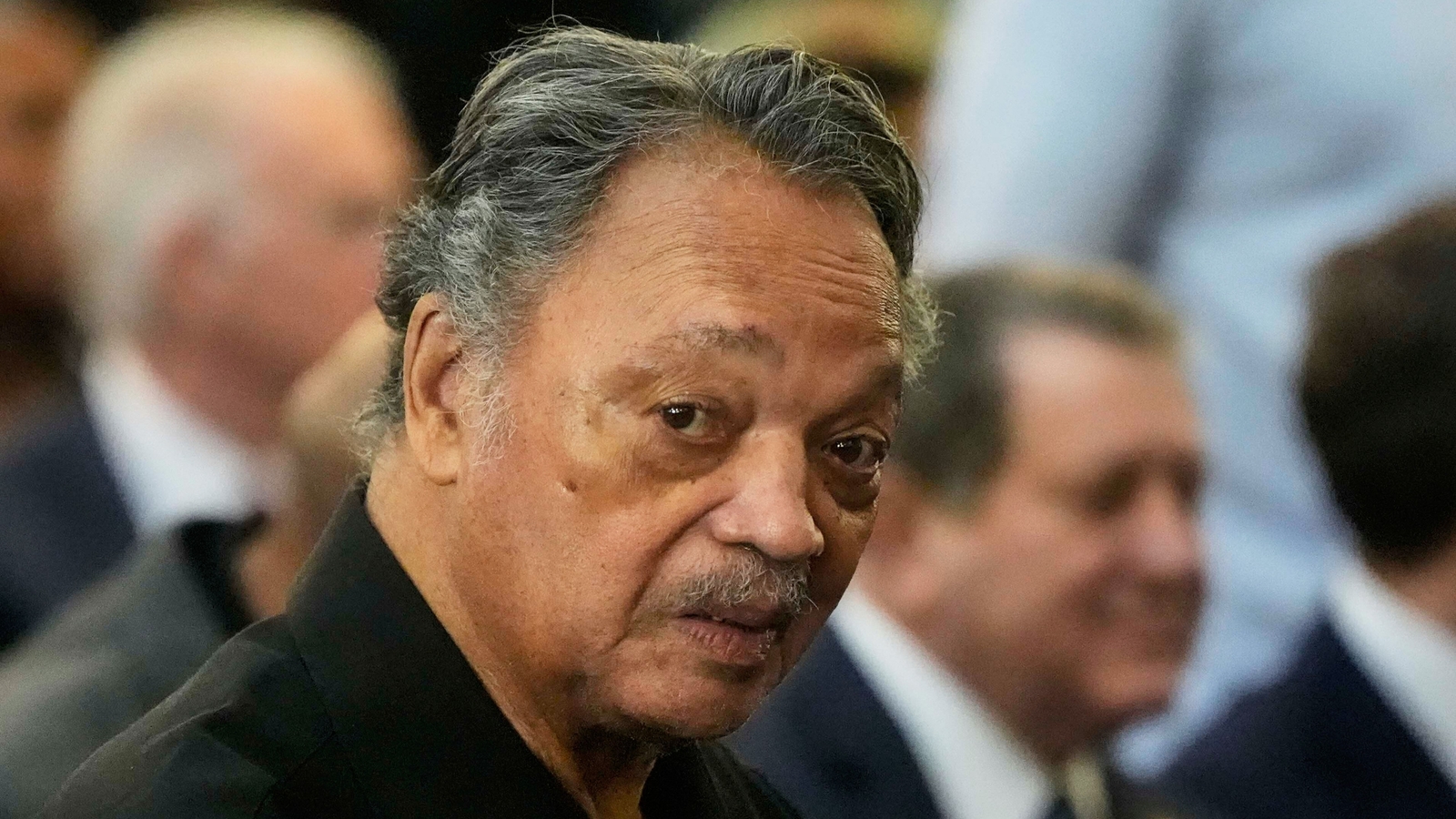
CHICAGO — Civil rights leader Reverend Jesse Jackson has passed away at the age of 84, his family confirmed on Tuesday.
In a heartfelt statement, the Jackson family shared that Rev. Jackson died peacefully while surrounded by loved ones.
ABC7 Chicago is now streaming 24/7. Click here to watch
“Our father was a servant leader—not just to us, but to the oppressed, the voiceless, and the overlooked across the globe,” the family expressed. “We shared him with the world, and in turn, the world became a part of our extended family. His unwavering commitment to justice, equality, and love inspired millions. We ask that his memory be honored by continuing the fight for the principles he championed.”
Jesse Jackson Jr., his son, made an appearance on ABC7 Tuesday morning to commemorate his father’s legacy.
“Reflecting on his life and contributions is a formidable task because, for over six decades, he dedicated himself to improving our nation and the world. Though he, like everyone, faced his share of critics, we are deeply grateful to everyone during this challenging time,” Jackson Jr. remarked. “I want to extend my gratitude to all Chicagoans, particularly the residents of this city, for allowing our family to share this ministry. The city enabled him to be his best self, making both him and the city better. We are all enriched by the life he led.”
Jackson’s journey as a civil rights advocate began in South Carolina, where he grew up. Born in the segregated town of Greenville to his mother, Helen Burns, who was a high school student at the time, Jackson learned early on about the realities of racial segregation, including riding in the back of the bus.
He did well in school and was accepted to the University of Illinois on a football scholarship. But on a visit back home to South Carolina, he joined a demonstration of Black students at the whites-only public library.
“Some of my classmates and I, we were arrested trying to use a public library in Greenville, South Carolina. We could not buy ice cream in the front door of the Howard Johnson,” Jackson said.
Jackson transferred to North Carolina Agricultural and Technical State University in Greensboro, and he found his focus in the civil rights movement.
“I am somebody. I may be poor, but I am somebody,” he said.
In 1965, Jackson marched with Dr. Martin Luther King Jr. in the Alabama marches from Selma to Montgomery, the state capitol.
“Against that setting, he dreamed of a day when we judge by character not condemned by color,” Jackson said.
Jackson’s passion impressed Dr. King. Although, their relationship was not always smooth. Jackson was appointed director of Operation Breadbasket in Chicago, the economic arm of the Southern Christian Leadership Conference.
The purpose was to create jobs for African Americans and support Black-owned businesses.
Jackson was with Dr. King in Memphis, Tennessee on April 4, 1968 when Martin Luther King Jr. was assassinated.
“Shot, killed in cold blood, all I can remember is some voice saying, ‘one bullet cannot kill a movement: We must keep going,’” Jackson said.
Two months later, in June, Jackson was ordained a minister.
In 1971, he founded Operation PUSH, People United to Save Humanity, which later became the Rainbow PUSH Coalition.
Based on Chicago’s South Side, it would become a powerful political and religious force, urging economic development and opportunity for Black Americans and racial diversity in hiring and management, using the muscle of boycotts against businesses that stood in the way of its efforts.
Coca Cola was a target, as were Anheuser Busch, Burger King, Nike and CBS Television, among others.
The man who demanded respect from giant corporations could also crack up America on “Saturday Night Live.”
His rendition of a Dr. Seuss classic in his trademark speaking style is iconic.
But over decades, Jackson was growing in political stature, and in his influence on international matters.
He traveled to Syria in 1983 to secure the release of a captured American Navy pilot.
He helped to negotiate the release of 22 Americans being held in Cuba by Fidel Castro.
His private diplomacy found success over the years, as well as his growing political strength.
In 1984, Jackson made his first run for president of the United States.
“This is not a Black campaign. It’s a campaign through the eyes of the hurt and the rejected,” Jackson said.
But his primary campaign took a hit when he used derogatory terms for Jewish people in New York City in a private conversation that became public.
He would run for president again in 1988, coming in second in the Democratic primary.
Jackson’s own goal of leading the nation from the Oval Office would not happen, but ABC7 Chicago was with Jackson in Denver in 2008: the night Barack Obama accepted the Democratic Party’s nomination for president.
“I practiced not crying tonight. I was gonna be real tough because I had a lot of emotions,” Jackson said.
Tears would fill Jackson’s eyes three months later, watching in Chicago as America elected its first Black president.
“We went from the balcony in Memphis, Tennessee, where Dr. King was killed, to the balcony the White House in Washington, President Barack Obama waving over the Potomac River,” Jackson said.
It was late 2017 when Jackson announced he’d been diagnosed with Parkinson’s disease, the same condition that took his father’s life.
The reverend’s Rainbow PUSH Coalition now says that years later, doctors instead diagnosed him with PSP, or progressive supranuclear palsy.
It didn’t slow his quest for civil rights and equality, protesting the deadly police shooting of Laquan McDonald.
“We need a sense of fairness and, and justice applies to all,” Jackson said.
In July 2023, Jackson stepped down as the head of the Rainbow PUSH Coalition.
And in July of 2025, the National Bar Association honored him with a Lifetime Achievement Award.
Jackson left large footprints for the journey that remains.
Copyright © 2026 WLS-TV. All Rights Reserved.