Share this @internewscast.com

Several Cesar Chavez commemorative events have been abruptly canceled following “profoundly shocking” allegations of sexual abuse, according to insiders who caution that these claims might only scratch the surface.
The late civil rights leader, renowned for his pivotal role in the labor movement, is accused of “abusing young women or minors,” as announced by the union he helped establish on Tuesday.
In response to these troubling accusations, the United Farm Workers and the Cesar Chavez Foundation have decided to cancel planned marches in California that were intended to honor Chavez.
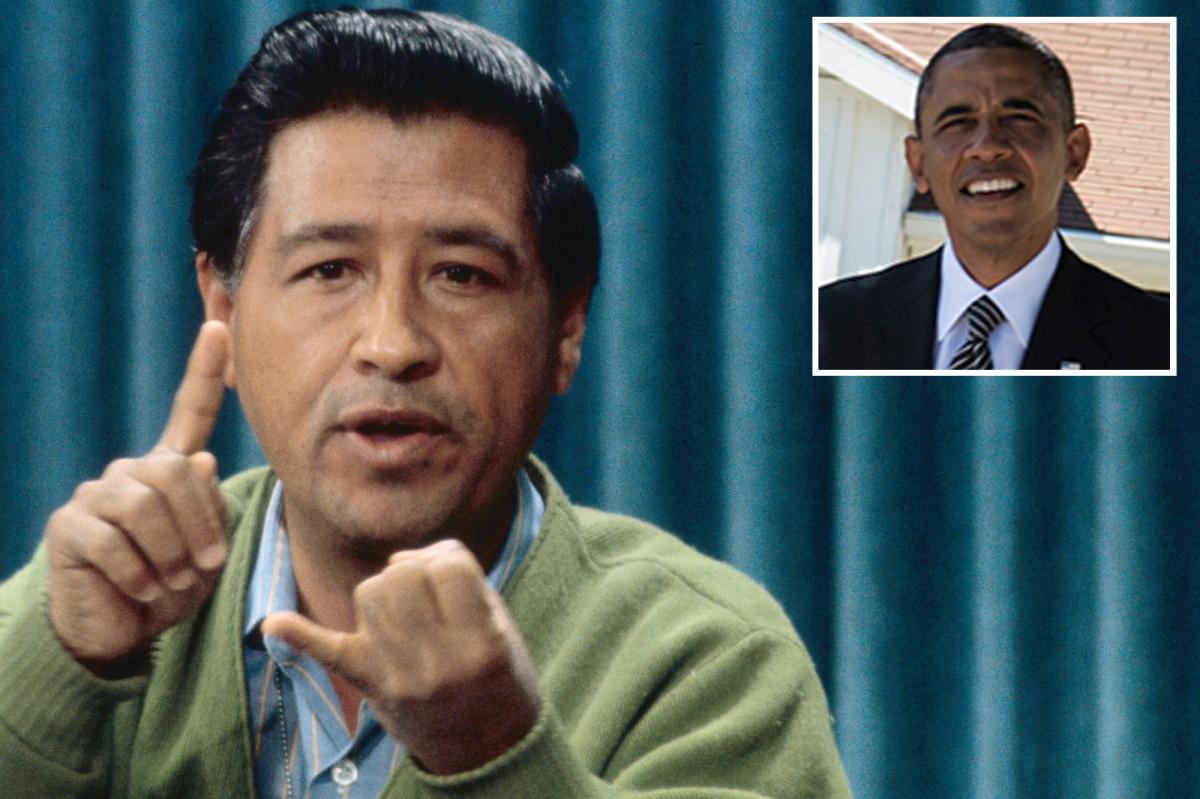
For decades, Chavez has been a revered figure among American progressives, having been celebrated by prominent leaders such as Barack Obama, Bill Clinton, and Joe Biden. Notably, during Biden’s presidency, a bust of Chavez was placed in the Oval Office.
Some insiders suggest that these startling allegations have been simmering beneath the surface for some time, though specifics have yet to be disclosed.
Enos Flores, a veteran of the labor movement, expressed his reaction to the San Antonio Express-News, stating, “When I saw that article, the first thought that came to mind was ‘the jig is up’.”
The Cesar Chavez Foundation said it was “deeply shocked and saddened” by the allegations, which are expected to be fully published in the coming weeks.
A statement read: “We have become aware of disturbing allegations that Cesar Chavez engaged in inappropriate sexual behavior with women and minors during his time as President of the United Farm Workers of America.”
“The Foundation is working with leaders in the Farmworker Movement to be responsive to these allegations, support the people who may have been harmed by his actions, and ensure we are united and guided by our commitment to justice and community empowerment.”
At the request of the foundations, events in Chavez’s name — often scheduled around his March 31 birthday — were cancelled or renamed in Tucson, Ariz., San Antonio and Corpus Christi, Texas, and Lansing, Mich, and across California.
Tucson Mayor Regina Romero said she was “personally devastated” by the allegations.
She said: “Moving forward, we will consider the input of the community on how to address the name of the holiday while continuing to honor workers and acknowledging the work that still needs to be done.”
San Antonio city spokesman Brian Chasnoff added to the Post that the César E. Chávez Legacy & Educational Foundation will not host an event in the city this year.
The abuse claims add a dark chapter to Chavez’s towering — yet complicated — legacy.
As co-founder of United Farm Workers in the 1960s, the first successful union representing farm laborers, Chavez led major strikes and boycotts that achieved better compensation and conditions for workers, who performed backbreaking labor for little pay.
His devotion to nonviolent protest, such as the Delano Grape Strike that asked Americans to boycott the popular fruit, and early success as an organizer won him almost saintlike status in the labor movement — especially in California, where Chavez co-founded United Farm Workers in the Central Valley alongside Dolores Huerta and Larry Itliong.
Download The California Post App, follow us on social, and subscribe to our newsletters
California Post News: Facebook, Instagram, TikTok, X, YouTube, WhatsApp, LinkedIn
California Post Sports Facebook, Instagram, TikTok, YouTube, X
California Post Opinion
California Post Newsletters: Sign up here!
California Post App: Download here!
Home delivery: Sign up here!
Page Six Hollywood: Sign up here!
Of the roughly 125 places named after Chavez nationwide — including schools, roads, parks, and community centers — approximately half are in California. In 2012, a naval ship was renamed after Chavez, who served in the US Navy from 1946-1948.
He was even hailed by the band Rage Against the Machine, which used his image in the video for “Renegades of Funk.” Singer Tom Morello sang about Chavez in a solo track called “Union Song.”
Former President Barack Obama spoke at the dedication of the Cesar Chavez National Monument in 2012 in Keene, Calif. — shouting, “Si, se puede,” the slogan popularized by Chavez’s farm worker movement.
“I want [visitors] to learn about a small man guided by enormous faith — in a righteous cause, a loving God, the dignity of every human being,” Obama said.
“Our world is a better place because Cesar Chavez decided to change it.”
Later, former President Joe Biden displayed a bronze bust of Chavez in the Oval Office.
But even before the new sexual abuse claims came to light, his legacy had become complicated, as scholars and others revealed the iconic leader’s failures and contradictions.
Critics have said that through the 1970s and 1980s, after United Farm Workers evolved into a national movement, Chavez took on an increasingly authoritarian leadership style that included purges of internal dissenters and fiscal problems.
Matthew Garcia, a professor of history at Dartmouth University, documented Chavez’s spiral in his book, “From the Jaws of Victory: The Triumph and Tragedy of Cesar Chavez and the Farm Worker Movement.”
Chavez’s personality shifted around the time Proposition 14, a key ballot measure that would have enshrined certain worker protections in the California constitution, was roundly defeated by voters in 1976, according to the book.
He became “increasingly manic” around the failure and was verbally abusive to staff, per the book, launching a “witch hunt” of internal critics — turning to a notorious cult leader, Charles Dederich of the controversial drug rehabilitation group Syanon, for tips on how to ferret out perceived enemies.
Synanon, first known as Tender Loving Care, started as a rehab but evolved into a twisted “attack therapy” cult that beat and brainwashed followers who lived in communes across California.
“Chavez saw Synanon as an unqualified success story for the financial independence it had achieved and strict obedience Dederich inspired from his followers,” Garcia wrote in his book.
Chavez was reportedly persuaded to use Synanon’s manipulative mind-control tactics, called “The Game,” on union members — including members of his own family.
In 2011, the New York Times reported that two of Chavez’s sons, Paul Chavez and Anthony Chavez, were embroiled in a bitter dispute tied to his legacy.
The siblings quarreled in court over management of nonprofits tied to United Farm Workers.
“The problem now is that the organization has simply drifted,” Miriam Pawel, who penned a book about the union, told the paper.
“It has become a family-run organization that is sort of purposeless and does little or nothing to help farm workers.”