
Share this @internewscast.com

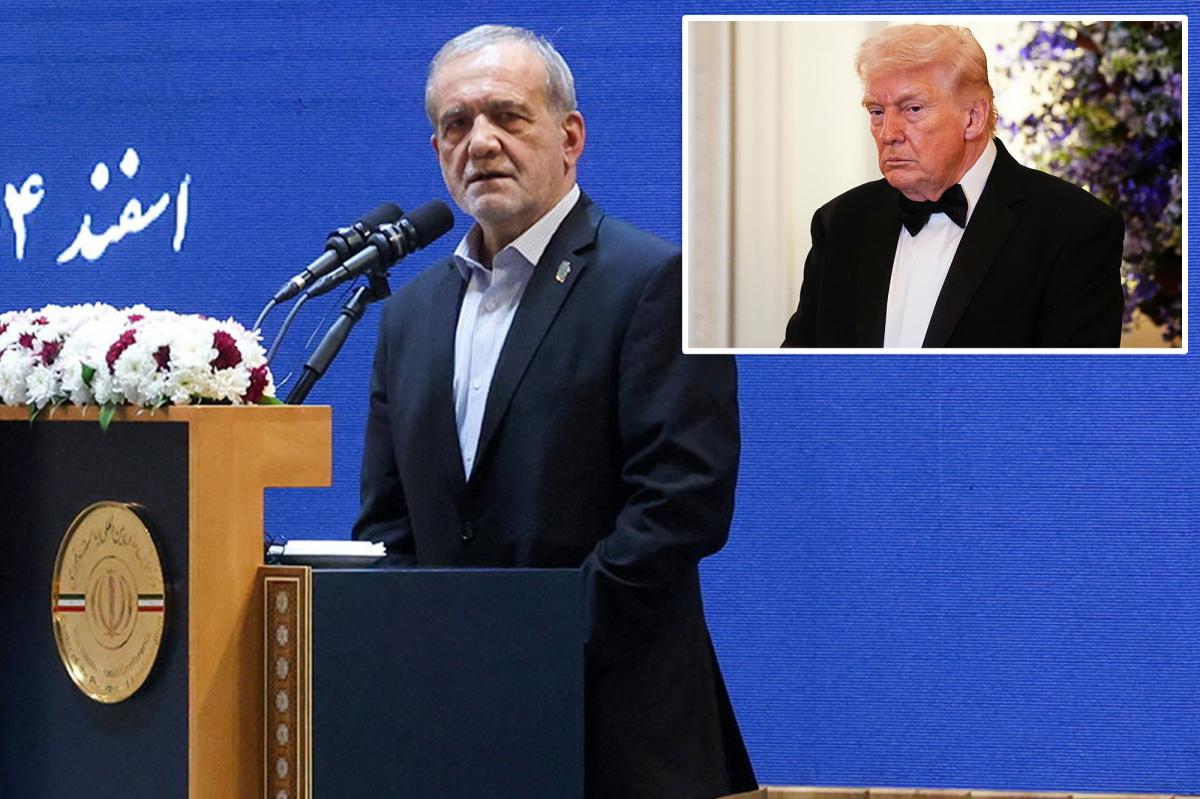
On Saturday, Iranian President Masoud Pezeshkian firmly declared that Tehran would resist foreign pressure, even as tensions escalate with the United States over nuclear negotiations. His announcement comes amid a significant U.S. military buildup in the Middle East, the largest since the Iraq invasion.
Speaking on state television, President Pezeshkian expressed defiance, stating, “World powers are aligning to make us submit, but we will not yield, despite all the challenges they impose on us.”
This firm stance arises as tensions over Iran’s nuclear program reach a boiling point. President Trump has issued a stern warning to Iran, giving the nation a mere ten days to strike a nuclear agreement or face severe airstrikes targeting its nuclear facilities.
Potential military actions could extend to the Islamic Republic itself, with possible targets including Iranian Supreme Leader Ayatollah Ali Khamenei, according to two U.S. officials speaking to Reuters.
President Trump has left the door open for military intervention against the Iranian regime, with the current military buildup in the region reminiscent of the forces gathered near Venezuela before the January 3 operation to capture leader Nicolas Maduro and his spouse.
Trump has not ruled out the use of military force against the theocratic regime, and his military buildup in the region mirrors the one he amassed near Venezuela before the Jan. 3 raid to capture strongman Nicolas Maduro and his wife.
“They have something for every scenario,” one Trump adviser told Axios of the Pentagon’s plan.
“One scenario takes out the ayatollah and his son and the mullahs. What the president chooses no one knows. I don’t think he knows.”
The Iranian dictator — whose brutal crackdown on nationwide protests last month has killed at least 7,000 — also threatened on social media to sink US warships. Trump had vowed to come to the protesters’ rescue, but has thus far declined to take military action against Iran.
“It is entirely possible we will see the regimes fall in Iran, in Venezuela and in Cuba, and we could also see governments replace them that want to be friends with the United States of America,” Texas Senator Ted Cruz told Fox News’ Sean Hannity Wednesday night.
The Republican said he told the president Iran’s regime is “teetering” and that the US has an opportunity to take military action, arguing that toppling it would mark the “most consequential geopolitical shift” since the fall of the Berlin Wall.
“We’re not going to see hundreds of thousands of troops on the ground. We’re not going to see massive American casualties, but the president is willing to defend American national security interests,” Cruz said.
Meanwhile, Washington continued its military build up ahead of a potential conflict, dispatching the world’s largest aircraft carrier, the USS Gerald R. Ford, to the Middle East to join the USS Abraham Lincoln and an expanding naval fleet in the region.
When asked if the US could target the Tehran regime’s nuclear sites again, Trump replied, “If we do it, that would be the least of the mission.”
Last year, Trump greenlit Operation Midnight Hammer to bomb three of Iran’s top nuclear facilities, a mission he claimed “completely and totally obliterated” those facilities, which the US alleged were used for a nuclear weapons program.
Iran has denied that it has been pursuing a nuclear weapon, despite having at one point enriched at 60%, far above the threshold needed for nuclear power plants.