
Share this @internewscast.com
On Palm Sunday, the Church of the Holy Sepulchre in Jerusalem, along with other significant holy sites, were shut down due to wartime restrictions imposed by Israel. This closure disrupted the observance of one of Christianity’s most sacred days as tensions from the ongoing conflict with Iran extended into its fifth week.
The Catholic Church criticized the decision by law enforcement, describing it as “a manifestly unreasonable and grossly disproportionate measure.”
Israeli police expressed regret over the restrictions impacting worship but emphasized the need to find a balance between religious freedom and public safety.
In a statement shared on social media platform X, Israeli police explained, “According to Home Front Command directives, life-saving restrictions apply to all holy sites in the Old City, affecting Jews, Christians, and Muslims alike.” They further highlighted that the Old City had been under attack multiple times this month with missiles, alongside continuous threats to residential areas.
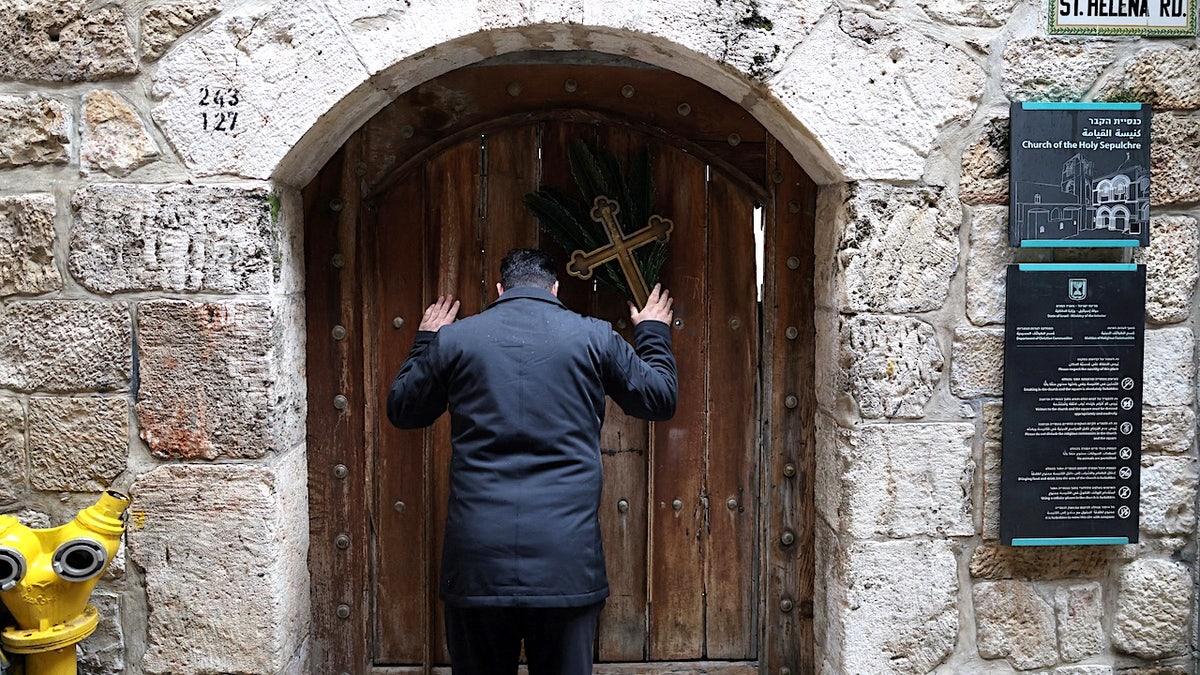
Issa Kassissieh, known for his role as the city’s Santa Claus, was seen holding a cross and a palm frond at the locked doors of the Church of the Holy Sepulchre. This came after the traditional Palm Sunday procession from the Mount of Olives was canceled. (Ammar Awad/Reuters)
The statement also reassured, “These threats do not discriminate between religions, and neither does our duty to protect you.” It mentioned ongoing discussions with religious leaders, including an upcoming meeting with the Patriarch, to explore solutions that ensure worship can continue safely while maintaining public security.
The Latin Patriarchate said Cardinal Pierbattista Pizzaballa, the Latin Patriarch of Jerusalem, and Father Francesco Ielpo were stopped by Israeli police while trying to reach the church privately to celebrate Mass, after the traditional Palm Sunday procession had already been canceled.
Israel President Isaac Herzog called the restricted worshipers to “express my great sorrow over this morning’s unfortunate incident.”
“I clarified that the incident stemmed from security concerns due to the continuous threat of missile attacks from the Iranian terror regime against the civilian population in Israel, following previous incidents in which Iranian missiles fell in the area of the Old City of Jerusalem in recent days,” he wrote Sunday on X. “I reaffirmed the State of Israel’s unwavering commitment to freedom of religion for all faiths and to upholding the status quo at the holy sites of Jerusalem.”
Italy rebuked what it called an “offense” on “religious freedom” in the Holy Land.
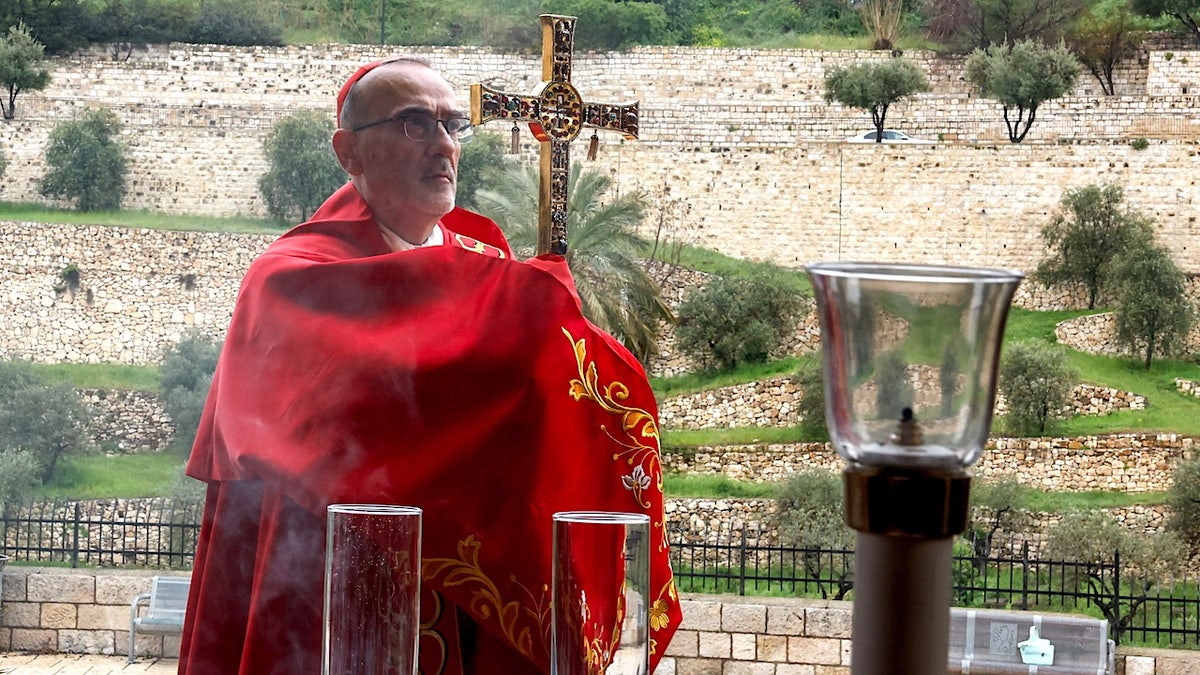
Cardinal Pierbattista Pizzaballa, the Latin Patriarch of Jerusalem, held a prayer service to mark Palm Sunday, following the cancellation of the traditional Palm Sunday procession from the Mount of Olives, amid restrictions on gathering in large groups and the U.S.-Israeli conflict with Iran. (Ammar Awad/Pool)
“The Italian government expresses closeness to Cardinal Pizzaballa, Father Ielpo and the religious who have been prevented today by the Israeli authorities from celebrating the Palm Sunday Mass in the Holy Sepulcher,” Italy Prime Minister Giorgia Meloni wrote in a statement. “The Holy Sepulchre of Jerusalem is a sacred place of Christianity, and as such to be preserved and protected for the celebration of sacred rites. Preventing the entry of the Patriarch of Jerusalem and the Keeper of the Holy Land, moreover in a central solemnity for the faith such as Palm Sunday, constitutes an offense not only for believers, but for every community that recognizes religious freedom.”
The Latin Patriarchate said the Church of the Holy Sepulchre has been hosting Masses that are not open to the public since the Iran war began Feb. 28, and it was unclear why Sunday’s Mass and access by the two priests was any different.
“It’s a very, very sacred day for Christians and in our opinion there was no justification for such a decision or such an action,” Latin Patriarchate of Jerusalem spokesperson Farid Jubran said.
The church had requested permission from the police, he added, for a few religious leaders to enter the church for a private Mass on Sunday — not one that was open to the public.
Pope Leo XIV, at the end of Palm Sunday Mass in St. Peter’s Square, prayed for all Christians in the Middle East who he said were living through an “atrocious” conflict. He said, “in many cases, they cannot live fully the rites of these holy days,” though he did not elaborate.
Israeli Prime Minister Benjamin Netanyahu said Sunday evening that there was no “malicious intent” and that the cardinal was prevented from accessing the church because of safety concerns, but that Israel would try to partially open the Church of the Holy Sepulchre.
“Given the holiness of the week leading up to Easter for the world’s Christians, Israel’s security arms are putting together a plan to enable church leaders to worship at the holy site in the coming days,” Netanyahu wrote on X.
The Western Wall, a holy site for Jews, is also mostly closed because of safety issues, but authorities are letting up to 50 people at a time pray in an enclosed area adjacent to the plaza.
Smaller churches, synagogues, and mosques are open in Jerusalem’s Old City if they are located within a certain distance of a bomb shelter deemed acceptable by Israel’s military and, if gatherings are kept under 50 people.