Share this @internewscast.com

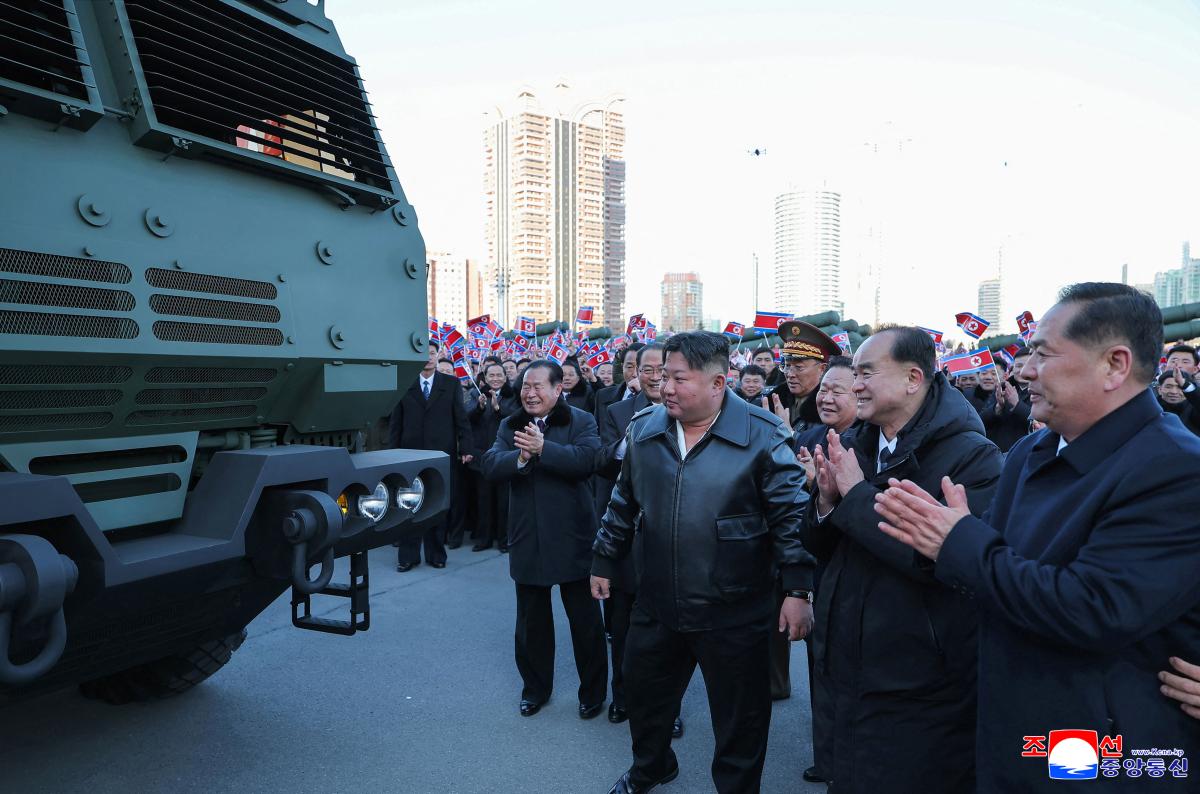
SEOUL, South Korea — On Thursday, North Korea announced that its leader, Kim Jong Un, presided over a ceremony revealing the deployment of 50 new launch vehicles. These vehicles are equipped to carry nuclear-capable short-range missiles, posing a threat to South Korea. This display of military prowess comes just before a significant congress of the ruling party.
In a related development, Kim’s sister, an influential figure in foreign policy, acknowledged an apology from a South Korean minister over alleged civilian drone incursions. However, she emphasized that North Korea is enhancing its border defenses in response to what it perceives as threats from the “enemy” South.
Since 2019, North Korea has largely halted dialogue and cooperation with South Korea. This pause followed the breakdown of Kim’s nuclear negotiations with then-U.S. President Trump, which faltered over sanctions led by the U.S.
Relations have deteriorated further in recent years as Kim abandoned North Korea’s long-time goal of peaceful reunification. Instead, he has embraced a more confrontational “two-state” approach on the Korean Peninsula. This perspective might be officially integrated into the Workers’ Party’s constitution at the forthcoming congress.
State media released images showing multiple launcher trucks lined up outside the April 25th House of Culture, which hosted party congresses in both 2016 and 2021.
The Korean Central News Agency reported that these new vehicles are compatible with North Korea’s 600-millimeter multiple rocket launcher systems.
Experts say North Korea’s large artillery rockets blur the distinction between artillery systems and short-range ballistic missiles because they can create their own thrust and are guided during delivery.
They are part of Kim’s growing collection of nuclear-capable short-range weapons that are designed to overwhelm missile defenses in South Korea.
Kim, in a speech, said the “wonderful” rocket launchers are equipped with artificial intelligence and advanced guiding technologies tailored to carry out a “strategic mission,” a term that implies nuclear purpose.
He said the upcoming congress will issue new plans to expand the capabilities of his nuclear-armed military, which already has various systems targeting U.S. allies in Asia and long-range missiles potentially capable of reaching the U.S. mainland.
In her statement, Kim’s sister, Kim Yo Jong, said she “highly assesses” an apology made by South Korean Unification Minister Chung Dong-young over the alleged drone flights but reiterated that the North would respond with force if such flights recur.
She said the country’s military would strengthen surveillance across the border with the South.
“The border with an enemy state should naturally be firm,” she said.
Chung on Wednesday said Seoul was considering reinstating a suspended 2018 inter-Korean military pact on reducing border tensions, which included a no-fly zone, as part of measures to prevent further drone incursions into the North.
North Korea threatened retaliation last month after accusing South Korea of launching a surveillance drone flight in September and again in January.
The South Korean government has denied operating any drones during the times specified by North Korea but law enforcement authorities are investigating three civilians suspected of flying drones into the North from border areas.