I probably should have thought twice, felt concern or apprehension. Maybe even a little fear.
When the editor inquired if I would be willing to assist in covering the war and, incidentally, transport $15,000 in cash consisting of $5, $10, and $20 bills into the battle zones of Vietnam and Cambodia, I enthusiastically agreed, saying, “Of course!”
During this period in 1975, both of these intense and prolonged conflicts were seemingly coming to a close as communist troops achieved repeated victories, seizing one province after another in each nation.
Perhaps understandably, businesses such as hotels, grocery stores, restaurants, car rentals, and similar services had grown hesitant to accept credit cards as a promise of payment for their services amidst the uncertain future.
So, the green of universal U.S. cash became crucial to work and survival for a major newspaper’s correspondents in the field.
I had spent 15 years dreaming, studying, practicing, scheming, apprenticing, and hoping to become a newspaper foreign correspondent. Now, I had been given the chance at my first assignment abroad, as a reporter reinforcement in the Saigon news bureau, where the sound of artillery fire in the suburbs was disturbingly routine.
The California bank vice president ushered me into a quiet, private room where a teller awaited with canvas Brinks bags. She began counting out mountains of bills — first the $5’s, then the $10’s, and finally, the $20’s.
As someone whose childhood allowance was 25 cents, I was rather impressed. I’m even more impressed knowing that those bills would now be worth $91,215.
The bank officer slid the receipt and a pen across the shiny table of wealth and said in an ominous tone, “Are you sure you want to do this?”
“Oh, yeh,” I responded in a piece-of-cake tone.
They watched me stuff fistfuls of bills into two new money-belts. In hindsight at my age in this age, it might have been wiser not to proceed directly from the money-belt department to a bank.
But I was about to become a foreign correspondent.
I pulled the shirt out of my pants to cover the belts wrapped around my waist. They were longer than I expected and overlapped. That’s when I realized the foreign-correspondent wardrobe would require casual shirts to conceal the bulge of my temporary wealth.
“Good luck,” the banker said.
In my years as a national correspondent, four hours was a long flight. It took only 15 minutes from home to the San Francisco airport.
But the Pacific is a very large place. It then took almost six hours to Honolulu. A two-hour layover. Then 11-and-a-half hours to Manila. Another layover. Then, three more hours to the city of Saigon that was about to get a new name.
The bulky fortune never left my hips the entire time, sleeping, waking, every minute. The belts were hot and made me feel fat. Naively though, I did not think much about being a walking robbery target, which was probably good since I didn’t appear to be cautiously hiding something.
Long, slowly-descending, straight-line airport approaches were out of the question in Vietnam in those days when the government controlled less and less territory around cities. So, the Pan Am pilot took us in a steep-corkscrew descent over the airport. It felt like a whirlpool.
I confess walking naively into the sudden cacophony of a packed Southeast Asian city under siege was a tad overwhelming. My colleagues, both American and local Vietnamese, could not have been more patient and understanding. And I could deposit the cash in the office safe.
After the fall of Vietnam, I would meet up with these same helpful local colleagues in Guam and repay some of their kindness by helping them and their extended families through the United States’ refugee acceptance process. In those days, it was very official, cumbersome, and time-consuming. Also required.
This accidentally produced an awkward, but hilarious half-hour when, locked in a camp, they asked me to explain this mysterious American holiday called Easter that involved a rabbit. And how big was he, by the way?

The Saigon team included the news legend Malcolm Browne. He was a chemistry major drafted as a journalist into the Korean War whose creative news exploits in the early days of Vietnam I had admired and closely studied as a college student. Now, I was having lunch with him while he shared tips and experiences.
He was one of the kindest, most patient, diligent journalists I ever met. That’s no small feat in a profession based on urgent deadlines and casual, passing relationships with people involved in the news.
After the fall of Vietnam, Mal expressed concern about the fate of his Vietnamese wife’s family. I was on Guam then covering the immense chaotic wartime evacuation. There, in the sprawling tent city of 120,000 frightened people, so large it had its own Zipcode, speaking little Vietnamese, I somehow found them and could send reassurance.
In-country the four of us correspondents took turns venturing out by chartered plane to encircled cities. One day, Mal returned from DaNang. “It’s over,” he said. “Families are selling heirlooms in the street.”
Direct American involvement in that war began in 1961 four months after Democrat John F. Kennedy became president and canceled his predecessor’s non-involvement.
During the next 14 years, 2.7 million U.S. service members deployed to Vietnam; 58,220 did not come home alive. The non-communist government there collapsed anyway.
While Mal was correct about the war’s imminent end, the U.S. ambassador, Graham Martin, refused to allow evacuation preparations, claiming that would ignite panic. When the end did come, seemingly suddenly, the lack of preparations ignited panic anyway.
Does any of this sound familiar?
The exact same thing happened in 2021 at the end of the United States’ next military defeat. After 20 years’ military involvement in Afghanistan, without careful preparation, another Democrat president, Joe Biden, abruptly pulled the plug one midnight without even notifying NATO or local allies there.
Once again, the U.S.-backed government collapsed. The Taliban quickly captured province after province. Panic, chaos, and death ensued and, despite Biden’s false assurances, U.S. diplomatic personnel required evacuation by helicopter from the embassy roof, just as in Saigon 46 years before. They neglected to destroy detailed personnel files on thousands of Afghans who’d helped the allies and were left behind. As was billions in brand-new military equipment.
Fortunately in 1975, CIA sources confirmed back-channel to us that the end was near and because of the lack of preparations it would be messy. Our editors ordered both correspondents with families to leave, and I donned my money-belts again. Eventually, the other reporters and all Vietnamese staff and families did get out safely.
As we underwent frisking to board the plane to Bangkok, my “helpful” colleague said out loud, “Gee, I hope they don’t find all the money you’re carrying out of the country.”
Apparently, the agent did not speak English. And I could spend the 90-minute flight watching large cockroaches scamper beneath the plane seats.
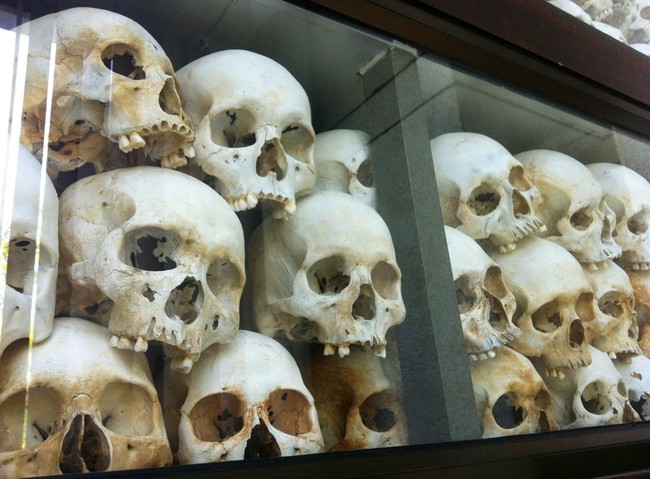
I do not recall where I hid the money in my Thai hotel room. But it worked. After a lengthy delay, I met my colleague there on his brief break from covering the Cambodian war that would become an Asian holocaust under the murderous Pol Pot and radical communist Khmer Rouge.
My fellow correspondent carefully counted out the money while I sipped a cold Coke. It was all there. I was relieved and went on to other assignments. One of them had me travel 110 miles south past caravans of cargo elephants to a U.S. airbase. There, I met and supplied the evacuated family of our Cambodian interpreter.
They had only the clothing they wore. Never having been on a giant helicopter, flown over an ocean, landed on an aircraft carrier, and been delivered to a foreign country, the mother and children were understandably terrified.
I gave them several bags of new clothes. To be honest, I had not purchased a bra for anyone before, let alone one for an Asian woman I had never met.
My solution: Don’t buy one. Get several in a range of sizes. I’ve wondered about her reaction when she pulled them all out, especially the large ones.
That afternoon at the money turnover in Bangkok was the last I saw of my temporary treasure. Until, that is, nine years later I experienced the chilling movie, “The Killing Fields,” about my coworker and his Cambodian interpreter’s harrowing experiences and escapes.
Viewer Advisory: It’s probably the most compelling and brutally real film I’ve ever seen. I’m glad the theater was dark.
In one scene, journalists including my colleague and his partner were leaving a hospital overflowing with dying and wounded as Khmer Rouge fighters launched their years-long killing spree of millions.
A hulking tank grumbled ominously in position to block the journalists’ exit. Shouting guerrillas brandishing AK-47’s seized the car and men. They broke open the trunk and rummaged through its contents, including a minor mountain of small U.S. bills that looked strikingly familiar.