
Share this @internewscast.com
By VESELIN TOSHKOV
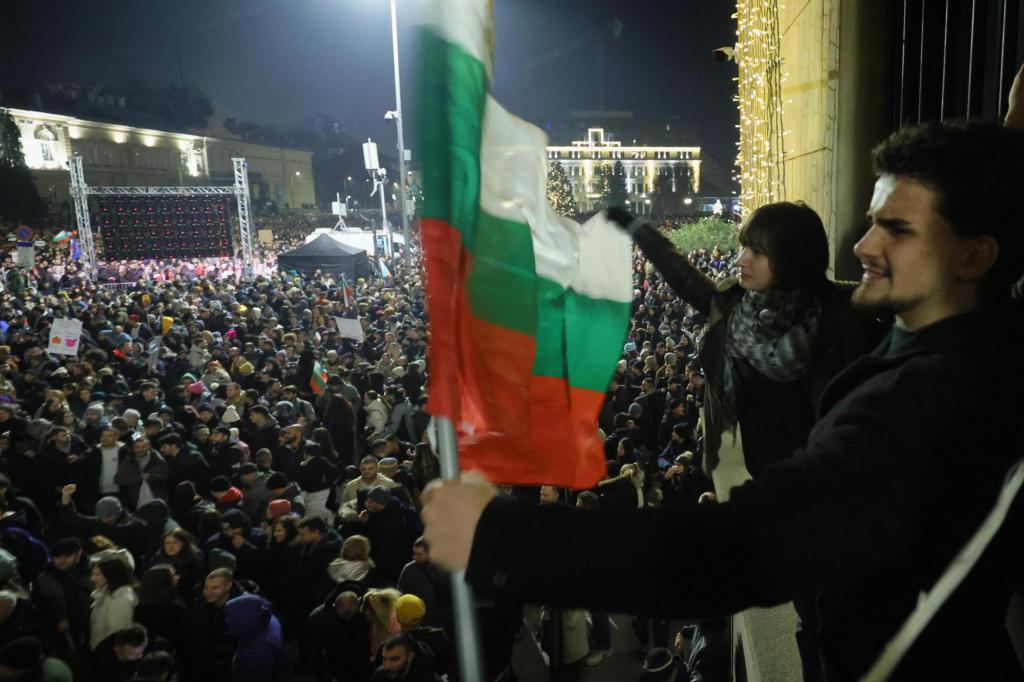
SOFIA, Bulgaria (AP) — On Wednesday, tens of thousands took to the streets across Bulgaria in widespread protests, accusing the government of pervasive corruption. These demonstrations highlight the political tensions in the country, mere weeks ahead of its planned adoption of the euro as its official currency at the beginning of next year.
The current wave of protests follows a series of demonstrations last week triggered by the government’s proposed budget, which called for increased taxes, higher social security contributions, and greater spending. In response to the backlash, officials have withdrawn the contentious 2026 budget plan.
Protesters have since broadened their demands, now calling for the resignation of Prime Minister Rosen Zhelyazkov’s center-right administration.
In Sofia, demonstrators converged on a central square surrounded by key government buildings, including parliament, the presidency, and the government headquarters. They vocalized their discontent with chants of “Resignation” and “Mafia,” urging Zhelyazkov’s minority coalition to relinquish power.
The protests attracted a significant turnout, including students from Sofia’s universities, reportedly surpassing the previous week’s gathering of over 50,000 participants. Drone footage estimated the crowd size to exceed 100,000.
At the core of the protesters’ frustrations is the role of Bulgarian politician and oligarch Delyan Peevski, who has been sanctioned by both the United States and Britain, and whose MRF New Beginning party backs the government. Peevski has been accused by opponents of helping shaping government policy in line with oligarchic interests.
-

TOPSHOT – This drone aerial photograph shows the crowd as tens of thosands of protesters gather in central Sofia to demonstrate against the Buglarian government, in Sofia on December 10, 2025. Tens of thousands of people held anti-government protests in Bulgaria on December 10, 2025 widening an anti-corruption movement sweeping the European Union’s poorest country as it prepares to adopt the euro. (Photo by Dobrin KASHAVELOV / AFP via Getty Images)


1 of 4
TOPSHOT – This drone aerial photograph shows the crowd as tens of thosands of protesters gather in central Sofia to demonstrate against the Buglarian government, in Sofia on December 10, 2025. Tens of thousands of people held anti-government protests in Bulgaria on December 10, 2025 widening an anti-corruption movement sweeping the European Union’s poorest country as it prepares to adopt the euro. (Photo by Dobrin KASHAVELOV / AFP via Getty Images)
No violence was reported and the protests ended peacefully.
Also on Wednesday, the opposition coalition We Continue the Change – Democratic Bulgaria called for a no-confidence vote in the government. The vote, the sixth such motion by the opposition, will take place on Thursday.
Bulgarian President Rumen Radev wrote on Facebook that Wednesday’s demonstrations were in effect a vote of “no confidence in the Cabinet.”
Radev, an opponent of the government who hails from the political left, urged the lawmakers to listen to the people and to “choose between the dignity of free voting and the shame of dependence” when they vote on Thursday.
Bulgaria is soon to become the 21st member of the eurozone, a euro currency union that is a key EU project aimed at deepening ties between member countries. The Balkan country of 6.4 million people is to make the switch from its national currency, the lev, to the euro on Jan. 1.