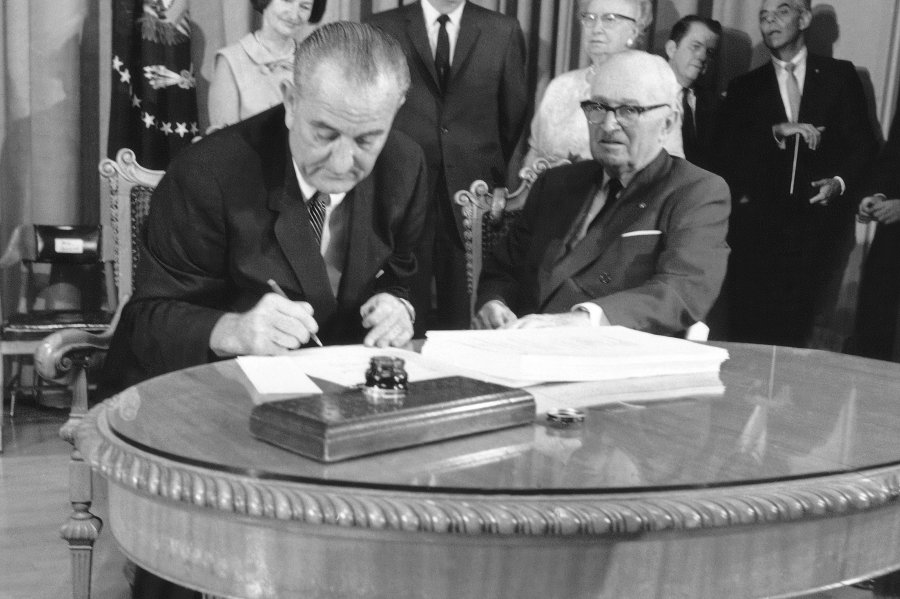


WASHINGTON (AP) — On this date in 1965, President Lyndon B. Johnson enacted legislation establishing Medicaid, providing a health care safety net for millions of low-income Americans. This initiative became one of the defining achievements of his domestic agenda.
A year prior, he took similar action regarding food stamps, inspired by President John F. Kennedy’s initial executive order to develop a “positive food and nutrition program for all Americans.”
This summer, with the stroke of a pen, President Donald Trump began to chisel them back.
The Republican Party’s substantial tax and spending legislation not only provided $4.5 trillion in tax breaks for Americans but also introduced significant reforms to the historic safety net programs. In exchange, over $1 trillion will be cut over ten years from federal health care and food assistance, primarily through imposing work requirements for aid and transferring certain federal costs to the states.
Republicans in Congress argue that these reductions are essential to align federal programs with fiscal realities to curb increasing federal deficits. They are also furthering a longstanding GOP objective to reduce the size of the federal government and its services.
“We’re making the first changes to the welfare state in generations,” House Speaker Mike Johnson said in a recent podcast interview.
As the law addressing tax breaks and spending cuts begins to take effect, it heralds a period of unpredictability for the safety net programs relied upon by millions across the country, potentially influencing future political landscapes.
Big safety net changes ahead
Polls indicate that most U.S. adults do not believe the government is overspending on these programs. There is broad public support for either increasing or maintaining current funding levels for key safety net programs, including Social Security and Medicare, as reflected in a poll from The Associated Press-NORC Center for Public Affairs Research.
Local governments are scrambling to figure out how they will comply with the new landscape, calculating whether they will need to raise their own taxes to cover costs, trim budgets elsewhere or cut back the aid provided to Americans.
“The cuts are really big, they are really broad and they are deeply damaging,” said Sharon Parrott, president of the Center for Budget and Policy Priorities, a research institute in Washington.
“The consequences are millions of people losing health care coverage,” she said. “Millions of people losing food assistance. And the net result of that is higher poverty, more hardship.”
At the same time, certain people who receive aid, including parents of teenagers and older Americans up to age 64, will have to prepare to work, engage in classes or do community service for 80 hours a month to meet new requirements.
All told, the nonpartisan Congressional Budget Office estimates 10 million more people will end up without health insurance. Some 3 million fewer people will participate in the Supplemental Nutritional Assistance Program, known as SNAP.
“People are really concerned what this means for their fiscal health,” said Mark Ritacco, chief governmental affairs officer at the National Association of Counties, which held its annual conference the week after Trump signed the bill into law.
The organization had pushed senators to delay the start dates for some Medicaid changes, and it hopes that further conversations with lawmakers in Congress can prevent some of them from ever taking hold. At its conference, questions swirled.
“We’re talking about Medicaid and SNAP — these are people’s lives and livelihoods,” Ritacco said.
GOP bill trims back health care and food aid
Republicans insist the law is adhering to Trump’s vow not to touch Medicaid as the changes root out waste, fraud and abuse. A memo from the House GOP’s campaign arm encourages lawmakers to focus on the popularity of its new work requirements and restrictions on benefits for certain immigrants.
“Those safety nets are meant for a small population of people — the elderly, disabled, young pregnant women who are single,” the House speaker said on “The Benny Show.”
He said the years since the Affordable Care Act, or Obamacare, came into law, “everybody got on the wagon.”
“All these young, able-bodied, young men who don’t have dependents, riding the wagon,” the speaker said.
Medicaid then and now
When President Johnson established Medicaid alongside Medicare — the health care program for seniors — as part of the Social Security Amendments of 1965, it was meant for low-income families as well as the disabled.
And it quickly took off. Almost every state signed on to participate in Medicaid by 1970, according to the KFF, an organization focused on health policy. It soon went beyond covering its core population to include pregnant women, school-age children and not just the very poor but also those with incomes just over the federal poverty limit, which is now about $15,650 annually for a single person and $26,650 for a family of three.
In the 15 years since the Affordable Care Act became law under President Barack Obama, Medicaid has grown substantially as most states opted to join the federal expansion. Some 80 million adults and children are covered.
While the uninsured population has tumbled, the federal costs of providing Medicaid have also grown, to more than $880 billion a year.
“There are a lot of effects Medicaid has on health, but the most stark thing that it does is that it saves lives,” said Bruce D. Meyer, an economist and public policy professor at the University of Chicago who co-authored a pivotal study assessing the program.
The law’s changes will certainly save the federal government “a substantial amount of money,” he said, but that will come at “substantial increases in mortality. And you have to decide what you value more.”
Food stamps, which had been offered toward the end of the Great Depression but were halted during World War II amid rationed supplies, launched as a federal program when Johnson signed the Food Stamp Act of 1964 into law.
Today, SNAP provides almost $200 in monthly benefits per person to some 40 million recipients nationwide.
Democratic Leader Hakeem Jeffries, who delivered the longest speech in House history while trying to stall the bill, said the changes will hurt households and communities nationwide.
“Who are these people?” Jeffries said. “Ripping health care away from the American people. The largest cuts in Medicaid in American history. Ripping food out of the mouths of children, seniors and veterans who are going to go hungry as a result of this one big, ugly bill.”