
Share this @internewscast.com

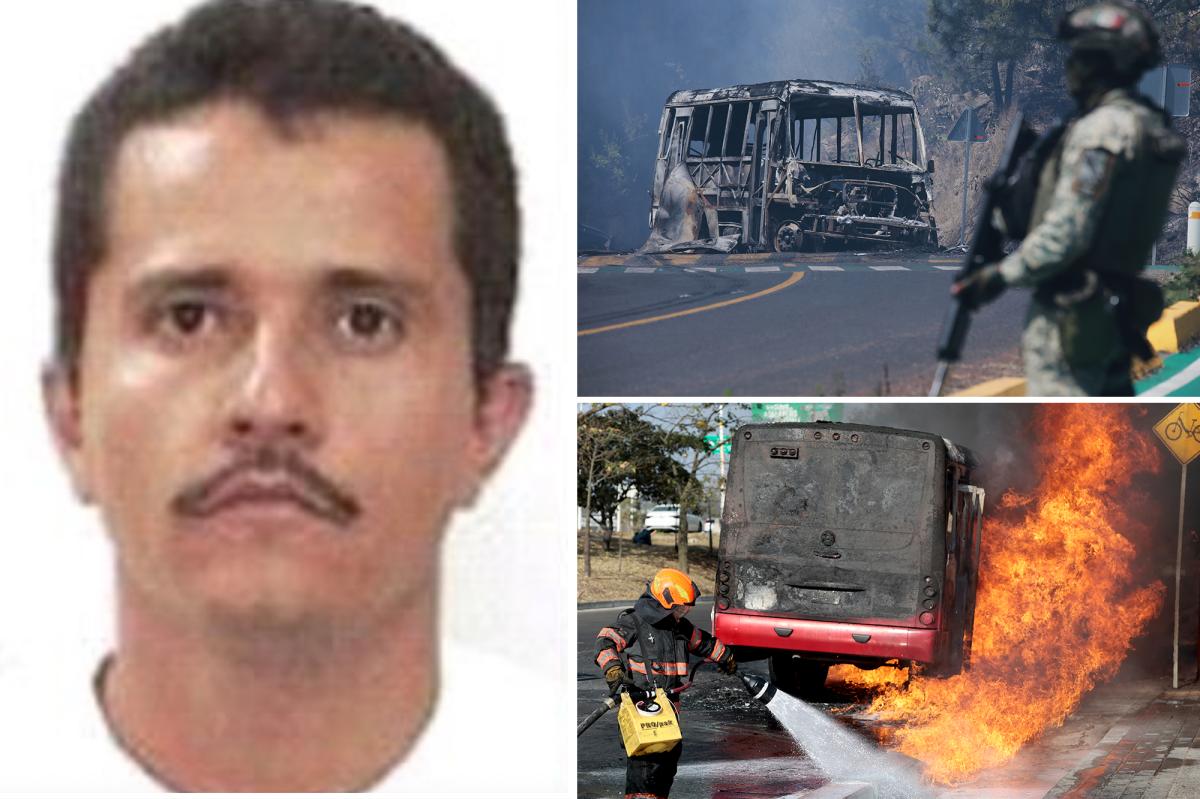
Nemesio Rubén “El Mencho” Oseguera Cervantes, the notorious leader of the Jalisco New Generation Cartel, met his end during a military operation on Sunday. Known as the most wanted drug lord in both Mexico and the United States, Oseguera Cervantes climbed the cartel ranks from a lead assassin to a feared kingpin through a meticulously executed and violent takeover.
Once a police officer, Oseguera Cervantes faced a hefty $15 million reward for his capture, as offered by the U.S. State Department. His life came to a dramatic close during a confrontation with Mexican military forces in Tapalpa, located in his stronghold of Jalisco.
Jalisco’s Governor, Pablo Lemus Navarro, confirmed that Oseguera Cervantes, the co-founder and leader of the Jalisco New Generation Cartel (CJNG), was among the seven individuals killed during the Tapalpa operation.
The aftermath of his death threw Puerto Vallarta, a renowned resort city on Jalisco’s coast, into turmoil. Incensed cartel operatives retaliated by setting fires in the streets to fend off advancing military personnel. Simultaneously, violence erupted in other regions including Michoacan, Tamaulipas, Colima, Guanajuato, Aguascalientes, and Veracruz, as reported by the Spanish-language news outlet Milenio.
This widespread havoc aligns with the violent legacy Oseguera Cervantes, aged 59, left behind. Under his command, the CJNG was notorious for heinous acts of torture, including acid baths, decapitations, and even cannibalism, as uncovered by a Courier Journal investigation.
Oseguera Cervantes’s path to infamy began in his youth when he abandoned school to assist his parents, who were modest farmers, in harvesting avocados in their native Michoacán.
He left Mexico when he was a teenager and illegally entered the US. He established his hodgepodge drug dealings in San Francisco, where he was caught and deported three times, according to authorities.
The third time was, by far, the sloppiest endeavor in Oseguera Cervantes’ laundry list of a criminal record.
He and his older brother, Antonio Oseguera Cervantes, tried to sell $9,500 worth of heroin to a pair of undercover cops in 1992. El Mencho served four years in a federal prison before he was deported back to Mexico, seemingly for the final time.
By then, he already had two American-born children.
Back in Mexico, Oseguera Cervantes settled in Tomatlán and enlisted in its police force.
Oseguera Cervantes soon circled back to his hometown and joined the Milenio Cartel. There, he met his wife, whose siblings made up a prominent branch of the cartel known as Los Cuinis and funded Nemesio’s rise.
He served as a lead assassin at a cartel cell in Guadalajara. He performed and ordered unspeakable acts against members of the Los Zetas cartel. They earned the nickname Los Matazetas — Zeta Killers, El Pais reported.
In the late 2010s, with Los Zetas’ control wavering, the Milenio Cartel moved into Guadalajara.
For all his work, Oseguera Cervantes expected a promotion to the cartel’s top ranks. His long wait was stalled in 2008 and 2009 after some of the cartel’s leaders were eliminated, leaving a gaping void in leadership.
Oseguera Cervantes and his brother-in-law cooked up a ploy to seize control. While his in-laws provided the funds, Oseguera Cervantes was their sword, and eagerly launched a bloody coup against his own.
Oseguera Cervantes’s side emerged victorious in 2011 and rebranded as the CJNG and the linked Los Cuinis organization.
CJNG’s growth was unprecented and by 2019, the cartel was responsible for at least a third of the drugs entering the US.
The cartel recruited hundreds of men to join — many by force and some as young as 12 — and trained them to be killers at remote paramilitary camps, according to the Courier Journal probe.
The ones who tried to escape the CJNG’s grip were tortured, killed and even cannibalized by fellow recruits as a gruesome initiation practice, US agents told the outlet.
Oseguera Cervantes’ empire expanded into all 32 states in Mexico, into the US and beyond, including Australia, Europe and Japan.
The cartel boss escaped at least two military raids before his death — in 2012 and 2018 — all thanks to his men who were willing to lay down their lives for him.
His family is entrenched in the cartel world, though the most prolific are behind bars.
His only son, Rubén Oseguera González, 36, is a high-ranking member of the CJNG serving life in prison for various drug trafficking offenses.
His eldest daughter, 39-year-old Jessica Johanna Oseguera González, was sentenced to 30 months in prison for willfully engaging in financial dealings with Mexican narcotics traffickers in 2021, but was released in April 2022.
His brother, 67-year-old Antonio, faked his death and jumped ship for California, where he was arrested in 2022.
His brother-in-law and co-founder of Los Cuinis, 49-year-old José González Valencia, was sentenced to 30 years in prison in June 2025 for his involvement in the family’s cartel, including arranging the use of a semi-submersible to avoid detection.
His son-in-law, 28-year-old Cristian Fernando Gutiérrez-Ochoa, was arrested in California after he also faked his own death and fled Mexico. He was sentenced to just over 11 years in prison for an international money laundering offense in December 2025.
Oseguera Cervantes and his wife, Rosalinda González Valencia, divorced in 2018. She was charged with money laundering and sentenced to five years in a Mexican prison in 2023, but was released early in January 2025, according to local media.
Oseguera Cervantes was indicted several times in Washington DC before his death, most recently in April 2022, when he was charged with conspiracy and distribution of controlled substances for illegal importation into the US.