
Share this @internewscast.com

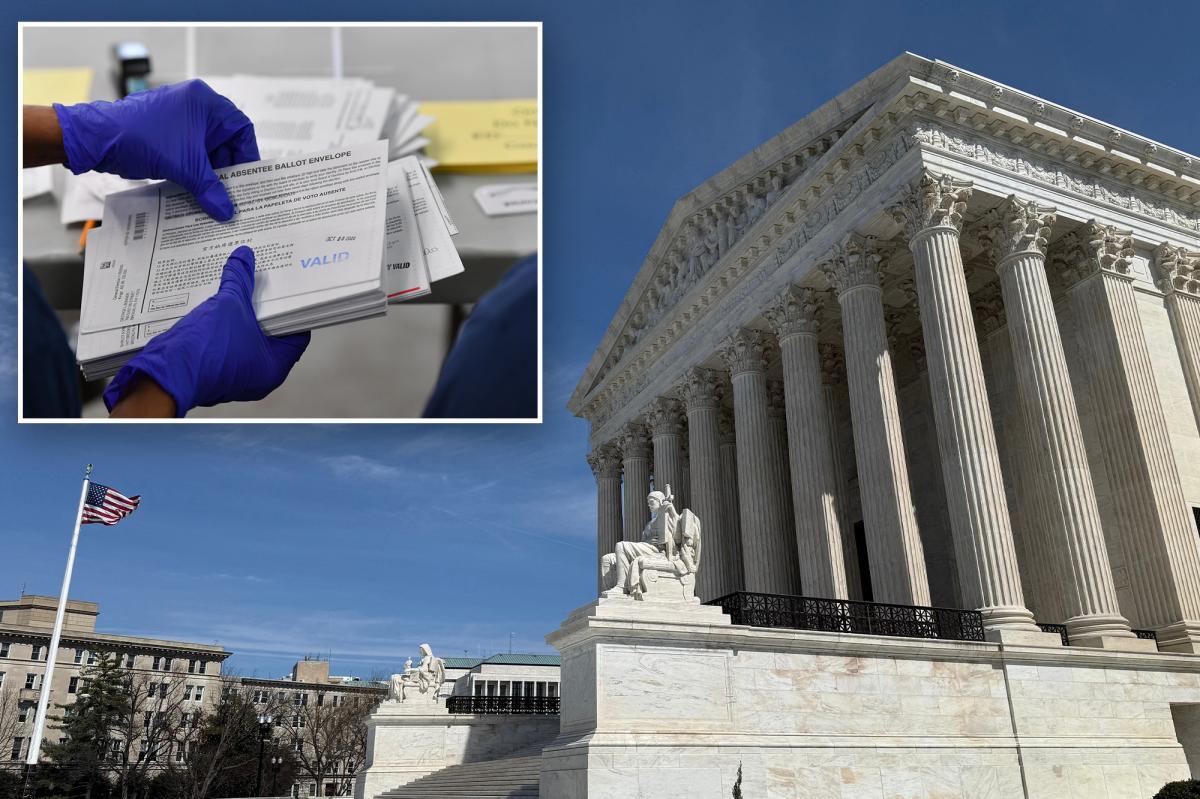
WASHINGTON — During a pivotal session at the Supreme Court on Monday, Mississippi’s solicitor general found himself on uncertain ground while discussing a significant mail-in-ballot case, leading to a surprising moment where liberal justices offered their assistance.
Scott Stewart, known for his successful argument in the 2022 Dobbs v. Jackson Women’s Health case that resulted in the court overturning Roe v. Wade, was challenged by hypothetical scenarios posed by conservative justices. He was there to defend a Mississippi law that permits the counting of mail-in ballots up to five days post-election, provided they are postmarked by Election Day.
Justice Amy Coney Barrett, appointed by former President Trump, questioned Stewart on the possibility of states allowing voters to retract mailed ballots before Election Day, a situation that seemed to momentarily unsettle him. It was then that Justice Ketanji Brown Jackson stepped in.
Jackson, a liberal justice, clarified, “This case is not about a Mississippi practice or policy related to recalling ballots,” expressing some confusion about why such policy questions were being raised. She reassured Stewart by noting that the longstanding practice of states managing their own elections actually supported his argument.
This intriguing case sees Mississippi, typically a Republican stronghold, in opposition to the Republican National Committee, the state’s Libertarian Party, and the Trump administration, all of whom are against the policy that emerged during the pandemic.
The unique case pitted the red state of Mississippi against the Republican National Committee, state Libertarian Party, and Trump administration, all of whom opposed the pandemic-era policy.
At least 14 other states have similar laws — including California, New York and Texas. Nearly 30 states have grace periods for absentee ballots, which are most often used by the military and US citizens overseas.
In another exchange, Justice Neil Gorsuch asked Stewart whether states could allow a voter to film themselves postmarking a ballot on Election Day, then have their brother submit it three weeks later.
“Why do you fight the premise?” Justice Sonia Sotomayor interjected after the Mississippian admitted he had “some concerns” about that scenario.
“If the state wants to make [a relative] a notary … a military officer, if it wants to make it a Supreme Court justice, if it wants to make it anyone, as long as it’s done by Election Day, that’s what’s counts, correct?” she contined.
Conservative Justice Samuel Alito then told Stewart that Sotomayor was “asking you what, I think, she intends to be a friendly question.”
All three Democrat-appointed justices sounded sympathetic to Mississippi, while conservative justices Gorsuch, Alito, Clarence Thomas, and Brett Kavanaugh appeared to lean towards overturning the state law.
Paul Clement, representing the Libertarian Party of Mississippi, argued that by setting the first Tuesday after the first Monday in November as a national Election Day in 1845, Congress inherently required that voting wrap up on that day.
“If somebody in Gulfport the day after the election asks, ‘Is the election over?’ the common sense answer is, ‘No it’s not, the ballots are still coming in,’” Clement argued. “That reality gives the lie to the idea that we have a uniform national election day.”
At the same time, the attorney insisted he was not arguing to make early voting illegal, a point with which all sides agreed.
The case, Watson v. RNC, comes amid President Trump’s push for Congress to tighten restrictions on mail-in ballots and enact a proof of citizenship requirement to vote in federal elections as part of the Safeguard American Voter Eligibility (SAVE) America Act, which faces an uphill battle in the Senate.
A decision is expected by the end of June.