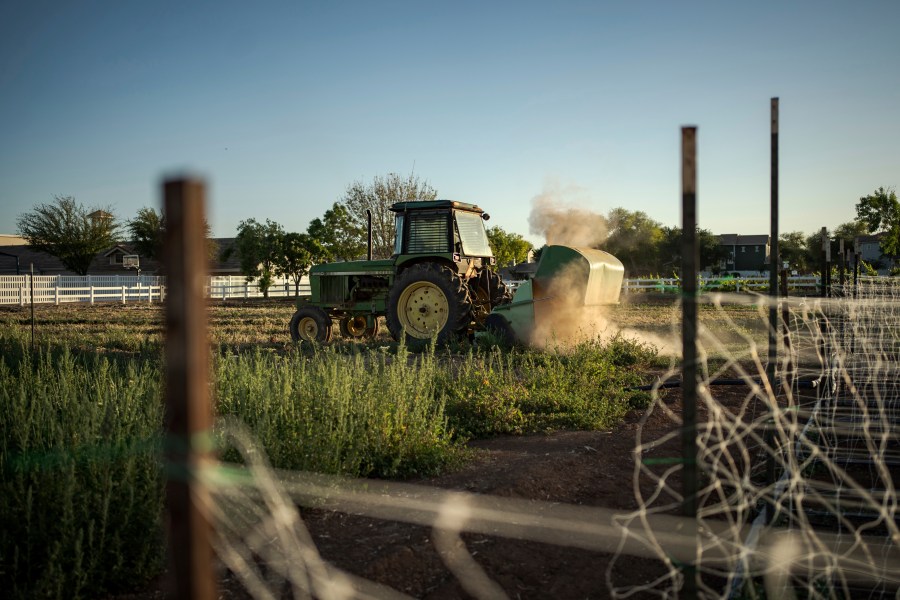


GILBERT, Ariz. (AP) — Just a stone’s throw away from the porches, backyards, clay rooftops, and pristine gardens typical of suburban areas, Kelly Saxer has become accustomed to curious inquiries. As she navigates through rows of tomato plants, picks asparagus, and generally immerses herself in farming tasks, both visitors and some of the neighbors are eager to understand her activities and how this farm found its home in such an unlikely spot.
“There are times when it feels like we’re on display, almost like animals in a zoo, because people stop and just look at us, almost in astonishment,” Saxer observed.
This location is Agritopia, an 11-acre (4.5-hectare) organic farm that marks what is left after sprawling fields of alfalfa, corn, cotton, durum wheat, and sugar beets were overtaken by the rapid expansion of Phoenix.
In this “agrihood” — a residential community that includes a working farm — kids play outside at a school that borders vegetable fields or in communal green spaces nestled between homes. Well-dressed couples and boisterous teenagers flock for selfies and picturesque photos. Lines form at the diner featured on Guy Fieri’s Food Network show. On the farm itself, people can walk the dirt roads, rent out plots to grow their own foods or buy its produce.
Some developers have turned to the agrihood concept in the past couple of decades to lure buyers with a different kind of amenity. At least 27 U.S. states and Canadian provinces had agrihoods as of a 2018 report from the Urban Land Institute, and more have cropped up since then.
Experts say agrihoods cater to buyers interested in sustainability, access to healthy food and a mix of urban and rural life. The core aim of many projects is to “create a feeling for people,” said Matt Norris, one of the lead authors of that report.
Agritopia’s founders saw change coming, and made a plan
It was the late 1990s when the family behind Agritopia saw “the writing on the wall,” said Joe Johnston.
The family farm was some 5 miles (8 kilometers) from Gilbert then but it was clear the Phoenix area’s rapid growth was going to bring development to their doorstep. With his parents mostly retired and a pair of brothers interested in doing other things, Johnston got their blessing to develop the land himself rather than simply selling it.
Johnston, with a background in design engineering, was intent on “creating place,” as he puts it. The neighborhood features narrow streets and homes within walking distance of restaurants, bars, shops, small parks and fitness businesses. The farm is at the center of it.
Melissa Checker, a professor of anthropology at City University of New York and author of a book on environmental gentrification, said agrihoods can appeal to people in different ways — their desire to feel environmentally conscious, nostalgia for an imagined idea of the past, increased interest in food “self-sufficiency” and even a heightened desire to be safe and connected to neighbors after the COVID-19 pandemic.
“You have a kind of convergence of some commercial interests, you know, something that you can sell to people, and then also this real desire to change the way we do things,” she said.
Agritopia, but not utopia
In an ideal world, using green community space to grow food could especially benefit people who are food-insecure, Checker said. But because agrihoods are often tied to real estate prices and developers want a return on their investment, “it’s much more likely that these kinds of projects go into gentrifying neighborhoods or more affluent neighborhoods,” she said.
It’s not clear just how big a role the farm plays in attracting buyers. At Agritopia, for example, few of the 500 homes participate in the farm box program that offers them first pick of seasonal fruits and vegetables. (The farm also sells at a market in downtown Gilbert and donates to a local food pantry.)
Johnston said he knew “not everyone’s going to be passionate about agriculture.” That’s why he was intent on creating a village where people have spaces to come together; it’s up to them how much, if at all, they want to be involved in farming.
Still, farms are a selling point for developers especially across the Sun Belt who compete to offer pools, gyms, parks and other perks to would-be residents who have a wide range of planned communities to choose from, said Scott Snodgrass. He’s founding partner of a developer that created Indigo, an agrihood outside Houston, and also of a company called Agmenity that runs farms for agrihood developers.
How the farm and the neighborhood intersect
As the sun rises, the farm’s workers snip the roots off scallions and pull up thick bunches of lettuce and green garlic.
Before he started working at Agritopia, Ernesto Penalba didn’t know all the steps involved in growing garlic — harvesting, cleaning, plus packing and transporting. “But we only perceive it as one process. So it was really interesting to understand that,” he said, speaking in Spanish.
CC Garrett, who goes by “Miss Hickory” when she’s leading educational tours for kids on the farm, said she loves watching young people connect with their food in new ways — eating and maybe even enjoying salad for the first time or learning why you can’t grow tomatoes year-round.
“It’s amazing for me just because this community, it just really speaks to me, being built around an urban farm, which I think is such an important American concept,” she said.
For some who live here, this place is more than a typical neighborhood. In Agritopia’s “kid pod,” a cluster of families with 23 kids between them, parents let the young ones roam freely, knowing at least one guardian will always be looking out for them. The rest of the parents make dinner or plan a date night. Just across the street, a peach and citrus orchard sways in the breeze, occasionally wafting the smells of fruit into front yards.
Maria Padron lives in the “kid pod” with her husband and two children. She loves living in Agritopia for the sense of camaraderie with her neighbors.
Her own family in Virginia had to give up their farm when her grandfather couldn’t take care of it anymore. She wishes it had stayed in the family, but it’s a vineyard now.
Asked whether she would have wanted her grandfather’s land to become an agrihood, she says maybe — if it was done right.
“There’s something obviously beautiful here that’s going on, but there is some grief there too, if you’ve watched this land be a certain thing and then it changes within an instant,” Padron said.
___
Follow Melina Walling on X @MelinaWalling and Bluesky @melinawalling.bsky.social. Follow Joshua A. Bickel on Instagram, Bluesky and X @joshuabickel. Follow Annika Hammerschlag on Instagram @ahammergram.
___
The Associated Press’ climate and environmental coverage receives financial support from multiple private foundations. AP is solely responsible for all content. Find AP’s standards for working with philanthropies, a list of supporters and funded coverage areas at AP.org.