
Share this @internewscast.com

The Metropolitan Transportation Authority (MTA) anticipates that the complete transition to a tap-to-pay system will simplify fare enforcement, particularly on buses where most fare evasion takes place.
Since its introduction in 2019, the OMNY system has allowed commuters to pay fares using tap-enabled credit cards, smart devices, or dedicated OMNY cards.
However, with the MetroCard system being phased out by next year, sales of the recognizable yellow fare card will cease on December 31. Starting in January, buses will no longer accept cash payments, streamlining the process for fare enforcement officers to verify payments.
“We’ve been discussing this transition for months,” remarked MTA Chairman Janno Lieber on Wednesday. “Once OMNY is fully implemented, fare enforcement officers can board a bus and ask riders to show proof of payment via their phone or OMNY card.”
Lieber further explained, “This allows for random validation across the system. Currently, this isn’t feasible because as long as coins are accepted on buses, passengers can falsely claim they’ve paid with coins.”
“Realistically, nobody’s paying $2.90 in coins,” Lieber noted. “People are typically handing over about 75 cents, and sometimes, we even get old Garden State Parkway tokens from 1958.”
MTA chair Janno Lieber called the spot-checks “European-style” fare enforcement at a public event earlier this week — particularly well-traveled straphangers may also recognize it as a digital version of what New Jersey has done for years on the Hudson-Bergen Light Rail.
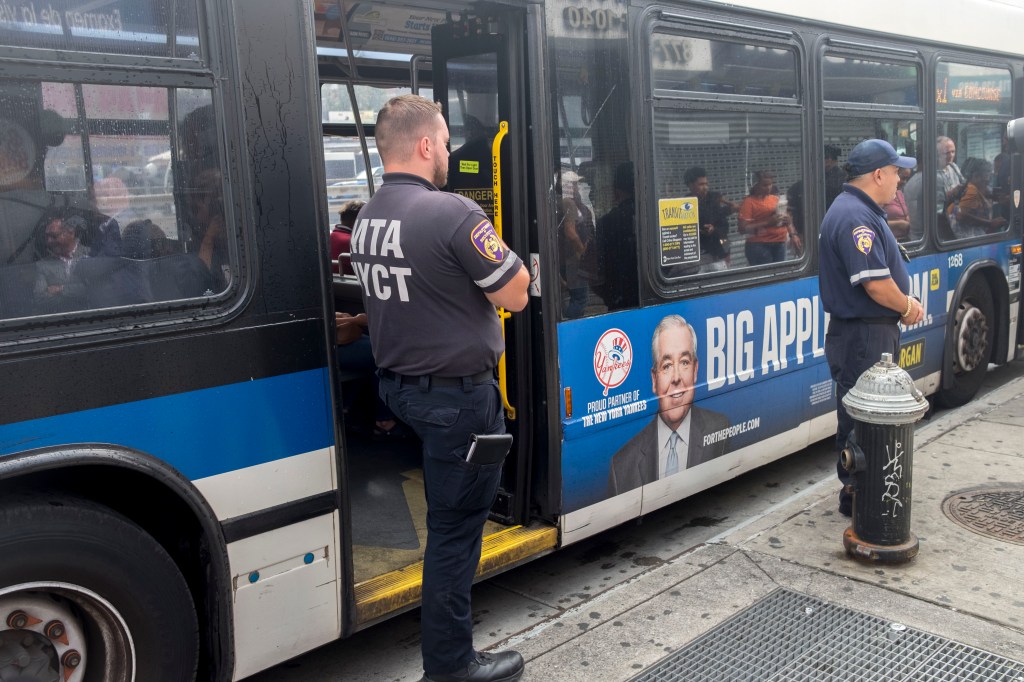
Indeed, the MTA has already been spot-checking payments on buses in recent years, deploying its unarmed Evasion And Graffiti Lawlessness Eradication teams — known as the Eagle Teams — to buses with wireless readers checking for fare payment. The removal of cash payment on buses is expected to make those checks more effective.
The MTA estimates roughly 44% of bus riders did not pay their fare during the third quarter of 2025.