Share this @internewscast.com

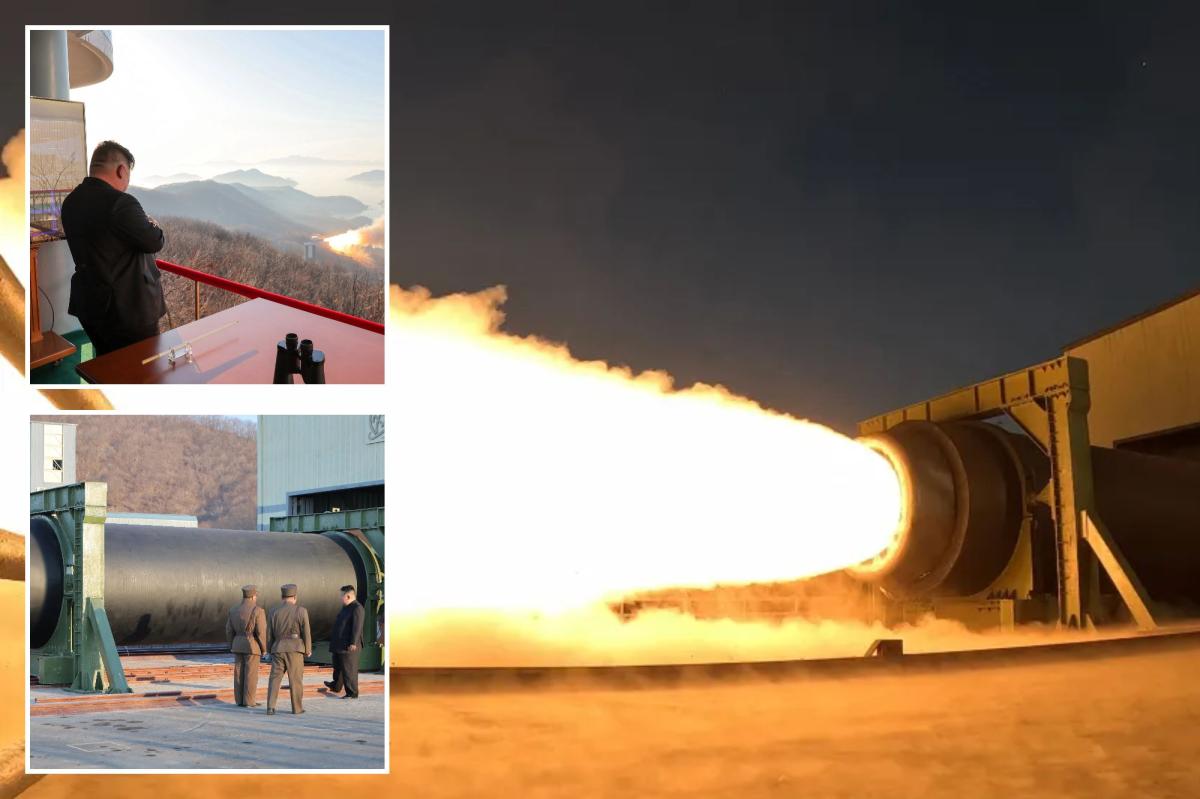
North Korean leader Kim Jong Un has overseen a significant test of a high-thrust solid-fuel engine, which he praised as a crucial step in enhancing the country’s strategic military capabilities, according to state media reports on Sunday.
This test signals Kim’s determination to expand and modernize North Korea’s missile arsenal, which is designed to potentially reach the mainland United States.
The Korean Central News Agency’s announcement followed Kim’s recent speech at North Korea’s Parliament, where he vowed to irrevocably establish his nation as a nuclear power. He also accused the United States of engaging in global “state terrorism and aggression,” referencing the ongoing conflict in the Middle East.
Kim observed the ground test of the newly upgraded engine, which utilizes a composite carbon fiber material. According to the KCNA, this engine boasts a maximum thrust of 2.5 million tons, an increase from the approximately 1.97 million tons achieved during a similar solid-fuel engine test in September.
Experts suggest that the drive to boost engine power is likely linked to North Korea’s ambition to mount multiple warheads on a single missile, thereby increasing its ability to overcome US defense systems.
The KCNA did not specify the exact timing or location of this test.
The test was conducted as part of the country’s five-year military escalation program. The plan’s objectives include upgrading “strategic strike means,” KCNA reported.
The reference is understood to mean nuclear-capable, intercontinental ballistic missiles targeting the continental US.
Kim said the latest engine test had “great significance in putting the country’s strategic military muscle on the highest level,” KCNA reported.
In recent years, North Korea has test-fired a variety of ICBMs demonstrating the potential range to reach the US mainland, including missiles with solid propellants that make detection prior to liftoff more difficult.
The country’s older liquid-fuel missiles must be fueled before liftoffs and cannot last long.
Some foreign experts say North Korea still faces technological hurdles before it has a functioning ICBM, such as ensuring its warheads survive the harsh conditions of atmospheric reentry.
But others dispute that assessment given the number of years the country has spent on its nuclear and missile programs.
North Korea has pushed hard to expand its nuclear arsenal since Kim’s high-stakes diplomacy with US President Donald Trump collapsed in 2019.
In a ruling Workers’ Party congress in February, Kim left open the door for dialogue with Trump but urged Washington to drop demands for the North’s nuclear disarmament as a precondition for talks.